The Majestic Great Horned Owl: A Comprehensive Overview
The Great Horned Owl, scientifically known as Bubo virginianus, is one of North America’s most iconic avian predators. Revered for its commanding presence and adaptability, this owl species is a fascinating subject for ornithologists and bird enthusiasts alike. With its striking features and mysterious demeanor, the Great Horned Owl continues to capture the imagination of those who encounter it.
Physical Characteristics
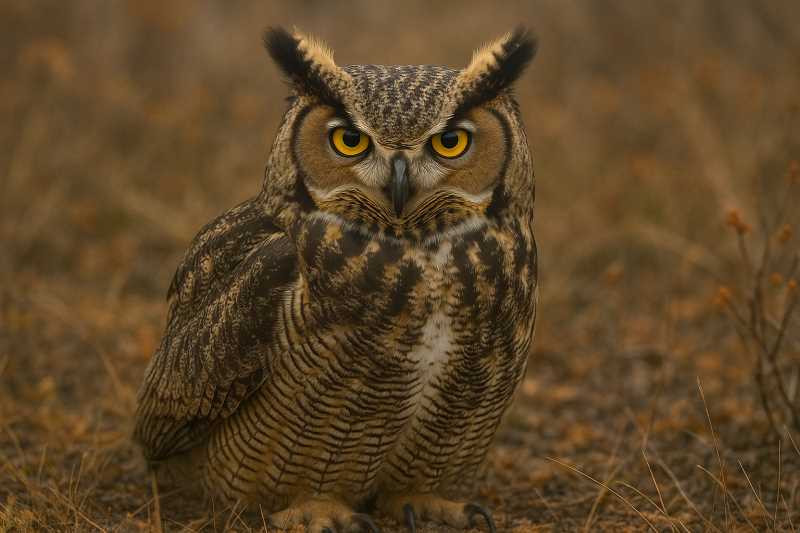
The Great Horned Owl is a large bird of prey, with females typically larger than males. It boasts an average wingspan of 3.3 to 4.8 feet (1 to 1.5 meters) and weighs between 3.2 to 5.5 pounds (1.4 to 2.5 kg). Its most distinctive features are the prominent tufts of feathers on its head, often referred to as "horns," and its large, yellow eyes that provide excellent night vision.
The owl’s plumage is a mottled pattern of gray, brown, and black, which provides effective camouflage against the bark of trees. This cryptic coloration allows it to remain undetected by both prey and predators alike. The facial disk, which is a characteristic feature of many owls, is outlined in black and helps to direct sound waves to its ears, enhancing its already acute hearing.
Habitat and Distribution
The Great Horned Owl is a highly adaptable bird, capable of thriving in a variety of environments. It is found across North and South America, from the Arctic treeline to the tip of South America. This widespread distribution is a testament to its adaptability, as it can inhabit forests, deserts, wetlands, grasslands, and even urban areas.
In wooded areas, these owls prefer deciduous and coniferous forests, where they can find ample nesting sites and prey. In more arid regions, they often take advantage of rocky outcrops and cacti for nesting. The Great Horned Owl is also known to occupy abandoned nests of other large birds, such as hawks or crows, demonstrating its opportunistic nature.
Hunting and Diet
As a formidable nocturnal predator, the Great Horned Owl primarily hunts at night. It is a generalist feeder, with a diet that includes a wide range of prey. Small to medium-sized mammals such as rabbits, hares, and rodents make up a significant portion of its diet, but it will also prey on birds, reptiles, and insects.
The owl’s hunting strategy is based on stealth and surprise. It uses its exceptional hearing and night vision to locate prey before swooping down silently, thanks to the specialized serrated edges on its flight feathers that muffle sound. Its powerful talons deliver a crushing grip, immobilizing its prey instantly.
Reproduction and Lifespan
Breeding season for the Great Horned Owl typically begins in late winter. Pairs are monogamous and often mate for life, returning to the same nesting site each year. The female lays a clutch of 2 to 3 eggs, which she incubates for about 30 to 37 days. During this period, the male provides food for the female and later for the chicks.
The young owlets are born with a covering of white down and are dependent on their parents for several months. They fledge about 6 to 7 weeks after hatching but continue to rely on their parents for food and protection until they develop the skills needed for independent survival. In the wild, Great Horned Owls can live up to 13 years, though some have been known to reach over 20 years.
Conservation Status
Currently, the Great Horned Owl is not considered to be at risk, and it is listed as a species of least concern by the International Union for Conservation of Nature (IUCN). Its adaptability to various habitats has ensured a stable population across its range. However, threats such as habitat destruction, rodenticides, and vehicle collisions can impact local populations.
Conclusion
The Great Horned Owl’s adaptability, powerful hunting abilities, and widespread distribution make it a vital part of the ecosystem. As both a predator and a subject of human fascination, it plays a crucial role in maintaining the balance of its environment. Efforts to conserve its habitat and mitigate human-induced threats will help ensure that this magnificent bird continues to thrive across the Americas.
Related posts