Introduction
The Andean Potoo (Nyctibius maculosus) is a rare, nocturnal member of the potoo family, Nyctibiidae. It is restricted to scattered localities in the Andes of Venezuela, Colombia, Ecuador, Peru and western Bolivia. Like other potoos, it relies on stillness and cryptic plumage to remain inconspicuous by day, but it is distinguished by its montane distribution, dark mottled plumage and conspicuous pale wing markings.
Physical Description
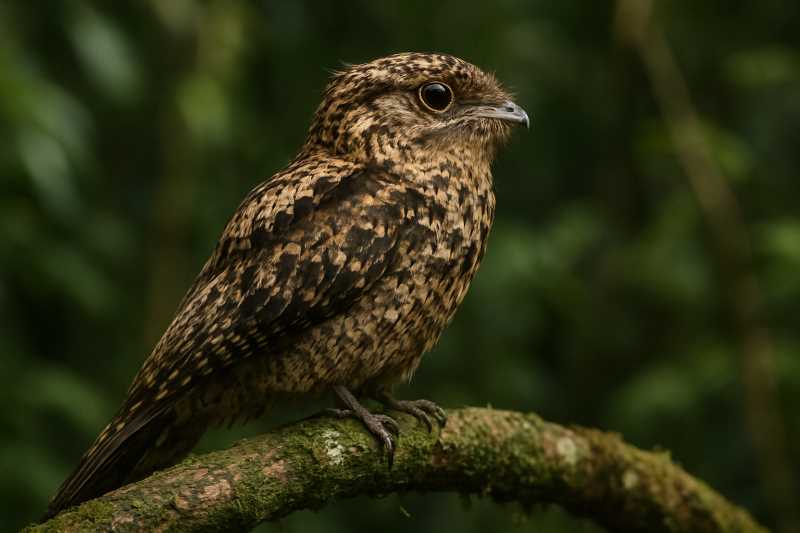
The Andean Potoo is a medium-sized potoo, measuring approximately 34–39 cm in length. The plumage is predominantly dark brown, grey and rufous, with intricate mottling, streaking and vermiculation that resemble bark, lichen and weathered wood. A broad whitish or buffish patch on the wing coverts is an important field mark, while the underparts are heavily marked and the tail shows pale barring.
The species has the characteristic potoo form: a large head, short neck, broad gape, long wings and a relatively short bill surrounded by rictal bristles. The iris is yellow. No consistent adult sexual dimorphism has been established, and the juvenile plumage remains poorly documented. A documented Colombian breeding observation found that a young bird had paler, softer plumage and lacked the adult’s characteristic shoulder patch during its early development.
Range and Habitat
The Andean Potoo has a discontinuous distribution along the Andes, from western Venezuela through Colombia and Ecuador to Peru and western Bolivia. Most records are from the eastern slopes and adjacent montane regions, although the species has also been recorded in several localities on the western side of the Colombian Andes.
It inhabits humid montane forest, cloud forest and forest edges, including areas near the transition between upper Andean forest and páramo. Published records extend from roughly 1,400 to 3,200 metres above sea level, with most observations concentrated between about 1,800 and 2,800 metres. It is not known to undertake regular long-distance migration, although seasonal or local movements cannot be ruled out because the species is poorly studied.
The Andean Potoo is locally distributed and often known from isolated records. This patchiness may reflect genuine rarity, specialised habitat requirements, limited field coverage or the difficulty of detecting a motionless nocturnal bird.
Behaviour and Diet
The Andean Potoo is primarily nocturnal and usually solitary. During the day, it commonly rests upright on an exposed branch, broken limb or dead snag. Its posture, mottled plumage and ability to remain motionless can make it extremely difficult to distinguish from the surrounding wood. Potoos also possess unusual upper-eyelid openings that allow them to monitor their surroundings while apparently keeping their eyes closed.
At dusk and during the night, it leaves its perch to make short aerial sallies after flying insects. Moths, beetles and other nocturnal arthropods are considered likely prey, although detailed, species-specific dietary studies are lacking. The bird’s large mouth and broad gape are adapted for taking insects in flight.
Its voice is described as a short, mournful or wailing call given at relatively long intervals. Vocal activity may be most noticeable before dawn, but the full range of its calls and their social functions remain incompletely documented.
Breeding information is limited. A 2026 report documented the first published breeding event for the species in central Colombia. The nest was situated on the end of a broken tree stump, and both adults were observed caring for and feeding the chick. The young bird developed rapidly, remaining near the nest or on nearby perches while gradually acquiring more adult-like plumage. These observations confirm parental care by both adults, but the timing, nesting frequency and complete breeding cycle are still not well known.
Identification Tips
Look for the following combination of features:
- A large, upright nocturnal bird perched vertically on the tip of an exposed branch or snag.
- Dark brown, grey and rufous plumage with dense mottling and streaking.
- A prominent whitish or buffish patch across the wing coverts.
- Yellow eyes that may reflect brightly when illuminated at night.
- A relatively compact potoo shape, usually encountered in humid montane forest at medium to high elevation.
- A short, wailing call separated by long intervals.
The Andean Potoo can be confused with other potoos where their ranges overlap. Its combination of higher-elevation habitat, dark plumage and pale wing patch helps separate it from the generally lower-elevation Common Potoo. The larger Long-tailed Potoo is usually distinguished by its greater size and longer tail. Identification should be based on the full combination of structure, plumage, habitat, elevation and voice rather than on a single feature.
Conservation Status
The Andean Potoo is currently assessed as Least Concern on the IUCN Red List. Its total population has not been quantified, and the species is regarded as rare or local in many parts of its range. The apparent scarcity of records should therefore be interpreted cautiously, because the bird’s camouflage, nocturnal habits and preference for remote montane forest make it easy to overlook.
The principal conservation concern is the continued loss and degradation of humid montane forest through agricultural expansion, logging, infrastructure development and other land-use changes. Protecting remaining cloud forests, maintaining habitat connectivity and improving surveys of known and suspected localities are important conservation measures. Further research is also needed on population size, distribution, diet, movements, breeding biology and juvenile plumage.
Frequently Asked Questions
Where does the Andean Potoo live?
It lives in scattered localities in the Andes of Venezuela, Colombia, Ecuador, Peru and western Bolivia, mainly in humid montane and cloud forests.
How high does the Andean Potoo occur?
Records range from approximately 1,400 to 3,200 metres above sea level, with most observations reported between about 1,800 and 2,800 metres.
Is the Andean Potoo nocturnal?
Yes. It rests during the day and becomes active around dusk and through the night, when it hunts flying insects from exposed perches.
What does the Andean Potoo eat?
It is believed to feed mainly on flying insects, including moths, beetles and other nocturnal arthropods. Detailed dietary studies of this species are still lacking.
How does the Andean Potoo avoid detection?
Its mottled brown, grey and rufous plumage resembles bark and weathered wood. By perching upright and remaining motionless on a branch or snag, it can be almost impossible to see during daylight.
What is the conservation status of the Andean Potoo?
The species is assessed as Least Concern by the IUCN. Nevertheless, habitat loss in the Andean montane forests it depends on remains an important conservation concern, and its population size is not well known.
References
- Ágreda-Arango, J., A. Alarcón-R, A. Cubillos-B & A. Marín-Bautista. 2026. Primer registro de reproducción del Bienparado andino (Nyctibius maculosus: Nyctibiidae) y ampliación de su rango de distribución en la región andina de Colombia. Ornitología Colombiana 29:22–31. https://doi.org/10.59517/oc.e640
- BirdLife International. 2024. Nyctibius maculosus. The IUCN Red List of Threatened Species 2024: e.T22689650A264102631. https://doi.org/10.2305/IUCN.UK.2024-2.RLTS.T22689650A264102631.en. Accessed 8 September 2026.
- Cornell Lab of Ornithology. 2025. Andean Potoo (Nyctibius maculosus). eBird species account. https://ebird.org/species/andpot1. Accessed 8 September 2026.
- Ridgway, R. 1912. Descriptions of some new species and subspecies of birds from tropical America. Proceedings of the Biological Society of Washington 25:87–92. https://www.biodiversitylibrary.org/page/3337650#page/119/mode/1up
- Schulenberg, T. S. & G. M. Kirwan. 2020. Andean Potoo (Nyctibius maculosus), version 1.0. In T. S. Schulenberg, ed., Birds of the World. Cornell Lab of Ornithology. https://doi.org/10.2173/bow.andpot1.01
- Schulenberg, T. S., S. E. Allen, D. F. Stotz & D. A. Wiedenfeld. 1984. Distributional records from the Cordillera Yanachaga, central Peru. Le Gerfaut 74(1):57–70. https://www.researchgate.net/publication/381341851_Distributional_records_from_the_Cordillera_Yanachaga_Peru
- White, N. D., C. Mitter & M. J. Braun. 2017. Ultraconserved elements resolve the phylogeny of potoos (Aves: Nyctibiidae). Journal of Avian Biology 48(6):872–880. https://doi.org/10.1111/jav.01313
- World Bird Names. n.d. Nyctibiidae / Potoos, including Andean Potoo (Nyctibius maculosus). https://www.worldbirdnames.com/caprimulgiformes/nyctibiidae. Accessed 8 September 2026.
Related posts