Introduction
The Eurasian Three-toed Woodpecker (Picoides tridactylus) is a fascinating avian species found predominantly in the boreal forests of Europe and Asia. Known for its unique three-toed adaptation, this bird is a specialist in coniferous woodland environments, playing a crucial role in the ecosystem as both a predator and a provider of cavities for other species. This article delves into the intriguing world of the Eurasian Three-toed Woodpecker, exploring its taxonomy, habitat, behavior, diet, and conservation status.
Taxonomy and Classification
The Eurasian Three-toed Woodpecker belongs to the family Picidae, which encompasses a diverse group of birds known for their behavior of pecking at wood to find insects or to create nesting sites. The scientific name, *Picoides tridactylus*, reflects one of the bird’s most distinctive features—its three toes. Unlike most woodpeckers, which typically have four toes, this species has evolved to have only three, an adaptation that provides a more stable grip on tree trunks.
Subspecies of the Eurasian Three-toed Woodpecker are distributed across its range, with variations in plumage and size. These include *Picoides tridactylus albidior*, found predominantly in eastern Europe, and *Picoides tridactylus crissoleucus*, located in the forests of Siberia. Each subspecies is adapted to the specific ecological conditions of its habitat, which contributes to the diversity of the species as a whole.
Habitat and Distribution
The Eurasian Three-toed Woodpecker is primarily found in coniferous forests across the northern hemisphere. Its range extends from Scandinavia and the Baltic states through Russia and into parts of China and Japan. This bird favors old-growth forests with a high density of dead or dying trees, which provide an abundance of insects and suitable nesting sites.
These woodpeckers are highly dependent on mature forests, and their presence is often considered an indicator of forest health. The loss of such habitats due to logging and land conversion poses a significant threat to their populations, making habitat conservation a priority for their continued survival.
Physical Description
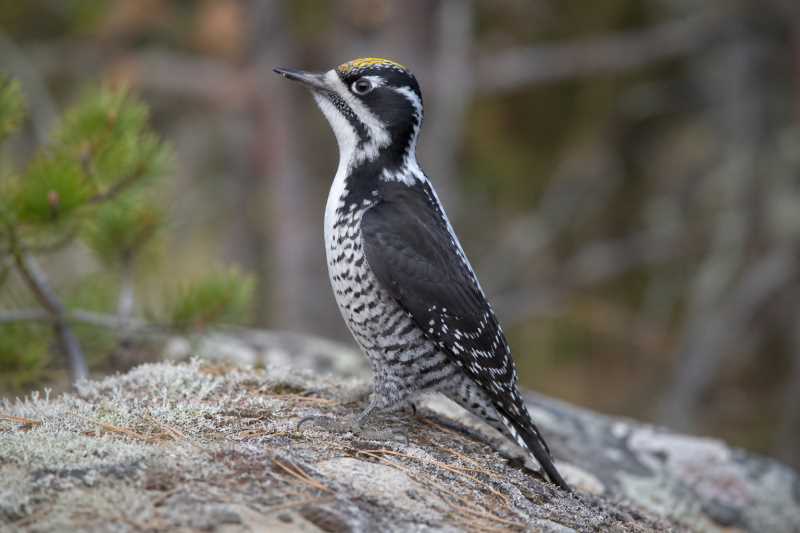
The Eurasian Three-toed Woodpecker is a medium-sized bird, measuring approximately 21-24 centimeters in length, with a wingspan of 35-40 centimeters. Its plumage is primarily black and white, with distinctive barring on the back and wings. The head features a striking pattern—males have a yellow crown, while females sport a black crown with white cheeks.
The three toes, two facing forward and one backward, are a unique adaptation that distinguishes this species from most other woodpeckers. This anatomical feature enhances their ability to cling to tree trunks as they forage for insects beneath the bark.
Behavior and Ecology
Eurasian Three-toed Woodpeckers are known for their solitary and elusive nature. They are non-migratory and spend most of their time within a well-defined territory, which they defend vigorously against intruders. These territories are rich in resources, providing ample foraging opportunities and nesting sites.
Their foraging behavior is highly specialized; they primarily feed on insects such as beetle larvae, which they extract from beneath the bark of trees. Their strong, chisel-like beaks are perfectly adapted for this task. Additionally, they play a vital role in controlling forest insect populations, thus maintaining the ecological balance.
During the breeding season, which occurs in late spring, the male and female collaborate to excavate a nesting cavity in a dead or decaying tree. The female typically lays a clutch of 3-5 eggs, which both parents incubate. After hatching, the chicks are fed by both parents until they fledge.
Vocalizations and Communication
The Eurasian Three-toed Woodpecker is relatively quiet compared to other woodpecker species, with a repertoire that includes soft drumming and a few call notes. Drumming serves as a communication method for establishing territory and attracting mates, while calls are used to signal alarm or maintain contact between mates and offspring.
Conservation Status
Although the Eurasian Three-toed Woodpecker is not currently listed as endangered, its populations are declining in some regions due to habitat loss and fragmentation. Conservation efforts focus on protecting mature forest habitats and promoting sustainable forestry practices. In some areas, artificial nesting boxes are being installed to compensate for the loss of natural nesting sites.
Importance to Ecosystem
As a keystone species, the Eurasian Three-toed Woodpecker plays a critical role in forest ecosystems. By controlling insect populations and creating nesting cavities, they support biodiversity and contribute to forest health. Their presence benefits a wide range of other species, including birds, mammals, and insects that rely on these resources.
Conclusion
The Eurasian Three-toed Woodpecker is a remarkable example of adaptation and specialization in avian species. Its unique features and ecological role underscore the importance of conserving its habitat to ensure the survival of not only this species but also the broader forest ecosystem. Continued research and conservation efforts are essential to protect this fascinating bird for future generations.
Related posts