Introduction
The Butterfly Coquette (Lophornis verreauxii) is a small hummingbird in the family Trochilidae. It occurs in humid forests and other wooded habitats across western and central Amazonia, where it is usually encountered singly or in low numbers. The species was formerly treated as part of the Festive Coquette complex, but it is now generally recognised as a separate species.
Physical Description
The Butterfly Coquette measures approximately 7.5–9.1 centimetres in length. Both sexes have green upperparts and a pale band across the rump, but the plumage is strongly sexually dimorphic.
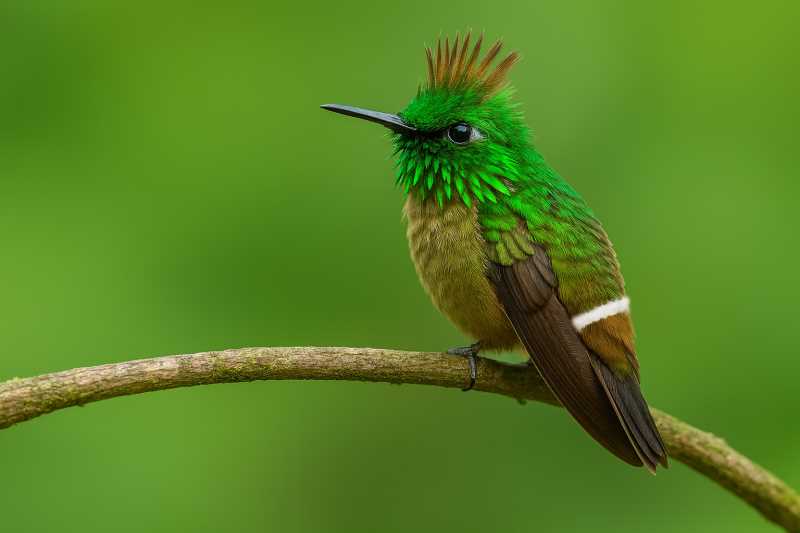
Adult males have an iridescent green forehead, face and crown, together with elongated ornamental feathers on the sides of the throat. These feathers are green with contrasting pale or white tips and can be fanned during display. The underparts are generally greyish green, while the rump and tail show brownish tones.
Females lack the male’s elongated crest and throat feathers. They are more subdued overall, with green upperparts, grey-brown underparts and a noticeable pale malar stripe. The female’s plain appearance and smaller size of the ornamental feathers help distinguish her from the male.
Range and Habitat
The Butterfly Coquette is distributed in Bolivia, Brazil, Colombia, Ecuador, Peru and Venezuela. The nominate form ranges from Amazonian Colombia, Ecuador and Peru into western and northern Brazil and southwards into central Bolivia. The subspecies Lophornis verreauxii klagesi is restricted to the Caura River basin in Venezuela.
It inhabits humid tropical and subtropical forest, including riverine forest, campinarana, forest edges, secondary woodland and scrubby clearings. It is most often associated with the canopy and mid-storey, although individuals may descend to flowering plants at lower levels. The species has been recorded from lowlands and foothills to approximately 1,000 metres above sea level.
The Butterfly Coquette is considered essentially sedentary, although short-distance seasonal movements may occur in response to local flowering conditions.
Where to See This Species
Manu National Park, Madre de Dios, Peru
The Butterfly Coquette has been recorded in Manu National Park and at wildlife-viewing sites within the Manu region. Look in humid lowland forest, forest edges, oxbow-lake surroundings and flowering gardens, particularly where trails provide views into the canopy and mid-storey. Sightings are possible but generally irregular, so patience and repeated visits are advisable.
Nearby accommodation: Puerto Maldonado is the main practical gateway, with hotels, guest houses, lodges and organised rainforest accommodation. Remote lodges and research stations are also available within the wider Manu region.
Tambopata National Reserve, Madre de Dios, Peru
The species has been documented in the Tambopata region, including sites associated with rainforest lodges and birding trails. The best prospects are in mature lowland forest, river-edge vegetation and flowering areas, where the bird may briefly visit nectar sources or pass through the canopy.
Nearby accommodation: Puerto Maldonado provides the most practical base, with hotels, guest houses and rainforest lodges. Accommodation inside or near the reserve is generally lodge-based and accessed through organised visits.
Pantiacolla Lodge, Madre de Dios, Peru
Pantiacolla Lodge has documented records of Butterfly Coquette and lies within a productive Amazonian birding landscape near the Manu region. Lodge trails, forest edges and flowering plants provide suitable places to watch for this small, fast-moving hummingbird, although encounters are not guaranteed.
Nearby accommodation: Puerto Maldonado is the principal gateway for the wider region, with hotels, guest houses and rainforest lodges. Overnight stays at the lodge itself are the most practical option for birding the surrounding forest.
Behaviour and Diet
The Butterfly Coquette is active during daylight hours. It usually forages alone, although individuals may compete briefly at concentrated patches of flowers. Unlike strongly territorial hummingbirds, it does not appear to defend a permanent feeding territory.
Nectar forms the main part of its diet. The species usually takes nectar while hovering and often visits a sequence of flowering plants in a regular circuit, a behaviour known as trap-lining. Most feeding occurs in the canopy, but birds may also use flowers at lower levels. Individuals have been recorded taking nectar by piercing the base of flowers rather than entering through the opening.
Small insects are also eaten, apparently by gleaning them from foliage. These prey provide protein and other nutrients that are not supplied by nectar alone.
Males perform aerial and plumage displays during courtship. Displays may include rapid flights, hovering and the fanning of the elongated ornamental feathers beside the throat. Detailed information on breeding timing and reproductive behaviour remains limited. The nest, eggs and incubation period have not been adequately described in reliable modern sources, so the original claims of a two-egg clutch and a 15–18-day incubation period should not be treated as confirmed for this species.
The Butterfly Coquette is usually quiet, but it may give short, high-pitched calls while feeding. Wing-generated clicks or other brief sounds may also be heard at close range.
Identification Tips
- Look for a very small hummingbird with green upperparts, a pale rump band and quick, agile flight.
- Adult males are distinctive because of the iridescent green face and crown and the elongated, white-tipped throat feathers that can be fanned during display.
- Females are less ornate, with grey-brown underparts and a pale malar stripe. They can be overlooked among foliage because they lack the male’s crest and throat ornaments.
- The bird is often encountered in the canopy or mid-storey, so brief views may show only a small green hummingbird with a pale flash across the rump.
- The female can resemble the female Black-bellied Thorntail, but the Butterfly Coquette has more uniformly grey-brown underparts rather than the stronger contrasting pattern associated with the thorntail.
- Identification is best confirmed from the combination of size, green facial plumage, rump band and, in males, the long white-tipped ornamental feathers.
Conservation Status
The Butterfly Coquette is currently classified as Least Concern. Its global population size has not been quantified, and available assessments indicate that the population may be declining. The species is described as uncommon to rare and patchily distributed across much of its range.
The principal concern is the loss and degradation of humid forest through agricultural expansion, logging, roads and other forms of land conversion. Protection of intact forest, maintenance of forest corridors and careful management of secondary habitats are important conservation measures. The species occurs in several protected areas, although its irregular distribution means that protected status does not guarantee frequent sightings.
Frequently Asked Questions
Where is the Butterfly Coquette found?
The species occurs in Bolivia, Brazil, Colombia, Ecuador, Peru and Venezuela, mainly in humid forests and associated wooded habitats across western and central Amazonia.
How large is a Butterfly Coquette?
It is approximately 7.5–9.1 centimetres long, making it one of the smaller hummingbirds in its range.
How can a male Butterfly Coquette be identified?
The male has an iridescent green face and crown, green upperparts, a pale rump band and elongated white-tipped feathers on the sides of the throat.
What does the Butterfly Coquette eat?
It feeds mainly on nectar from flowering plants and also takes small insects, which it appears to glean from leaves and other vegetation.
Is the Butterfly Coquette migratory?
It is considered essentially sedentary. Short-distance seasonal movements may occur, probably in response to changes in flowering and food availability.
Is the Butterfly Coquette endangered?
No. It is currently listed as Least Concern, although it is locally uncommon or rare, its population size is unknown and habitat loss may be causing a decline.
References
- BirdLife International
- Cornell Lab of Ornithology, Birds of the World
- International Ornithologists’ Union, IOC World Bird List
Related posts