Introduction
The Ecuadorian Ground Dove (Columbina buckleyi) is a small ground-feeding dove of western Ecuador and north-western Peru. It is associated mainly with the dry forests, scrublands and open habitats of the Tumbesian region, although it can also occur in cultivated landscapes, gardens and other human-modified areas.
Physical Description
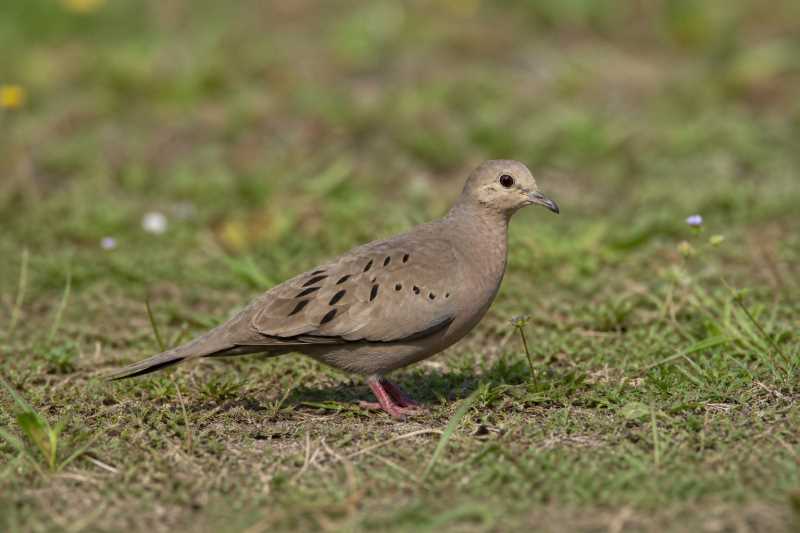
The Ecuadorian Ground Dove is a small dove measuring about 18 centimetres in length. It has a compact body, short square-ended tail and pinkish legs. The upperparts are generally brownish-grey, while the underparts are paler and more subdued.
Adult males are usually recognisable by their blue-grey crown and nape, contrasting with the warmer brown tones of the back and wings. The wings show dark spotting and patterning that can be noticeable when the bird moves or takes flight. Females are browner overall and lack the male’s contrasting blue-grey head. Juveniles are less distinctly marked and tend to resemble females.
The dark eye, pale to pinkish legs and small dove-like bill complete the species’ understated appearance. Its muted colouration provides effective camouflage in dry woodland, leaf litter and scrub.
Range and Habitat
The Ecuadorian Ground Dove occurs in western Ecuador, from the north-western coastal region south through the country’s dry and seasonally dry lowlands, and into far north-western Peru, particularly Tumbes and adjacent areas. It is largely associated with the Tumbesian biogeographic region and is considered resident rather than a long-distance migrant.
Typical habitats include tropical dry forest, deciduous and semi-deciduous woodland, dry scrub, forest edges, open woodland, agricultural land and urban green spaces. It is most often encountered in relatively open areas with low vegetation and bare or lightly covered ground, where it can search for food. Records extend from lowland sites into foothill areas, although it is principally a bird of the western lowlands and lower slopes.
Where to See This Species
Bosque Protector Cerro Blanco, Guayas, Ecuador
Cerro Blanco is a publicly accessible protected area containing one of the most important remaining tracts of dry forest near Guayaquil. The Ecuadorian Ground Dove is documented in the reserve’s bird records and is a realistic species to look for along open trails, forest edges and dry scrub. Early morning is usually the most productive period for ground-feeding doves.
Nearby accommodation: Guayaquil offers the widest choice of hotels and guest houses, while camping may be available at the reserve subject to its current arrangements.
Reserva Ecológica Arenillas, El Oro, Ecuador
The Arenillas Ecological Reserve protects extensive dry forest, scrub and associated coastal habitats in south-western Ecuador. The species is documented from the reserve, where quiet roads, clearings and open woodland provide suitable places to scan the ground and low vegetation.
Nearby accommodation: Practical accommodation is available in Arenillas and Huaquillas, including hotels, guest houses and simple local lodgings.
Reserva Ecológica de Loma Alta, Santa Elena, Ecuador
Loma Alta protects remnant garúa and dry forest on the Santa Elena Peninsula. A bird survey recorded the Ecuadorian Ground Dove at the reserve, making it a reasonable site to search in dry forest, scrub and open areas, particularly during the drier season when birds may be more visible around clearings.
Nearby accommodation: Visitors can use simple guest houses and community accommodation around Loma Alta and Valdivia, with a broader range of hotels and self-catering options in Santa Elena.
Behaviour and Diet
The Ecuadorian Ground Dove usually forages on the ground, walking through open patches, leaf litter and low vegetation while picking up seeds and other small plant material. It may occur singly, in pairs or in small loose groups. Its quiet, repetitive calls can help reveal its presence when the bird remains concealed in scrub.
The species is generally a low, deliberate flier but can make quick, direct flights between feeding areas and cover. It is not known as a long-distance migrant.
Breeding information is limited, but the species builds a substantial cup-shaped nest from twigs and plant material, usually in a shrub or small tree. The eggs are white and elliptical. Observations from western Ecuador include adults carrying nest material, and both parents are expected to contribute to nest care, as in other small Columbina doves.
Identification Tips
- Look for a small, compact dove walking on the ground in dry woodland, scrub, open country or gardens.
- Adult males show a distinctive blue-grey crown and nape with a brownish-grey body.
- Females and juveniles are browner and less strongly contrasted than adult males.
- Pinkish legs, a short square-ended tail and dark wing spotting are useful supporting features.
- The species is generally paler and more softly patterned than the Croaking Ground Dove, which has a more strongly marked appearance and a different, raspier vocal quality.
- In western Ecuador, check the habitat carefully because several small ground doves may occur in the same general region.
Conservation Status
The Ecuadorian Ground Dove is currently classified as Least Concern on the global IUCN Red List. It remains locally exposed to the loss, fragmentation and degradation of dry forest and scrub caused by agriculture, urban expansion, roads, grazing and other land-use changes.
Its ability to use open habitats, cultivated areas and some urban green spaces may reduce the effects of habitat loss in parts of its range. However, the continued protection and restoration of Tumbesian dry forests remain important, particularly because this region supports many species with restricted distributions.
Frequently Asked Questions
Where is the Ecuadorian Ground Dove found?
It is found in western Ecuador and far north-western Peru, especially in the Tumbesian region and associated dry lowland and foothill habitats.
Is the Ecuadorian Ground Dove migratory?
It is generally considered a resident species. There is no indication that it undertakes regular long-distance migration.
How can the Ecuadorian Ground Dove be identified?
Look for a small ground dove with a short square-ended tail, pinkish legs and dark wing spotting. Adult males have a blue-grey crown and nape, while females and juveniles are browner overall.
What does the Ecuadorian Ground Dove eat?
Its diet is based mainly on seeds and other small plant material collected from the ground. It forages by walking through open areas, leaf litter and low vegetation.
Where is the best place to see this dove?
Dry-forest reserves near Guayaquil, the Arenillas Ecological Reserve and Loma Alta Ecological Reserve are documented sites where observers can search for the species.
Is the Ecuadorian Ground Dove threatened?
It is currently listed as Least Concern, but habitat destruction and fragmentation remain important local pressures, especially in the dry forests of western Ecuador and north-western Peru.
References
- BirdLife International
- IOC World Bird List
- Boletín SAO
Related posts