The Dusky Munia: A Closer Look at Lonchura fuscans
The Dusky Munia, scientifically known as Lonchura fuscans, is a small bird belonging to the family Estrildidae. Native to the lush habitats of Southeast Asia, particularly Borneo, this species has fascinated ornithologists and bird enthusiasts alike with its unique characteristics and behaviors. This article delves into the intricate details of this charming bird, exploring its habitat, physical characteristics, behavior, diet, and conservation status.
Habitat and Distribution
The Dusky Munia is predominantly found in the island of Borneo, which is politically divided among Malaysia, Indonesia, and Brunei. This bird thrives in a variety of habitats, ranging from lowland forests and scrublands to agricultural areas and even urban gardens. Its adaptability to diverse environments is a testament to its resilience and resourcefulness.
Borneo’s rich natural landscapes provide the perfect backdrop for the Dusky Munia. The island’s equatorial climate, characterized by high humidity and abundant rainfall, supports a wide array of flora and fauna, offering ample resources and shelter for these birds. As a result, they are commonly spotted in areas with dense vegetation, where they can easily forage for food and build nests.
Physical Characteristics
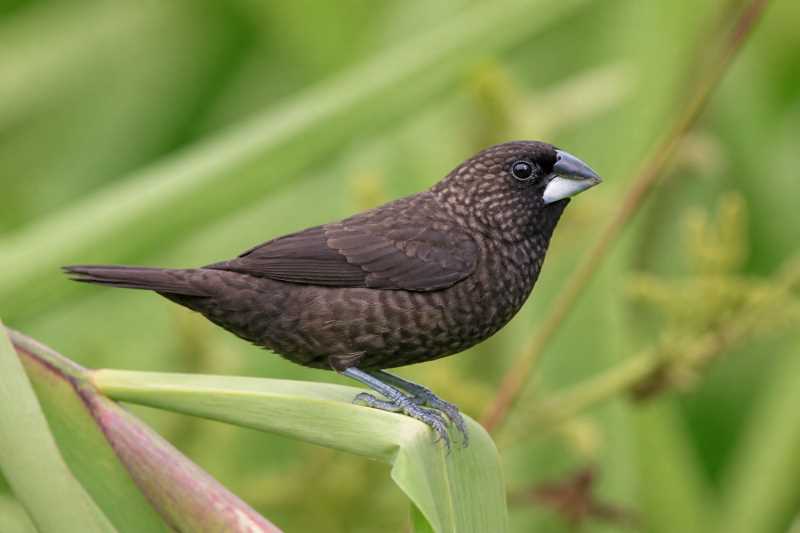
The Dusky Munia is a small bird, measuring approximately 10 to 11 centimeters in length. Its plumage is predominantly dark brown, with a subtle gloss that gives it a sleek appearance. The bird’s underparts are lighter, often displaying a brownish hue that blends seamlessly with its darker upperparts.
One of the defining features of the Dusky Munia is its short, stout bill, which is perfectly adapted for its granivorous diet. The bill is conical and strong, allowing the bird to efficiently crack open seeds and grains. Additionally, the bird’s legs and feet are adapted for perching and foraging, with a structure that enables it to navigate through thick foliage with ease.
Behavior and Social Structure
The Dusky Munia is a highly social bird, often seen in small flocks ranging from a few individuals to larger groups. These flocks are not just social gatherings; they play a crucial role in the birds’ survival strategy, offering protection against predators and increasing foraging efficiency.
Communication within flocks is facilitated by a series of soft calls and chirps, which help maintain cohesion among group members. During the breeding season, these vocalizations become more pronounced, as males engage in courtship displays to attract females. This involves a combination of song and physical displays, such as fluffing feathers and hopping movements.
Nesting typically occurs in dense vegetation or tall grasses, where the birds construct dome-shaped nests using grasses and other plant materials. These nests are well-camouflaged, providing protection for the eggs and chicks from potential predators.
Diet and Feeding Habits
As a granivorous bird, the Dusky Munia’s diet primarily consists of seeds and grains. It forages both on the ground and in vegetation, using its strong bill to access food sources. In addition to seeds, the bird may occasionally consume small insects, providing a source of protein that is particularly beneficial during the breeding season.
The availability of food resources influences the movement and distribution of Dusky Munia flocks. During periods of abundance, flocks are more sedentary, while scarcity may prompt them to migrate to areas with more plentiful resources. This adaptability in feeding habits is crucial for the species’ survival in varying environmental conditions.
Conservation Status
The International Union for Conservation of Nature (IUCN) currently classifies the Dusky Munia as a species of Least Concern. Despite facing habitat loss due to deforestation and agricultural expansion, the bird’s population remains stable, largely due to its adaptability to modified environments.
Conservation efforts in Borneo focus on preserving the island’s rich biodiversity, which supports a multitude of species, including the Dusky Munia. Protected areas and national parks play a vital role in safeguarding these habitats, ensuring that the ecological balance is maintained.
Education and awareness campaigns are also crucial components of conservation strategies, highlighting the importance of sustainable practices and the protection of natural habitats. By fostering a deeper understanding of the Dusky Munia and its ecosystem, these efforts aim to inspire local communities and stakeholders to participate in conservation initiatives.
Conclusion
The Dusky Munia is a remarkable example of nature’s adaptability and resilience. Its presence in the diverse ecosystems of Borneo underscores the importance of conserving natural habitats and promoting biodiversity. As we continue to learn more about this fascinating bird, we gain valuable insights into the intricate web of life that sustains our planet.
In conclusion, the Dusky Munia is not just a bird, but a symbol of the rich biodiversity that Borneo has to offer. Its survival and prosperity are intricately linked to the health of its environment, reminding us of our responsibility to protect and preserve the natural world for future generations.
Related posts