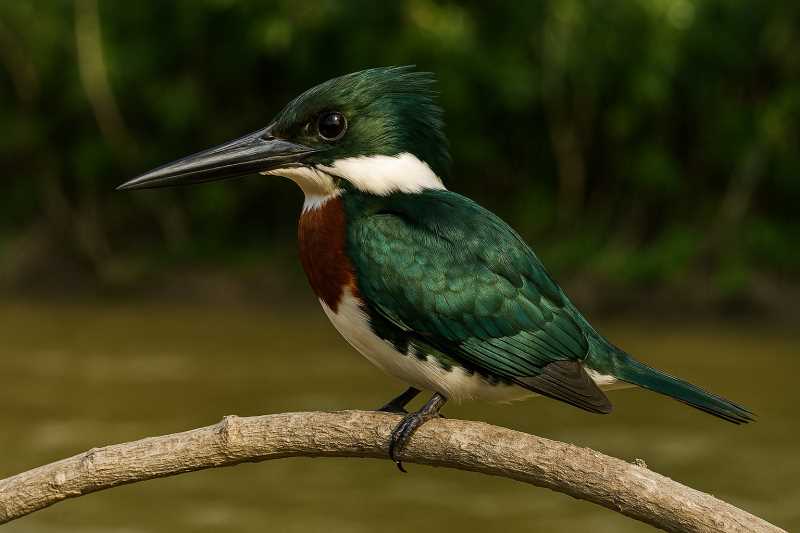
The Amazon Kingfisher (Chloroceryle amazona) is a dazzling representative of the Neotropical bird world, instantly recognizable by its vivid green plumage and assertive presence along forested rivers and streams. Found throughout Central and South America, this mid-sized kingfisher captivates birdwatchers and researchers alike with its agile hunting behavior, vibrant appearance, and ecological role as a top predator in freshwater systems.
Physical Description
Slightly larger than the Green Kingfisher but smaller than the Ringed Kingfisher, the Amazon Kingfisher measures around 29–30 centimeters (11.4–11.8 inches) in length. It displays glossy green upperparts, a shaggy crest, and a long, straight bill adapted for diving. The underparts are predominantly white, but males sport a broad chestnut band across the breast, while females have a green band and additional spotting along the flanks.
This sexual dimorphism aids in field identification and reflects subtle differences in foraging and reproductive behavior. Their plumage, while beautiful to human eyes, also serves a purpose in the dappled sunlight of riparian forests, offering camouflage from predators above.
Range and Habitat
The Amazon Kingfisher has a wide distribution, ranging from southern Mexico through Central America and across much of South America east of the Andes, including the vast Amazon Basin. It inhabits lowland freshwater environments—slow-moving rivers, oxbow lakes, mangroves, and swamps—often within or bordering tropical forests.
Unlike some other kingfishers that adapt to urban waterways, the Amazon Kingfisher is more secretive and reliant on intact natural habitats. It favors perches low over the water, such as branches, exposed roots, or driftwood, from which it vigilantly surveys for prey.
Behavior and Diet
True to its name, the Amazon Kingfisher is a master fisher. Its hunting technique is methodical: it scans the water patiently before diving in a rapid, precise arc to capture small fish, its primary prey. It may also eat aquatic insects, crustaceans, or amphibians when available.
Once prey is captured, the bird typically returns to its perch to beat the fish against the branch, stunning or killing it before swallowing it headfirst. This ensures that spines and scales do not hinder digestion. These birds are solitary feeders and maintain exclusive hunting territories, especially during the breeding season.
Breeding and Nesting
Breeding usually coincides with the dry season when water levels are lower, and prey is more concentrated. Amazon Kingfishers excavate nesting burrows in earthen banks, typically above the high-water mark of rivers or streams. The tunnel can extend up to a meter in length, ending in a nesting chamber where 3 to 5 glossy white eggs are laid.
Both male and female participate in excavation and incubation duties. The burrow offers protection from many predators, though nests are still vulnerable to flooding or disturbance by humans and animals. Chicks hatch altricial—blind and featherless—but grow rapidly thanks to the parents’ relentless fishing.
Conservation Status
Currently listed as a species of Least Concern by the IUCN, the Amazon Kingfisher enjoys a relatively stable population across its range. However, like many riparian species, it is vulnerable to habitat degradation. Deforestation, dam construction, and pollution of freshwater systems pose growing threats to its long-term survival.
Preservation of riverine forests and wetlands is crucial not only for the Amazon Kingfisher but for the myriad of species that share its habitat. The bird’s presence can serve as a valuable ecological indicator of healthy aquatic ecosystems.
Significance to Birdwatchers and Ecotourism
The Amazon Kingfisher is a prized sighting for birdwatchers touring Central and South America. Its relative boldness, coupled with its striking appearance, makes it an excellent subject for photography and observation. Ecotourism in areas like the Pantanal, the Amazon rainforest, and Central American wetlands often highlight this species during guided birding tours.
Moreover, the kingfisher’s presence adds to the ecological richness and allure of these biodiverse regions, reinforcing the need for sustainable tourism and conservation-based economies.
Conclusion
The Amazon Kingfisher is more than just a flash of green on the riverbank—it is a symbol of the rich biodiversity of the Neotropics and a vital player in the health of freshwater ecosystems. Protecting its habitat ensures that this magnificent bird continues to grace tropical waterways for generations to come.
Have a look at our American Birds Coloring Book on Amazon USA

Related posts