Dot-winged Antwren: A Glimpse into the Life of a Unique Bird Species
The Dot-winged Antwren (Microrhopias quixensis) is a captivating member of the avian world, notable for its striking plumage and intriguing behaviors. Native to the neotropical regions of Central and South America, this small passerine bird enchants birdwatchers and ornithologists alike with its distinctive characteristics and ecological significance.
Taxonomy and Physical Characteristics
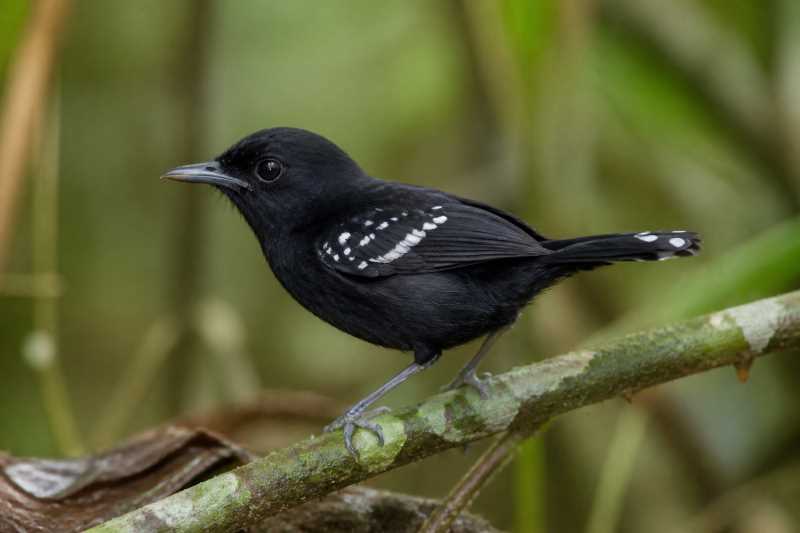
Belonging to the Thamnophilidae family, the Dot-winged Antwren is one of the many species of antbirds. It derives its name from the small white spots on its wings, which stand out against its predominantly black or slate-gray plumage. The sexual dimorphism in this species is subtle, with males generally exhibiting a darker, more pronounced coloration compared to the slightly paler females.
Typically, an adult Dot-winged Antwren measures about 10 to 11 centimeters in length and weighs approximately 8 to 12 grams, making it a relatively small bird. Its compact physique and short, rounded wings are well-suited for maneuvering through dense undergrowth, a habitat it frequently occupies.
Habitat and Distribution
The Dot-winged Antwren is widely distributed across a range that extends from southern Mexico through Central America, reaching as far south as western Ecuador, northern Bolivia, and the Amazon Basin in Brazil. It inhabits lowland rainforests, preferring areas with dense foliage and tangled vegetation, which provide ample cover and feeding opportunities.
Within these lush environments, the Dot-winged Antwren is often found in the midstory and lower canopy, where it can be seen flitting between branches in search of food. The species adapts well to secondary growth forests and edge habitats, making it somewhat resilient to habitat disturbances, although deforestation remains a significant threat.
Feeding Habits and Diet
As its name suggests, the Dot-winged Antwren is part of the antbird group, known for its association with army ant swarms. These birds exhibit a specialized foraging behavior known as "ant-following," where they capitalize on the insects and other small invertebrates flushed out by the advancing ants. This symbiotic relationship allows the antwren to access a reliable food source, consisting mainly of spiders, beetles, grasshoppers, and various other arthropods.
Their foraging technique is characterized by quick, agile movements, often hovering or sallying short distances to snatch prey. This active foraging style is energy-intensive but effective, allowing the Dot-winged Antwren to thrive in its environment.
Breeding and Nesting
The breeding season of the Dot-winged Antwren varies across its range, generally coinciding with the start of the rainy season when food resources become more abundant. During this time, males engage in vocal displays to attract mates and establish territories. Their calls, a series of high-pitched notes, are distinctive and can be heard echoing through the forest.
Nest construction is a cooperative effort between the male and female. They build small, cup-shaped nests using leaves, plant fibers, and spider webs, typically placing them in low shrubs or saplings. The female lays two eggs, which both parents incubate over about two weeks. After hatching, the chicks are altricial, requiring extensive parental care until they fledge at around two to three weeks of age.
Conservation Status
Currently, the Dot-winged Antwren is classified as a species of Least Concern by the International Union for Conservation of Nature (IUCN). Despite facing threats from habitat loss due to deforestation, its wide distribution and adaptability to altered habitats have so far buffered the species from severe population declines.
Conservation efforts aimed at preserving tropical forests are crucial for ensuring the long-term survival of the Dot-winged Antwren and countless other species that rely on these ecosystems. Sustainable forestry practices and the establishment of protected areas are essential strategies in this regard.
Conclusion
The Dot-winged Antwren is a remarkable example of the diversity and complexity of life within neotropical rainforests. Its unique adaptations, intriguing behaviors, and ecological role highlight the intricate balance of these ecosystems and the importance of conserving them. By understanding and appreciating species like the Dot-winged Antwren, we gain insight into the broader challenges facing biodiversity and the steps needed to protect it for future generations.
References
- Zimmer, K. J., & Isler, M. L. (2003). "Thamnophilidae (Antbirds)." In: del Hoyo, J., Elliot, A., & Christie, D. (eds.) Handbook of the Birds of the World. Vol. 8. Lynx Edicions.
- Stotz, D. F., Fitzpatrick, J. W., Parker, T. A., & Moskovits, D. K. (1996). "Neotropical Birds: Ecology and Conservation." University of Chicago Press.
- BirdLife International. (2020). "Microrhopias quixensis." The IUCN Red List of Threatened Species 2020.
Related posts