Introduction
The Tibetan Snowcock, Tetraogallus tibetanus, is a large pheasant of the high mountains of Central Asia. It is associated mainly with the Qinghai–Tibetan Plateau and adjoining ranges, including parts of China, India, Nepal, Bhutan and Tajikistan. Its specialised alpine lifestyle allows it to occupy cold, exposed terrain near and above the treeline. The species is recognised as valid by the IOC World Bird List and belongs to the pheasant family, Phasianidae. (ww.worldbirdnames.org)
Physical Description
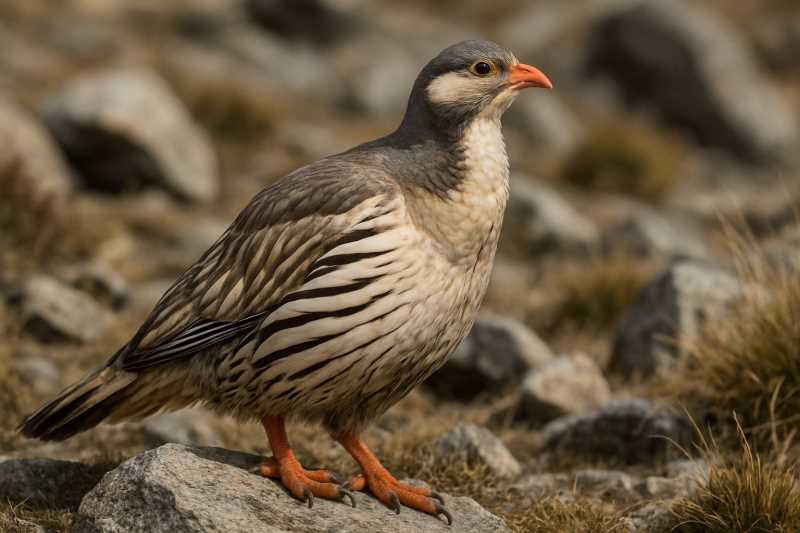
The Tibetan Snowcock is a robust, long-bodied mountain gamebird, generally about 45–55 cm long. Adults have mainly sandy-grey to grey-brown upperparts, a grey head and neck, and a whitish throat and breast. The underparts are pale, with conspicuous dark barring or streaking on the flanks and lower belly. The rump and upper tail-coverts are greyish to rufous and finely marked, while the tail is dark brown. In flight, the pale wing pattern and contrasting dark flight feathers can be noticeable.
Males are usually larger and more strongly marked than females. Females are duller overall, with less sharply defined patterning and more dusky spotting. Juveniles are less contrasting than adults and may show browner, less clearly barred plumage. The combination of large size, pale underparts, grey head and strongly marked flanks is useful for identification in its barren alpine surroundings. (cites.org)
Range and Habitat
The species occurs across high mountain systems from the eastern Pamirs and Tajikistan through northern India, Nepal, Bhutan and the Tibetan Plateau, with the principal distribution in western and south-western China. It is also reported from adjoining parts of the Himalayas and the Hengduan Mountains. The Tibetan Snowcock is a resident species, although individuals commonly move to lower elevations in winter and return to higher alpine areas during the breeding season.
It occupies alpine meadows, grass-covered plateaux, rocky slopes, scree, barren moraines and open alpine shrublands. Studies on the Qinghai–Tibetan Plateau have recorded it from approximately 3,600 m to at least 5,500 m, with some observations at still higher elevations. Habitat use varies seasonally: birds may use lower slopes near the treeline during winter, then move towards alpine grassland, shrubland and areas near the snowline when food becomes more available in summer. (pmc.ncbi.nlm.nih.gov)
The species often selects open ground with sparse vegetation, rocks and short grass. Research in the Lhasa region found that foraging and roosting sites were associated with low vegetation cover, rocky features and proximity to human settlements, although this local pattern should not be assumed to apply throughout the entire range. (journal.hep.com.cn)
Behaviour and Diet
Tibetan Snowcocks are generally social outside the breeding period and may occur in small groups or coveys. They forage mainly on the ground and are adapted to walking across steep slopes, scree and rocky plateaux. Birds may call during the morning and evening, while resting individuals can use elevated rocks as lookout points. When disturbed, they may run uphill before taking flight, or cross a valley on strong, direct wingbeats.
The diet is predominantly plant-based. Recorded foods include roots, shoots, leaves, grasses and other alpine vegetation, with seeds, plant reproductive parts and underground storage organs also taken when available. Invertebrates, including insects, may be eaten occasionally, particularly when birds are feeding young. During winter, snow cover can make food difficult to reach, and the birds rely on exposed vegetation, dry plant material and lower, less snowbound slopes. (pmc.ncbi.nlm.nih.gov)
Breeding takes place in late spring and early summer. Pairs form as winter groups disperse, and the nest is a shallow ground depression, usually placed among rocks or in open alpine vegetation. Egg-laying has been reported from around mid-May in Tibet, with hatching occurring by early June in some studied populations. Clutch size is commonly reported as approximately four to seven eggs, although detailed breeding information remains limited across much of the range. (onlinelibrary.wiley.com)
Identification Tips
Look for a large, pale-grey mountain pheasant in open rocky terrain. The most useful field marks are:
- Grey head and neck with a contrasting whitish throat and breast.
- Pale underparts marked by bold dark barring on the flanks and lower body.
- Sandy-grey upperparts that blend with scree, moraine and alpine grassland.
- Large size and a broad, powerful flight compared with most alpine partridges.
- Preference for high, open slopes, ridges, plateaux and rocky ground rather than wooded habitat.
The Himalayan Snowcock, Tetraogallus himalayensis, is the most relevant comparison where the two species overlap. The Tibetan Snowcock is generally smaller and paler below, with a distinctive grey head and strong dark barring on the flanks. Care is needed because lighting, distance and seasonal plumage can make the two snowcocks appear more alike than they are at close range. (datazone.birdlife.org)
Conservation Status
The Tibetan Snowcock is currently assessed as Least Concern on the IUCN Red List. Its broad distribution and generally stable population assessment mean that it is not presently considered globally threatened. A reliable, up-to-date global population estimate is not available, so unsupported population totals should be treated with caution. (cites.org)
Potential pressures include illegal hunting, trapping, local disturbance, habitat degradation and the effects of climate change on alpine snowfields, moraines and seasonal food resources. In Nepal, the species has been recorded in several high-altitude national parks and conservation areas, where protected landscapes provide important refuges. Conservation priorities include maintaining connected alpine habitat, limiting disturbance and unsustainable hunting, improving population monitoring, and protecting high-elevation areas from poorly planned infrastructure and extractive activities. (cms.zsl.org)
Frequently Asked Questions
Where does the Tibetan Snowcock live?
It lives in high mountain regions of Central Asia, especially the Tibetan Plateau and adjoining Himalayas. Its range includes parts of China, India, Nepal, Bhutan and Tajikistan.
How high does the Tibetan Snowcock live?
It commonly occurs between about 3,600 and 5,500 m, although records from higher elevations exist. Altitudinal use varies with season, snow cover and food availability.
What does the Tibetan Snowcock eat?
Its diet is mainly plant-based and includes roots, shoots, leaves, grasses, seeds and other alpine vegetation. Insects and other invertebrates may be eaten occasionally.
Is the Tibetan Snowcock migratory?
It is considered resident rather than a long-distance migrant. However, it makes seasonal movements within mountain valleys and slopes, often descending in winter and moving higher during the breeding season.
How can the Tibetan Snowcock be identified?
Look for a large grey and sandy-coloured pheasant with a pale throat and breast, strongly barred flanks, and a preference for open rocky alpine terrain. The Himalayan Snowcock is a similar species but is generally larger and darker below.
Is the Tibetan Snowcock endangered?
No. It is currently classified as Least Concern, although local hunting, disturbance, habitat degradation and climate-related changes in alpine environments may pose future risks.
References
- BirdLife International. 2016. Tetraogallus tibetanus. Species factsheet, BirdLife International. Stable species-factsheet record referenced through BirdLife DataZone: https://datazone.birdlife.org/species/factsheet/tibetan-snowcock-tetraogallus-tibetanus. Accessed 8 September 2026.
- Gill, F., Donsker, D. and Rasmussen, P., eds. 2026. IOC World Bird List, version 15.2. International Ornithologists’ Union. https://www.worldbirdnames.org/. Accessed 8 September 2026.
- International Union for Conservation of Nature and Natural Resources. n.d. Tibetan Snowcock, Tetraogallus tibetanus: IUCN Red List assessment and supplementary information. IUCN Red List of Threatened Species. https://nrl.iucnredlist.org/resources/gss-supplementary. Accessed 8 September 2026.
- Jiaqi, L., Hongquan, S. and Naifa, L. 2008. Habitat selection of the Tibetan Snow Cock Tetraogallus tibetanus in the spring in Lhasa. Frontiers of Biology in China, 3(2), 232–235. https://doi.org/10.1007/s11515-008-0035-9.
- Yao, L., et al. 2021. How do Snow Partridge (Lerwa lerwa) and Tibetan Snowcock (Tetraogallus tibetanus) coexist in sympatry under high-elevation conditions on the Qinghai–Tibetan Plateau? Ecology and Evolution. https://doi.org/10.1002/ece3.8424.
- Li, J., et al. 2019. Habitat use and diel activity pattern of the Tibetan Snowcock (Tetraogallus tibetanus): a case study using camera traps for surveying high-elevation bird species. Avian Research. https://doi.org/10.1186/s40657-019-0144-y.
- Liu, H., et al. 2020. The uplift of the Qinghai–Tibet Plateau and glacial oscillations triggered the diversification of Tetraogallus (Galliformes, Phasianidae). BMC Evolutionary Biology, 20, article 29. https://doi.org/10.1186/s12862-020-1593-8.
- Zoological Society of London. 2016. The Status of Nepal’s Birds: The National Red List Series, Volume 1. ZSL, London. https://cms.zsl.org/sites/default/files/2023-02/ZSL-National-Red-List-of-Nepal%27s-Birds-Volume-1-2016.pdf. Accessed 8 September 2026.
Related posts