Introduction
The Cape Verde Swift, also known as Alexander’s Swift, is an endemic swift of the Cape Verde archipelago. Its accepted scientific name is Apus alexandri. It is a small, fast-flying insectivore associated with cliffs, rocky slopes, valleys and human structures across the islands.
Physical Description
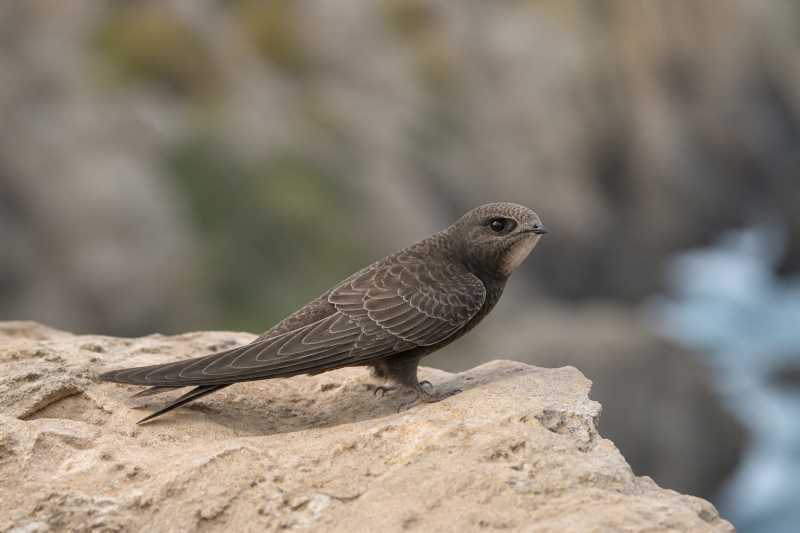
The Cape Verde Swift is approximately 13 cm long, with a wingspan of about 34–35 cm. It has mainly dark grey-brown plumage, a noticeably paler throat and relatively short, narrow wings. The tail is only shallowly forked compared with several other Apus swifts.
Males and females are not known to show obvious differences in external appearance. Juveniles are likely to resemble adults, although young birds may appear less worn and less sharply contrasted in the throat area. Identification is often more difficult than expected because the species is usually seen at a distance and in rapid flight.
Range and Habitat
The Cape Verde Swift is endemic to the Cape Verde Islands and is considered resident rather than migratory. It has been recorded on most of the archipelago, with important populations and breeding records from islands including Santiago, Fogo, Brava, Santo Antão and São Nicolau. It is also reported from other islands, although local abundance and breeding evidence vary.
The species uses a broad range of habitats, from coastal cliffs and rocky ravines to mountainous terrain and settled areas. It nests in cliff crevices, caves and sometimes on buildings. Protected mountain areas and rugged coastal landscapes provide suitable combinations of nesting sites and open airspace for feeding.
Where to See This Species
Serra Malagueta Natural Park, Santiago, Cape Verde
Cape Verde Swifts have been recorded in and around Serra Malagueta, a mountainous protected area with steep slopes, ravines and open airspace. Birdwatchers should scan above cliffs, valleys and forest edges, particularly during periods of active insect movement.
Nearby accommodation: Assomada and Tarrafal provide practical bases with guest houses, small hotels and self-catering accommodation.
Fogo Natural Park, Fogo, Cape Verde
The species is listed among the birds of Fogo Natural Park, where volcanic slopes, cliffs and highland habitats provide suitable conditions. Swifts may be seen hunting over the park and around rocky settlements, especially when flying insects are abundant.
Nearby accommodation: São Filipe and Chã das Caldeiras offer guest houses, small hotels and locally run accommodation.
Monte Gordo Natural Park, São Nicolau, Cape Verde
Monte Gordo and the surrounding central mountain range are recognised locations for Cape Verde Swift records. The park’s rugged uplands, valleys and varied vegetation provide both nesting opportunities and open feeding areas.
Nearby accommodation: Ribeira Brava and Tarrafal de São Nicolau offer guest houses, small hotels and self-catering accommodation.
Behaviour and Diet
Cape Verde Swifts spend much of their active time in the air. They catch flying insects during sustained flight and may forage alone or in small groups over cliffs, gullies, valleys, shorelines and other open areas. Their diet is principally composed of aerial insects.
The flight is relatively light and fluttering for an Apus swift, with rapid wingbeats and frequent changes of direction. The species is generally seen moving quickly across the sky rather than perching in exposed positions.
Nests are built in protected crevices, caves and similar sheltered sites. The nest is a small saucer-shaped structure made from plant material and feathers, and two white eggs have been reported. Both adults are presumed to contribute to parental care, although detailed breeding information remains limited.
Identification Tips
- Look for a small, dark swift with a contrasting pale throat.
- Note the relatively short wings and shallow tail fork.
- The flight can appear more fluttering and less powerful than that of larger swifts.
- Search above cliffs, ravines, mountain valleys and coastal slopes.
- The species is usually identified by a combination of size, pale throat, flight style and location rather than by a single feature.
- Do not confuse it with the larger Alpine Swift, which has a broad white belly, or with the more strongly forked and differently proportioned swifts that may occur in the region.
Conservation Status
The Cape Verde Swift is currently assessed as Least Concern on the IUCN Red List. Although its distribution is restricted because it is confined to the Cape Verde archipelago, it is regarded as locally common in parts of its range, and there is no published evidence of a continuing global population decline.
The original article’s claims that the species is currently Near Threatened and that specific threats from introduced rats, cats and climate change are established are not supported by the current conservation assessment. Nevertheless, habitat alteration, disturbance of nesting sites, changes in insect abundance and poorly managed development could affect local populations. Maintaining protected areas, safeguarding cliffs and ravines, and improving monitoring of breeding sites remain important conservation measures.
Frequently Asked Questions
Where is the Cape Verde Swift found?
It is found only in the Cape Verde archipelago. Records exist from several islands, including Santiago, Fogo, Brava, Santo Antão and São Nicolau.
Is the Cape Verde Swift migratory?
The species is generally considered resident. It remains within the Cape Verde Islands rather than undertaking a regular long-distance migration.
What does the Cape Verde Swift eat?
It feeds mainly on flying insects caught in the air. It often hunts over cliffs, valleys, ravines, shorelines and other open habitats.
Where does the Cape Verde Swift nest?
It nests in sheltered crevices and cavities in cliffs and caves, and it may also use suitable spaces on buildings. Its nest is a small cup or saucer-shaped structure made from grass and feathers.
How can the Cape Verde Swift be identified?
Look for a small dark swift with a pale throat, relatively short wings and a shallow tail fork. Its flight is often more fluttering than that of larger swifts.
What is the conservation status of the Cape Verde Swift?
The species is assessed as Least Concern. It has a restricted island range but is locally common in parts of Cape Verde, and no continuing global population decline has been established.
References
- BirdLife International
- IUCN Red List of Threatened Species
- IOC World Bird List
Related posts