Introduction
The Black-fronted Wood Quail (Odontophorus atrifrons) is a secretive New World quail of humid montane forests in northern Colombia and north-western Venezuela. It is associated with dense ground vegetation and is more often detected by its calls than seen. The species is currently recognised as distinct by major international bird checklists, although some aspects of its distribution, ecology and population status remain poorly documented.
Physical Description
The Black-fronted Wood Quail is a compact, medium-sized bird measuring approximately 28–31 cm in length. It has a robust body, short tail and strong legs suited to walking and scratching through leaf litter.
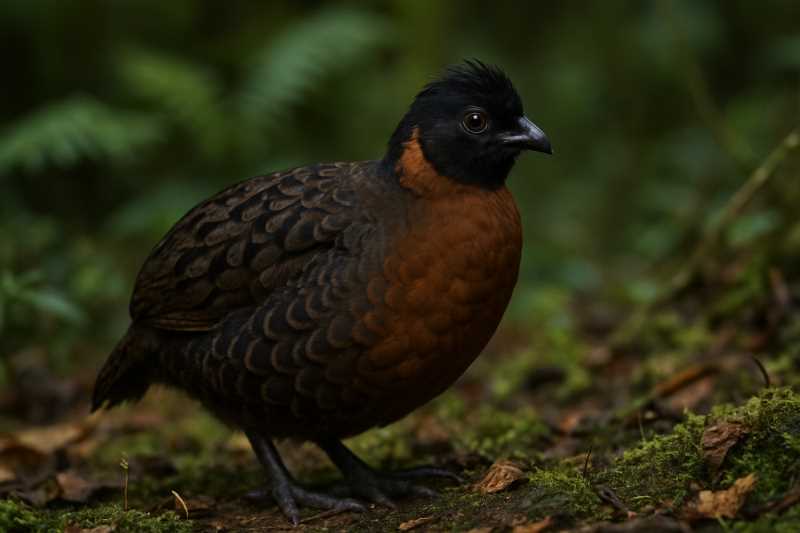
The head is the most distinctive feature. The forehead, cheeks, sides of the head, nape and throat are dark blackish, forming a noticeable facial mask. The crown is reddish brown, while the upperparts are brown or olive-brown with darker streaking and pale buff markings. The wings show chestnut-brown tones with darker barring and pale spots. The underparts are generally greyish or brownish, with fine darker streaks and mottling.
The sexes are broadly similar in appearance, although individual variation in crest colour and the intensity of the body pattern has been reported. Young birds are less well documented but are understood to resemble adults in general shape and pattern while showing less sharply defined plumage.
Range and Habitat
The species has a disjunct distribution in the northern Andes. The nominate subspecies occurs in the Sierra Nevada de Santa Marta in north-eastern Colombia. The subspecies O. a. navai occurs in the Serranía de Perijá along the Colombia–Venezuela border, mainly on the Venezuelan side but extending into Colombia. The subspecies O. a. variegatus has been reported from the northern part of Colombia’s Eastern Andes, particularly Santander and adjacent departments, although its current status in that area is uncertain.
The Black-fronted Wood Quail inhabits humid montane and cloud forests with dense undergrowth. Records span approximately 700–3,100 metres above sea level in Colombia and about 1,650–3,100 metres in Venezuela, although the precise limits vary between regions. It is a resident species rather than a long-distance migrant, but local movements may occur in response to habitat conditions and food availability.
Forest clearance, agricultural conversion and fragmentation have reduced suitable habitat in parts of its range. Some populations occur within protected landscapes, including protected areas in the Sierra Nevada de Santa Marta, but protection is uneven across the species’ fragmented distribution.
Behaviour and Diet
Black-fronted Wood Quails are wary, ground-dwelling birds that forage in dense vegetation and among fallen leaves. They may occur in small groups, or coveys, and usually walk away or remain concealed rather than flying when approached. Their short, rounded wings are used for sudden escape flights when necessary.
Available observations indicate a mixed diet that includes seeds, berries, other plant matter and small invertebrates such as insects. The species scratches through leaf litter while feeding, but detailed studies of its diet and seasonal food preferences are lacking.
The birds are often heard before they are seen. Their vocal activity can include rhythmic, whistled advertising calls, rattling sounds and softer calls between members of a group. Calling is especially useful for detecting birds in thick forest and has been recorded during the early morning and around dusk.
Very little is known about reproduction. A documented nest was a concealed ground structure made from leaves and small sticks, and contained three eggs. Other published observations of breeding-condition adults and immature birds suggest activity during the wetter part of the year, but a general breeding season, incubation period and parental roles have not been established with confidence.
Identification Tips
When seen, the Black-fronted Wood Quail can be identified by the combination of:
- A stocky, short-tailed shape and strongly terrestrial behaviour.
- A conspicuous blackish forehead, cheeks and throat.
- A reddish-brown crown contrasting with the dark face.
- Brown to olive-brown upperparts with streaking and pale flecks.
- Presence in dense humid montane forest, usually at middle to high elevations.
- Rhythmic calls coming from thick undergrowth, often when the bird itself remains hidden.
The dark facial pattern is the most useful field mark, but views are often brief. Identification should also take account of location, elevation and habitat because several other wood quails occur in the northern Andes and may be difficult to separate in poor light or dense vegetation. Recordings and repeated calls can be particularly valuable for confirming the species.
Conservation Status
The Black-fronted Wood Quail is currently listed as Least Concern in the 2023.1 reassessment process associated with the IUCN Red List. Earlier assessments treated it as Vulnerable, reflecting its restricted, fragmented range and continuing habitat loss. The change in global category does not mean that all populations are secure, and older conservation concerns remain relevant at regional and local levels.
The main threats are deforestation, conversion of montane forest for agriculture, degradation of dense understorey and fragmentation of isolated forest blocks. The variegatus and navai populations are particularly poorly known, and some former localities have few or no recent records.
Important conservation measures include protecting remaining montane and cloud forests, maintaining links between forest remnants, surveying poorly known populations and improving knowledge of breeding biology and population trends. Local protection and habitat restoration are especially important where the species occurs outside larger national parks and reserves.
Frequently Asked Questions
Where does the Black-fronted Wood Quail live?
It occurs in northern Colombia and north-western Venezuela, including the Sierra Nevada de Santa Marta, the Serranía de Perijá and parts of Colombia’s northern Eastern Andes.
What habitat does the Black-fronted Wood Quail prefer?
It prefers humid montane and cloud forests with dense undergrowth and a well-developed layer of leaf litter. Recorded elevations range broadly from about 700 to 3,100 metres, depending on the region.
What does the Black-fronted Wood Quail eat?
Its reported diet includes seeds, berries, other plant material and small invertebrates. It finds food mainly by scratching through leaf litter on the forest floor.
Is the Black-fronted Wood Quail endangered?
The current global assessment is Least Concern, but the species has a restricted and fragmented distribution. Habitat loss remains a serious regional threat, and some subspecies and local populations are poorly known.
Why is the Black-fronted Wood Quail difficult to see?
It is shy, ground-dwelling and strongly associated with dense vegetation. It often stays concealed and is more readily detected by its rhythmic calls than by direct observation.
Does the Black-fronted Wood Quail migrate?
There is no evidence that it undertakes long-distance migration. It is generally regarded as resident, although local movements may occur within suitable forest habitat.
References
- BirdLife International. 2023. Black-fronted Wood-quail (Odontophorus atrifrons), 2023.1 Globally Threatened Bird Forum assessment discussion and recommended categorisation. BirdLife International. https://forums.birdlife.org/2023-1-black-fronted-wood-quail-odontophorus-atrifrons/ Accessed 8 September 2026.
- Gill, F., Donsker, D. and Rasmussen, P., eds. 2026. IOC World Bird List, version 15.2. International Ornithologists’ Union. https://www.worldbirdnames.org/ Accessed 8 September 2026.
- International Union for Conservation of Nature. 2023. 2023-1 Red List statistics tables, including reassessments for Odontophorus atrifrons. IUCN Red List of Threatened Species. https://nc.iucnredlist.org/redlist/content/attachment_files/2023-1_RL_Table_7.pdf Accessed 8 September 2026.
- Strewe, R. and Navarro, C. 2004. New and noteworthy records of birds from the Sierra Nevada de Santa Marta region, north-eastern Colombia. Bulletin of the British Ornithologists’ Club 124(1): 38–51. https://boc-online.org/bulletin/bulletin-index/bulletin-124 Accessed 8 September 2026.
- Strewe, R., Villa-De León, C. and Vega, J. 2010. First reported nest of the Black-fronted Woodquail (Odontophorus atrifrons). Ornitología Neotropical 21(2): 295–298. https://digitalcommons.usf.edu/ornitologia_neotropical/vol21/iss2/13/ Accessed 8 September 2026.
- Verhelst, J. 2010. Atlas of the Birds of Colombia: Odontophorus atrifrons. Atlas of the Birds of Colombia. https://sites.google.com/site/haariehbamidbar/atlas-of-the-birds-of-colombia/maps/galliformes/odontophorus-atrifrons Accessed 8 September 2026.
- Hilty, S. L. 2003. Birds of Venezuela. Princeton University Press, Princeton, New Jersey.
Related posts