Introduction
The Ash-colored Cuckoo, Coccycua cinerea, is a small South American cuckoo in the family Cuculidae. It is a discreet bird of wooded and shrubby habitats, best recognised by its plain grey-brown plumage, red eye and dark bill. Unlike the brood-parasitic cuckoos familiar from parts of the Old World, this species builds its own nest and raises its own young. (elhornero.avesargentinas.org.ar)
Physical Description
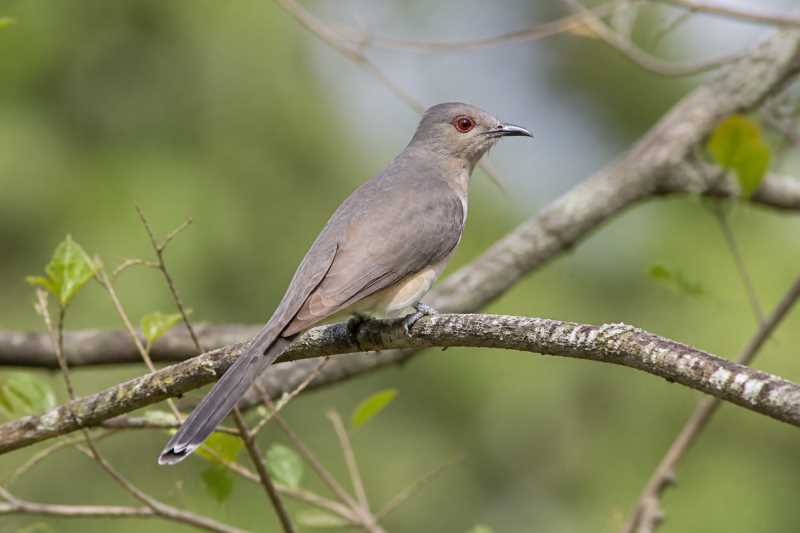
The Ash-colored Cuckoo is a slender bird measuring about 21–23 cm in length and weighing approximately 35–42 g. Adults have grey to brownish-grey upperparts, a paler throat and breast, and whitish or buff-tinged underparts. The bill is short, dark and slightly curved, while the iris is typically bright red, with a narrow, less conspicuous orbital ring.
The tail is relatively long and graduated, with narrow white tips on the outer feathers. These pale tips can be especially noticeable when the tail is spread. The sexes are generally similar in appearance. Juveniles are duller and browner, with less strongly coloured eyes and less distinct tail markings. (ecoregistros.org)
Range and Habitat
The species breeds mainly from northern and central Argentina through Paraguay and Uruguay to southern and southeastern Brazil. During the non-breeding season, many individuals move northwards into central and western Brazil, eastern and northern Bolivia, southern and northeastern Peru, and the extreme southeast of Colombia. The extent and regularity of these movements are not fully understood, but the species is best treated as seasonally mobile rather than wholly sedentary. (elhornero.avesargentinas.org.ar)
Ash-colored Cuckoos use a range of lowland habitats, including dry woodland, gallery forest, riverine vegetation, scrub, wooded savanna and forest edges. In Argentina, breeding birds have been recorded in native tala woodland, including both forest interiors and edges. Dense shrubs and small trees provide cover, nesting sites and suitable feeding habitat.
Where to See This Species
Parque Nacional Ciervo de los Pantanos, Buenos Aires Province, Argentina
The species is listed as a regular part of the park’s bird community, and multiple records have been documented there. Look for it in riparian woodland, woodland edges, scrub and other areas where wetland habitats meet trees and dense vegetation. The austral spring and summer are a useful period to search, although local movements may affect its presence. (sib.gob.ar)
Nearby accommodation: Campana and the wider Campana–Zárate area provide practical options including hotels, guest houses and self-catering accommodation.
Reserva Natural Punta Lara, Buenos Aires Province, Argentina
Punta Lara protects gallery forest, riverine scrub, marshes, grassland and other habitats along the Río de la Plata. The Ash-colored Cuckoo has been documented in the reserve and is treated as a scarce summer visitor associated with woodland and riverine thickets. Search quietly along wooded trails and habitat edges during the warmer months. (ambiente.gba.gob.ar)
Nearby accommodation: Punta Lara, Ensenada and La Plata offer hotels, guest houses and other urban accommodation, with La Plata providing the broadest range of services.
Parque Nacional El Palmar, Entre Ríos Province, Argentina
The species has been recorded within El Palmar, including an observation near the camping area, and the park supports the open woodland, scrub and grassland mosaic favoured by the species. It is an unobtrusive bird, so patient searches around wooded margins and lightly wooded areas are more productive than scanning open ground. (neotropicalbirdingandconservation.org)
Nearby accommodation: Ubajay is the nearest practical gateway settlement, while Colón provides a wider choice of hotels, guest houses, cabins and campsites.
Behaviour and Diet
The Ash-colored Cuckoo is generally quiet and inconspicuous. It usually moves through foliage in short flights, perches unobtrusively and forages among leaves and branches. Its diet consists mainly of arthropods, including beetles, caterpillar larvae, spiders, grasshoppers and termites. Small amounts of plant material have also been recorded, but insects and other invertebrates appear to form the main part of its diet. (elhornero.avesargentinas.org.ar)
Its calls are relatively soft and can be difficult to locate, often consisting of repeated, descending notes. Calling activity is particularly relevant during the breeding season, when vocalisations may help maintain contact between adults or advertise occupancy of a territory.
Breeding information remains limited, but the species is not an obligate brood parasite. It constructs a shallow nest on a native tree, usually in woodland or along a forest edge. A documented study in central-eastern Argentina recorded clutches of about three eggs, an incubation period of approximately 14 days and a nestling period of about 15 days. Predation was the main cause of nest failure in that study. (elhornero.avesargentinas.org.ar)
Identification Tips
- Look for a small, slim cuckoo with plain grey-brown upperparts and noticeably paler underparts.
- The bright red iris is one of the most useful features, especially at close range.
- Check for a short blackish bill, a plain face without a strong mask and narrow white tips on the outer tail feathers.
- The bird often remains partly concealed, so movement through foliage may be noticed before the whole bird is seen.
- Do not confuse it with the larger Dark-billed Cuckoo, which is longer and has more contrasting underparts and facial patterning. The Ash-colored Cuckoo is also much smaller and plainer than the long-tailed Squirrel Cuckoo.
- Juveniles are browner and less distinctive, with weaker eye colour and less obvious white tail tips.
Conservation Status
The Ash-colored Cuckoo is classified as Least Concern on the IUCN Red List. Its broad distribution and occurrence across several habitat types mean that it is not currently considered globally threatened. A precise global population estimate and a well-supported population trend are not available in the sources used here. (sib.gob.ar)
At a local level, habitat loss, woodland clearance, agricultural expansion and the fragmentation of riparian and dry-forest habitats may reduce available nesting and feeding sites. Maintaining native woodland, scrub corridors and forest edges, especially within protected areas, is an important conservation measure.
Frequently Asked Questions
Where can the Ash-colored Cuckoo be found?
It is found mainly in Argentina, Paraguay, Uruguay and southern Brazil during the breeding season. Some birds move north in the non-breeding season into parts of Bolivia, Peru, Brazil and southeastern Colombia.
Is the Ash-colored Cuckoo a brood parasite?
No. Unlike many familiar cuckoos, the Ash-colored Cuckoo builds its own nest, incubates its eggs and feeds its own young.
What does the Ash-colored Cuckoo eat?
Its diet is dominated by arthropods, including beetles, caterpillar larvae, spiders, grasshoppers and termites. It may occasionally take plant material as well.
How can the Ash-colored Cuckoo be identified?
Look for a small grey-brown cuckoo with pale underparts, a dark slightly curved bill, a bright red iris and narrow white tips on the outer tail feathers.
When is the best time to see this species?
In its southern breeding range, spring and summer are generally the most productive seasons. It is easiest to find in native woodland, gallery forest, scrub and habitat edges, where quiet observation and attention to its soft calls are useful.
Is the Ash-colored Cuckoo endangered?
No. It is currently assessed as Least Concern, although local populations may be affected by habitat loss and fragmentation.
References
- IUCN Red List of Threatened Species
- Sistema de Información de Biodiversidad de la Administración de Parques Nacionales, Argentina
- El Hornero
Related posts