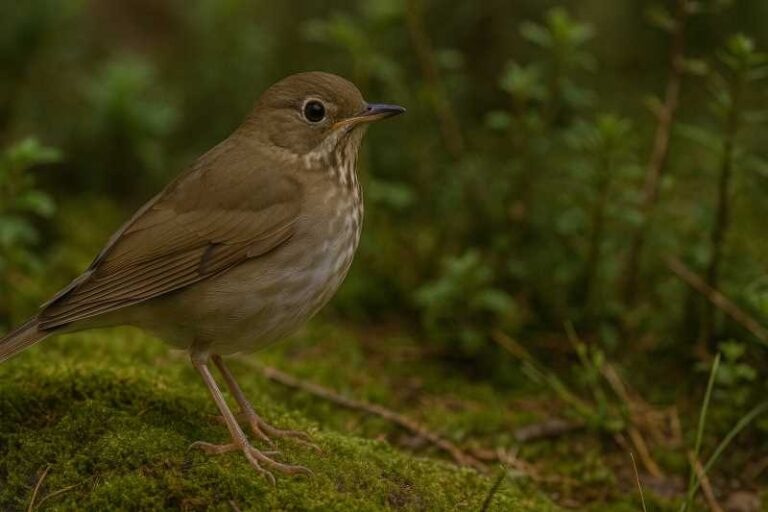
The American Pipit (Anthus rubescens) is a slender, inconspicuous songbird that graces the open tundra, alpine meadows, and windswept shorelines of North America. Though often overlooked due to its drab appearance and ground-hugging habits, this bird is a remarkable long-distance migrant, thriving in some of the continent’s harshest habitats. Its high-pitched song and gentle demeanor bring life to otherwise barren landscapes, while its seasonal movements connect the Arctic with temperate and subtropical regions far to the south.
As a true ground specialist, the American Pipit exemplifies resilience and adaptability in environments where few other songbirds can persist.
Physical Characteristics
The American Pipit is a small, slim songbird, measuring 15–17 cm (6–6.7 inches) in length with a wingspan of 25–28 cm (10–11 inches). It has a thin, pointed bill, long legs, and a long tail that is frequently wagged—a behavior characteristic of pipits and helpful for identification.
In plumage, it is modestly colored: pale brown to grayish above with streaked underparts, a buffy breast, and a whitish belly. The face is subtly marked, with a pale eyeline and faint malar (whisker) stripe. During the breeding season, birds in the tundra can develop warmer buff tones, but overall, the American Pipit’s coloration helps it blend seamlessly into rocky or grassy terrain.
This camouflage is essential for survival, as the bird nests and forages almost exclusively on the ground, making it vulnerable to predators.
Range and Habitat
The American Pipit breeds in the high Arctic, subalpine meadows, and tundra regions of North America—from Alaska and northern Canada to high mountain ranges in the western United States. These windswept, treeless environments provide the open landscapes the pipit favors for nesting and foraging.
In the non-breeding season, the species migrates to lower elevations and warmer climates. Wintering grounds stretch across the southern United States, Mexico, Central America, and as far south as northern South America. During migration and winter, pipits can be found in open habitats such as agricultural fields, mudflats, riverbanks, beaches, short-grass prairies, and even roadside verges.
The American Pipit is among the few songbirds that breed in the Arctic, and its migratory journeys reflect the vast distances required to move between suitable seasonal habitats.
Behavior and Diet
American Pipits are ground-dwelling birds that walk or run briskly across open areas, wagging their tails as they go. They often forage in flocks during migration and winter, carefully searching the ground for insects and seeds.
Their diet consists primarily of insects and other invertebrates—beetles, caterpillars, spiders, flies, and small mollusks—in the breeding season, shifting to include more seeds and plant material in winter. Their methodical foraging style allows them to glean prey from soil, gravel, or short vegetation with precision.
Pipits are not shy about human-modified landscapes. They readily feed in plowed fields, livestock pastures, and exposed mudflats, often going unnoticed due to their small size and cryptic plumage.
Breeding and Lifecycle
Breeding occurs during the brief Arctic or alpine summer, typically from May to July. Pipits nest on the ground in a shallow cup of grass, moss, and feathers, often tucked into a small depression, crevice, or under a rock for protection.
The female lays 3–7 eggs and incubates them for around 13–14 days. After hatching, both parents feed the young, which fledge about two weeks later. Given the short breeding season, American Pipits raise only one brood per year.
Breeding in such exposed, predator-rich environments poses significant risks, but the birds’ camouflage, vigilance, and short nesting period help them minimize threats from foxes, jaegers, and gulls.
Vocalizations
The American Pipit’s call is a high, sharp “pip-it” or “pi-pit,” from which it gets its name. Its flight song—often delivered during fluttering display flights over breeding grounds—is a gentle series of high-pitched, tinkling notes that evoke the remoteness and tranquility of the tundra.
During migration, their call notes are often the first sign of their presence as they pass overhead in flocks.
Conservation and Threats
The American Pipit is classified as a species of Least Concern by the IUCN, with a widespread range and a stable global population. However, certain threats do exist:
- Climate Change: Warming temperatures in Arctic and alpine breeding habitats may alter vegetation, disrupt insect availability, and shift the timing of nesting.
- Habitat Loss: Conversion of open lands and wetlands into agriculture or urban areas can impact critical stopover and wintering sites.
- Pollution: Pesticide use in wintering habitats may reduce insect prey availability and introduce harmful toxins.
Ongoing monitoring and conservation of key migratory and breeding habitats are important for ensuring the continued success of this species.
A Quiet Sentinel of the Open Ground
Though it lacks the vibrant colors or bold patterns of many other songbirds, the American Pipit is a remarkable species, thriving in the extreme and open environments few others dare to inhabit. Its understated elegance, long migrations, and ecological adaptability make it a bird of quiet distinction—one worth noticing and protecting.
Whether seen bobbing along a snowy mountain ridge or flitting across a plowed field, the American Pipit brings subtle beauty and ecological richness to the vast, open spaces of the Americas.
Related posts