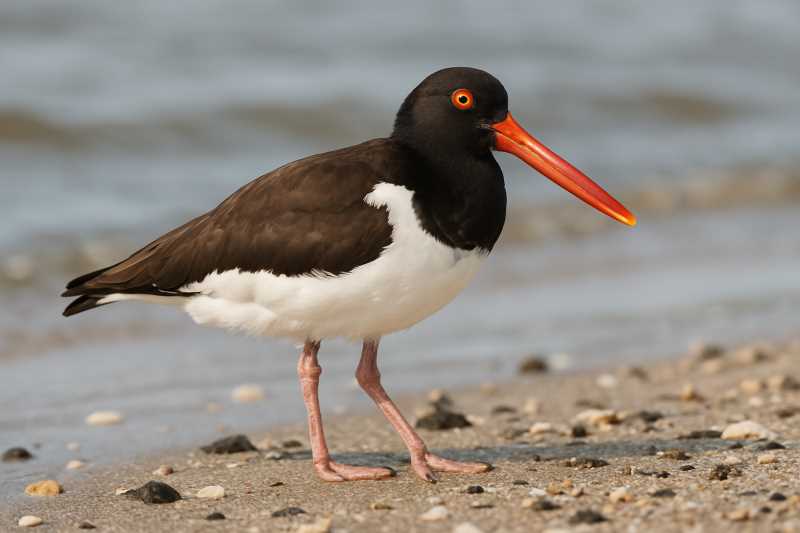
The American Oystercatcher (Haematopus palliatus) is a striking shorebird found along the Atlantic and Gulf coasts of North America, as well as parts of Central and South America. With its bold black-and-white plumage, vivid orange-red bill, and loud piping calls, it is one of the most charismatic and easily recognizable coastal birds. Beyond its photogenic appearance, the American Oystercatcher plays a crucial role in shoreline ecosystems, particularly in managing populations of bivalves such as oysters, clams, and mussels.
As coastal habitats face increasing threats from development, rising sea levels, and human disturbance, the American Oystercatcher serves as both an ambassador for conservation and a barometer of shoreline health.
Identification and Physical Description
The American Oystercatcher is a large, stocky shorebird measuring 42–52 cm (16.5–20.5 inches) in length, with a wingspan of 76–91 cm (30–36 inches). It features a black head and upper breast that sharply contrast with its white underparts and brown back. The most distinctive feature is its long, straight, bright orange-red bill, which is perfectly adapted for prying open shellfish.
The bird’s eyes are yellow with an orange orbital ring, giving it an alert and expressive look. Both sexes appear similar, though males may be slightly larger with a more robust bill. Juveniles are duller in coloration, with a shorter bill and mottled plumage.
The American Oystercatcher’s powerful bill is not only its defining trait but also its primary tool for survival, used to expertly open mollusks or sever their adductor muscles with precision.
Range and Habitat
American Oystercatchers are found along the Atlantic Coast from New England to Florida, around the Gulf of Mexico, and sporadically along the Pacific Coast and Caribbean. Southern populations extend into Central and South America, where they often overlap with related subspecies.
They inhabit sandy beaches, tidal flats, salt marshes, and oyster reefs—environments that provide both feeding and nesting opportunities. Their strong preference for undeveloped or minimally disturbed habitats makes them vulnerable to coastal development and recreational pressures.
During winter, many northern breeders migrate southward, though some remain year-round along the southeastern U.S. and Gulf Coast.
Behavior and Feeding Ecology
True to their name, American Oystercatchers specialize in feeding on shellfish. Their diet includes oysters, clams, mussels, and other marine invertebrates, which they extract using their chisel-like bill. Depending on the species of prey and its accessibility, oystercatchers may use different techniques: hammering the shell to break it open, stabbing to sever the muscle holding the shell shut, or prying it open after weakening the hinge.
They are most active during low tide when intertidal areas are exposed. Foraging often occurs in pairs or small groups, and the birds will walk slowly across mudflats or sandbars, using sight and touch to locate prey.
Vocal and territorial, American Oystercatchers emit high-pitched “wheep” or “kleeep” calls, especially during courtship or when defending nesting areas.
Breeding and Reproduction
Breeding begins in late spring. Pairs form strong bonds and return to the same territory each year. Courtship includes synchronized flight displays, mutual calling, and offering of small prey items.
The nest is a shallow scrape in sand or shell-covered substrate, often lined with bits of shell or pebbles. It is typically located above the high-tide line but within close proximity to feeding grounds. The female lays 2–4 eggs, which are camouflaged to blend in with their surroundings.
Both parents share incubation duties over a period of about 24–28 days. After hatching, the precocial chicks remain with the adults and are fed by them for several weeks. Fledging occurs at around 35–45 days, but young may continue to rely on adults for food even after they can fly.
Nest success can be heavily influenced by disturbance, flooding, and predation from raccoons, gulls, and foxes.
Conservation and Threats
The American Oystercatcher is listed as a species of Least Concern by the IUCN globally, but regional populations—especially in the northeastern United States—are considered vulnerable due to low reproductive success and ongoing habitat threats.
Key challenges include:
- Coastal Development: Loss of nesting and feeding areas due to urbanization and infrastructure.
- Human Disturbance: Recreational beach use during the nesting season can lead to nest abandonment or chick mortality.
- Sea Level Rise: Climate change-induced sea level rise threatens to inundate nesting sites.
- Predation: Increased predator presence in disturbed areas can severely impact nesting success.
Conservation efforts are focused on habitat protection, predator control, and public education. Protected areas, managed nesting sites, and community engagement have proven effective in boosting breeding success in some regions.
A Coastal Guardian Worth Protecting
The American Oystercatcher is more than a striking presence on the shoreline—it is a vital player in the health of intertidal ecosystems and a flagship species for coastal conservation. Its specialized feeding habits, site fidelity, and sensitivity to environmental changes make it an important indicator of ecosystem integrity.
By protecting the habitats that support the American Oystercatcher, we also safeguard a host of other coastal species and preserve the natural beauty and biodiversity of our shorelines for future generations.
Related posts