Introduction
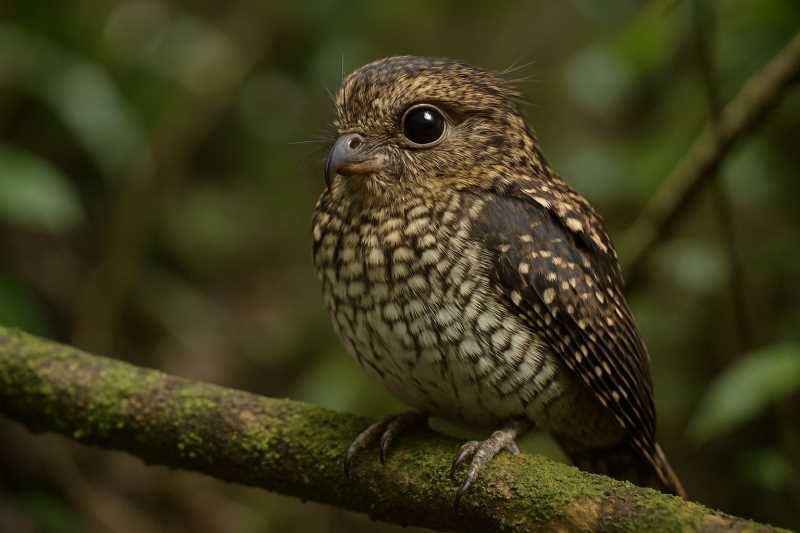
The Moluccan Owlet-nightjar (Aegotheles crinifrons) is a secretive nocturnal bird of the northern Moluccas in Indonesia. It belongs to the small Australasian family Aegothelidae and is also known as the Long-whiskered Owlet-nightjar. Its restricted island range, cryptic plumage and quiet forest habits make it a difficult species to observe, even where it is locally present.
Physical Description
The Moluccan Owlet-nightjar is a medium-sized owlet-nightjar, measuring approximately 29 centimetres in length. Published specimen measurements indicate a body mass of roughly 136 to 167 grams, although individual weights vary.
Its plumage is predominantly cryptic, with brown, greyish and rufous-chestnut tones that help it blend with bark, shadow and dense foliage. The bird has a broad head, large dark eyes, a short bill surrounded by conspicuous bristles and a relatively long, rounded tail. The facial bristles are particularly useful for identification and account for the alternative name Long-whiskered Owlet-nightjar.
Males and females are similar in general appearance. Detailed information on age-related plumage differences is limited, and immature birds are not as well documented as adults.
Range and Habitat
The species is endemic to the northern Moluccas of Indonesia. Its documented range includes Halmahera, Bacan and Kasiruta, although records are uneven because the bird is nocturnal and difficult to detect.
It occurs in primary forest, mature secondary forest, lightly logged forest, forest edges and, in some areas, cultivated landscapes such as coconut plantations. Recorded elevations range from near sea level to approximately 1,800 metres, with the upper limit varying between islands. On Halmahera, it has been recorded from lowland habitats to about 1,250 metres.
The Moluccan Owlet-nightjar is regarded as resident rather than migratory. Its dependence on forested habitats makes the retention of mature trees and natural vegetation important, particularly on islands where suitable habitat is naturally limited.
Where to See This Species
The Moluccan Owlet-nightjar is rarely seen, and most encounters involve an individual heard at dusk or detected during night birding. Visits should be arranged with local guides and relevant protected-area authorities. Playback should be used sparingly and in accordance with local birding and conservation guidelines.
Aketajawe-Lolobata National Park, North Maluku, Indonesia
This large protected area on Halmahera contains suitable lowland and hill forest, and the species is documented from the park and surrounding Halmahera forest. It is a realistic destination for observers joining guided nocturnal birding or broader Halmahera endemic-bird surveys. Night drives, forest-edge routes and quiet trails may be more productive than daytime searching.
Nearby accommodation: Subaim and other settlements around the park provide practical gateway accommodation, including simple guest houses and locally arranged stays. Sofifi may offer a wider choice of hotels and guest houses for travellers using the provincial capital as a base.
Gunung Sibela, Bacan Island, North Maluku, Indonesia
The Gunung Sibela Key Biodiversity Area on Bacan includes the Moluccan Owlet-nightjar among its documented bird species. Forested slopes and remaining mature vegetation provide appropriate habitat, but access can be difficult and sightings are likely to be infrequent. A local guide with knowledge of the reserve and night-birding conditions is strongly recommended.
Nearby accommodation: Labuha is the main practical gateway on Bacan Island, with small hotels, guest houses and locally arranged accommodation available for visitors travelling towards the Gunung Sibela area.
Behaviour and Diet
The Moluccan Owlet-nightjar is primarily nocturnal, with activity beginning around dusk and continuing through the night. It is usually encountered alone rather than in groups. During the day, it is likely to remain concealed in dense vegetation, among branches or in other sheltered positions where its camouflage is effective.
Like other owlet-nightjars, it feeds mainly on insects and other small invertebrates. It commonly hunts by making short sallies from a perch to capture flying prey, although prey may also be taken from vegetation or the ground. Beetles, moths and other nocturnal insects are likely components of its diet, but detailed species-specific dietary studies are limited.
Its calls are an important means of detection. The voice has been described in field reports as a soft, fading or multi-syllabled call. Vocal activity may increase around dusk and during territorial or breeding activity, but the full range of its vocal behaviour remains poorly documented.
Breeding information is scarce. Owlet-nightjars generally use tree hollows or other natural cavities, and the Moluccan Owlet-nightjar is associated with forest containing suitable mature trees. The timing of breeding, clutch size and parental care are not sufficiently documented to describe confidently in detail.
Identification Tips
Look and listen for the following combination of features:
- A medium-sized, compact nocturnal bird, approximately 29 centimetres long.
- Cryptic brown, greyish and rufous-chestnut plumage that can resemble bark or shadow.
- Large dark eyes and a broad head.
- Prominent bristles around the bill, giving the face a whiskered appearance.
- A relatively long, rounded tail and short, rounded wings.
- Solitary behaviour in forest, particularly around dusk and during the night.
- A soft, unusual call that may be easier to detect than the bird itself.
It should not be confused with a true owl or a typical nightjar. Owlet-nightjars are a distinct Australasian group, and their broad head, facial bristles, compact shape and forest-roosting habits help separate them from most owls and nightjars. On Halmahera and Bacan, the species’ restricted range is also a useful identification aid.
Conservation Status
The Moluccan Owlet-nightjar is currently assessed as Least Concern on the IUCN Red List. This category does not mean that the species is common or easy to find. It has a restricted island distribution and is described as scarce in parts of its range, while reliable information on its population size and long-term trend remains limited.
The principal conservation concern is the loss and degradation of forest through logging, agricultural expansion, mining and other land-use changes. Protection of remaining forest on Halmahera and Bacan, maintenance of mature trees and improved monitoring of nocturnal forest birds are important conservation measures. Protected areas such as Aketajawe-Lolobata National Park and Gunung Sibela provide valuable habitat, but effective management and local community involvement remain essential.
Frequently Asked Questions
Where is the Moluccan Owlet-nightjar found?
It is endemic to the northern Moluccas of Indonesia, with documented records from Halmahera, Bacan and Kasiruta.
Is the Moluccan Owlet-nightjar an owl?
No. Despite its name and owl-like appearance, it belongs to the family Aegothelidae, a distinct Australasian group related to nightjars and frogmouths.
What does the Moluccan Owlet-nightjar eat?
It feeds mainly on insects and other small invertebrates, usually catching prey during short flights from a perch or taking it from vegetation and the ground.
When is the best time to look for this species?
The best opportunity is around dusk or during the night, when the bird becomes active. Listening for calls during guided nocturnal surveys is often more productive than searching visually.
Is the Moluccan Owlet-nightjar endangered?
It is currently assessed as Least Concern, although forest loss and degradation remain important concerns because the species has a restricted island range.
Can the Moluccan Owlet-nightjar be seen in a national park?
Yes. It is documented from Aketajawe-Lolobata National Park on Halmahera. It is also documented from the Gunung Sibela Key Biodiversity Area on Bacan, although sightings at both locations are likely to be infrequent.
References
- BirdLife International
- IUCN Red List of Threatened Species
- Thane K. Pratt, The Auk, species-limits and morphological study of owlet-nightjars
Related posts