The Enigmatic Jackson’s Widowbird: A Marvel of Avian Evolution
The Jackson’s Widowbird (Euplectes jacksoni) remains one of the most captivating avian species due to its striking appearance and fascinating behavioral patterns. Native to the grasslands of East Africa, particularly in Kenya and Uganda, this bird is a testament to the intricate processes of natural selection and sexual selection that drive evolutionary change.
Taxonomy and Distribution
Belonging to the family Ploceidae, Jackson’s Widowbird is one of several species in the genus Euplectes. Its closest relatives include other widowbirds and bishops, which are similarly known for their dramatic plumage and complex mating displays. The species was first described by Sharpe in 1891 and named in honor of Frederick Jackson, a British administrator and ornithologist who contributed significantly to the understanding of East African wildlife.
Jackson’s Widowbird is primarily found in montane grasslands and open moorlands at elevations between 1,500 to 2,500 meters. Its distribution is largely restricted to the highland regions of Kenya and Uganda, where it relies on specific habitat conditions to thrive.
Physical Characteristics
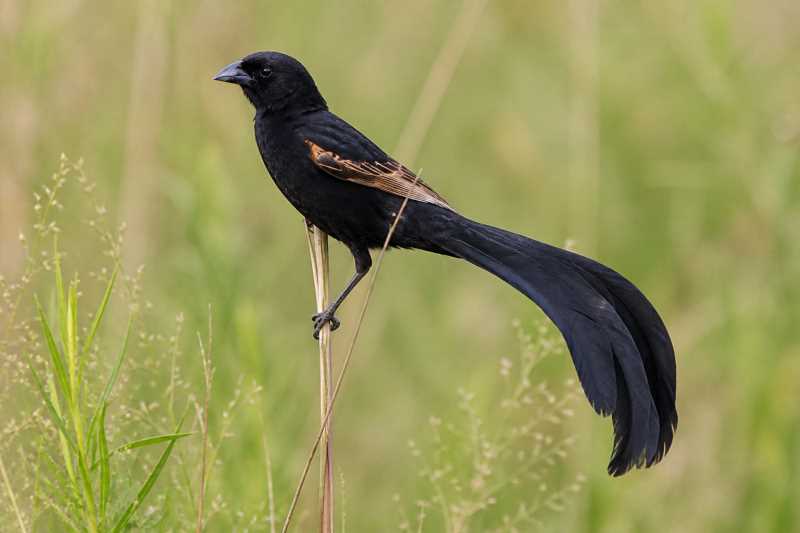
The most striking feature of the Jackson’s Widowbird is the male’s breeding plumage. During the breeding season, males undergo a dramatic transformation, shedding their non-descript brownish feathers for a flamboyant display of glossy black plumage with elongated tail feathers, which can extend up to half a meter. This tail, though cumbersome in flight, is an essential component of the male’s courtship display and a classic example of sexual selection.
Females, by contrast, retain a more subdued coloration throughout the year—a brown and streaky plumage that provides effective camouflage against predators in their grassland habitat.
Behavioral Patterns
The breeding season is a spectacle of aerial displays and territorial disputes. Males establish and defend territories within suitable breeding habitats, performing elaborate flight displays to attract females. These displays often involve soaring and gliding with the elongated tail feathers splayed out, showcasing their physical prowess and genetic fitness.
Females select mates based on these displays, with preference given to males that exhibit the most impressive aerial maneuvers and the longest tails. Once a male has successfully attracted a female, he leads her to his territory, where she inspects potential nesting sites.
Nesting and Reproduction
Nesting occurs in dense grass tussocks, which provide protection from predators and harsh weather. The female is solely responsible for constructing the nest, incubating the eggs, and caring for the young. Clutch sizes typically range from two to four eggs, with an incubation period of about two weeks.
Chicks are born altricial, meaning they are initially helpless and require significant parental care. The female feeds the chicks a diet rich in insects, which are abundant in their grassland habitat. Fledging occurs approximately two to three weeks after hatching, at which point the young birds begin to explore their environment under the watchful eye of their mother.
Conservation Status
Currently, Jackson’s Widowbird is classified as Near Threatened by the International Union for Conservation of Nature (IUCN). Habitat loss due to agricultural expansion, overgrazing, and human settlement poses significant threats to its survival. Conservation efforts are focused on preserving the montane grassland ecosystems that are crucial to the species’ reproductive success.
In addition, climate change poses an emerging threat, potentially altering the distribution and quality of suitable habitats. Conservationists emphasize the importance of habitat protection and restoration, as well as community engagement in sustainable land-use practices.
The Role of Jackson’s Widowbird in the Ecosystem
Jackson’s Widowbird plays a vital role in the ecosystems it inhabits. As an insectivorous bird, it helps control insect populations, contributing to the ecological balance of its habitat. Furthermore, its presence is an indicator of healthy grassland ecosystems, as the species is sensitive to environmental changes and habitat quality.
Conclusion
Jackson’s Widowbird is a fascinating example of the complexities of avian evolution and the power of sexual selection. Its striking appearance and intricate behaviors are a testament to the dynamic processes that shape biodiversity. As we continue to study and appreciate this remarkable species, it becomes increasingly clear that preserving its habitat is not only crucial for its survival but also for maintaining the ecological integrity of East Africa’s montane grasslands.
Through concerted conservation efforts and a commitment to sustainable development, we can ensure that future generations will have the opportunity to witness the breathtaking displays of Jackson’s Widowbird and the diverse ecosystems it calls home.
Related posts