Introduction
The Blue-billed Teal, Spatula hottentota, is a small dabbling duck of sub-Saharan Africa and Madagascar. It is associated mainly with shallow freshwater wetlands, including marshes, lakes, floodplains and vegetated pools. The species was formerly widely known as the Hottentot Teal, but Blue-billed Teal is the current common name used by major modern bird checklists. (ww.worldbirdnames.org)
Physical Description
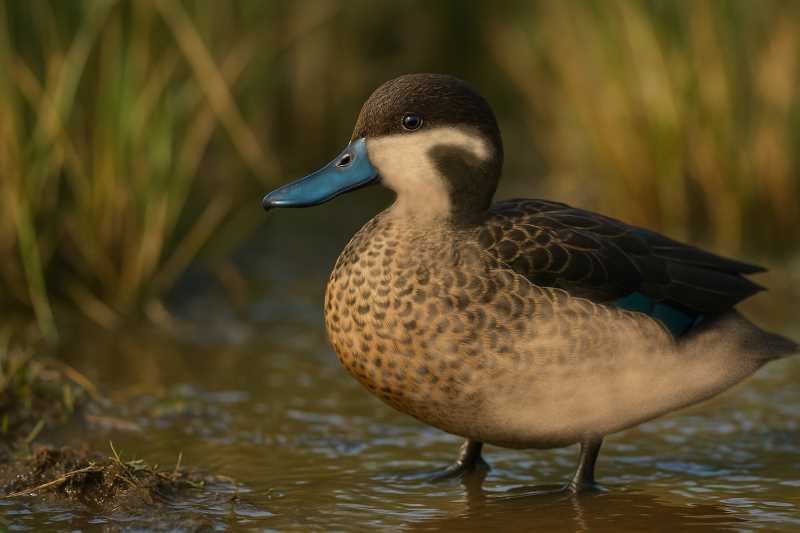
The Blue-billed Teal is approximately 30–35 cm long and weighs about 240–280 g. It is one of the smallest dabbling ducks. Both sexes have a dark crown and nape, pale buff cheeks and throat, brown upperparts edged with lighter feathers, and a mottled breast and belly. The bill is blue-grey with a darker central stripe, while the legs and feet are grey. A green iridescent wing speculum is visible when the bird is in flight or stretching its wings. (seaworld.org)
Males are generally more strongly marked, particularly on the breast, while females tend to appear paler below and more heavily mottled on the flanks. Juveniles are duller and less distinctly patterned than adults. The species is currently treated as monotypic, with no recognised subspecies. (en.wikipedia.org)
Range and Habitat
The Blue-billed Teal occurs across parts of sub-Saharan Africa, with records extending from western Africa through eastern and southern Africa, as well as Madagascar. Its distribution is broad but uneven, reflecting the scattered and seasonal nature of suitable wetlands. (waterfowl.org.uk)
It favours shallow freshwater habitats with open water and aquatic or emergent vegetation. Important habitats include marshes, small lakes, floodplains, pools and wetland margins. The species may also use modified wetlands where suitable feeding and cover remain available. It is not considered endemic to a single country or region, and its movements vary geographically. Some populations are largely resident, while others make local or short-distance movements in response to rainfall and changing water levels. (waterfowl.org.uk)
Behaviour and Diet
Blue-billed Teals are usually encountered singly, in pairs or in small groups. They are often most active during the cooler parts of the day and may rest among dense vegetation during periods of disturbance or heat. Their calls are relatively soft, and courtship includes coordinated head and body movements, wing-stretching and other display behaviour. (lpzoo.org)
As dabbling ducks, they feed mainly at the water surface or in shallow water. Their diet includes seeds, aquatic plants and other vegetable matter, supplemented by small aquatic invertebrates such as insects, crustaceans and molluscs. Surface feeding, dipping and occasional upending allow them to exploit both open water and vegetated wetland margins. (seaworld.org)
Breeding can occur at different times of year across the species’ range and is often associated with local rainfall and the availability of suitable wetlands. The nest is built on or close to the ground, usually concealed in dense vegetation. A documented breeding study recorded clutches of about six to eight eggs and an incubation period of approximately 25–27 days, with the female undertaking incubation while the male may remain nearby. (tandfonline.com)
Identification Tips
Look for the following combination of features:
- Very small size and compact proportions.
- Dark crown and nape contrasting with pale buff cheeks and throat.
- Blue-grey bill with a darker central stripe.
- Brown, finely mottled body, with stronger spotting on the breast.
- Green wing speculum, most obvious in flight or during wing-stretching.
- Grey legs and feet.
The Blue-billed Teal can be confused with other small African teals, especially at a distance. The blue-grey bill and dark-capped, pale-cheeked head pattern are useful identification features. The Red-billed Teal, Anas erythrorhyncha, has a distinctly red bill, while the larger Cape Shoveler, Spatula smithii, has a noticeably broader, more shovel-shaped bill. (theworldbirds.org)
Conservation Status
The Blue-billed Teal is currently assessed as Least Concern. Its wide geographic range and occurrence in many wetlands support this assessment, although a precise global population estimate is not given here. (worldbirdnames.com)
The species depends on functioning wetlands, so local populations may be affected by wetland drainage, conversion for agriculture, excessive water abstraction, pollution and changes in flooding patterns. These pressures are particularly important where shallow wetlands are seasonal or isolated. Climate change may further alter rainfall, water availability and the timing of breeding, although the scale of its effect on the global population remains uncertain.
Conservation measures should focus on protecting and restoring freshwater wetlands, maintaining natural water regimes, reducing pollution and incorporating wetland requirements into agricultural and water-management planning. Regular monitoring is also valuable because local declines may occur even when a species remains widespread and globally assessed as Least Concern.
Frequently Asked Questions
Where does the Blue-billed Teal live?
The Blue-billed Teal occurs in parts of sub-Saharan Africa and Madagascar. It is most often associated with shallow freshwater wetlands, including marshes, lakes, floodplains and vegetated pools.
What does the Blue-billed Teal look like?
It is a very small duck with a dark crown, pale cheeks and throat, mottled brown plumage, a blue-grey bill with a dark central stripe, grey legs and a green wing speculum.
What does the Blue-billed Teal eat?
Its diet consists mainly of seeds, aquatic plants and other vegetable matter, together with small aquatic invertebrates such as insects, crustaceans and molluscs.
Is the Blue-billed Teal migratory?
Movement varies across its range. Some populations are largely resident, while others make local or short-distance movements in response to rainfall, water levels and wetland conditions.
Where does the Blue-billed Teal build its nest?
The nest is usually placed on or close to the ground and concealed among dense vegetation near suitable water. Breeding timing varies geographically and is often linked to rainfall.
Is the Blue-billed Teal endangered?
No. The species is currently classified as Least Concern, although local populations may be affected by wetland loss, water pollution, altered flooding patterns and other forms of habitat degradation.
References
- BirdLife International. n.d. BirdLife DataZone. BirdLife International. Available at: https://datazone.birdlife.org/ (accessed 8 September 2026).
- BirdLife South Africa. n.d. Waterbirds: Blue-billed Teal, Spatula hottentota. BirdLife South Africa. Available at: https://www.birdlife.org.za/red-data-book/bird-group/waterbirds/ (accessed 8 September 2026).
- British Waterfowl Association. n.d. Blue-billed Teal, Spatula hottentota. British Waterfowl Association. Available at: https://www.waterfowl.org.uk/wildfowl/true-ducks/blue-billed-teal/ (accessed 8 September 2026).
- Clark, A. 1969. The breeding of the Hottentot Teal. Ostrich 40(2): 33–36. https://doi.org/10.1080/00306525.1969.9634326.
- Gill, F., Donsker, D. and Rasmussen, P., eds. 2026. IOC World Bird List, version 15.2. International Ornithologists’ Union. Available at: https://www.worldbirdnames.org/ (accessed 8 September 2026).
- Lincoln Park Zoo. n.d. Blue-billed Teal, Spatula hottentota. Lincoln Park Zoo. Available at: https://www.lpzoo.org/animals/blue-billed-teal/ (accessed 8 September 2026).
- Oiseaux.net. n.d. Blue-billed Teal, Spatula hottentota. Available at: https://www.oiseaux.net/en/oiseaux/blue-billed.teal.html (accessed 8 September 2026).
- World Bird Names. n.d. Hottentot Teal, Spatula hottentota. Available at: https://www.worldbirdnames.com/bird/hottentot-teal/430.html (accessed 8 September 2026).
Related posts