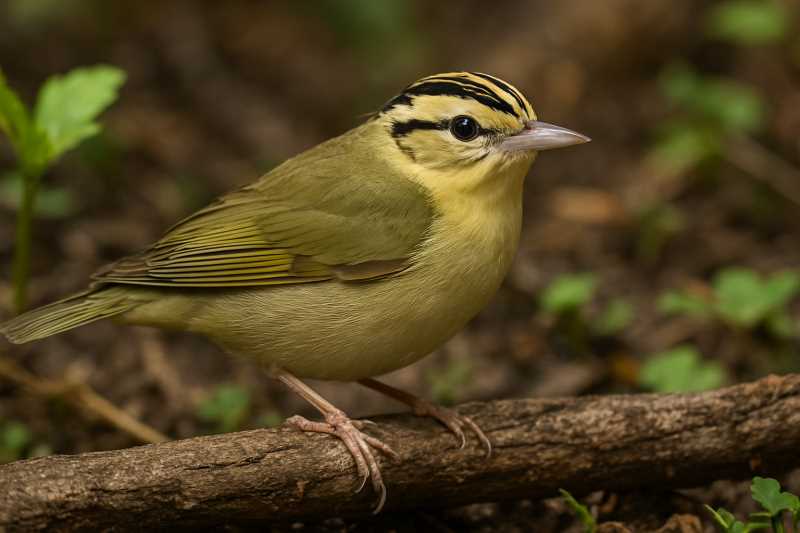
The Worm-eating Warbler: An Unassuming Gem of the Forest Understory
The Worm-eating Warbler (*Helmitheros vermivorum*) is a captivating yet often overlooked member of the New World warbler family. Despite its understated plumage, this bird plays a significant role in the ecosystems it inhabits. Found primarily in the deciduous forests of the eastern United States during the breeding season, the Worm-eating Warbler migrates to Central America and the Caribbean for the winter months. This article delves into the intricacies of the Worm-eating Warbler’s life, including its habitat, diet, behavior, and conservation status.
Habitat and Distribution
The Worm-eating Warbler favors mature deciduous or mixed forests, where it can find ample leaf litter and dense understory vegetation. These environments are most prevalent in the Appalachian Mountains and the surrounding regions, which provide the perfect combination of resources. During migration, these warblers can be found in a variety of forested habitats, including secondary growth and scrubby areas, often along the Gulf Coast.
Their wintering grounds are equally diverse, stretching from southern Mexico through Central America to northern South America, including the Caribbean islands. Here, they occupy humid tropical forests, favoring areas with thick undergrowth where they can continue their leaf-litter foraging.
Diet and Feeding Behavior
Contrary to what their name might suggest, Worm-eating Warblers do not primarily consume worms. Instead, their diet mainly consists of insects and other invertebrates, which they glean from leaves and branches. They are particularly adept at foraging in the leaf litter on the forest floor, using their sharp bills to probe for prey hidden among the debris.
Caterpillars are a favored food source, along with spiders, beetles, and other small insects. This diet plays a crucial role in controlling the populations of these invertebrates, thus maintaining the balance within their ecosystem.
Breeding and Nesting
The breeding season for the Worm-eating Warbler typically begins in late April and extends through early July. Males arrive at the breeding grounds first and establish territories by singing a dry, insect-like trill. This song helps them attract females and ward off rival males.
Nesting occurs on or near the ground, often hidden in dense leaf litter or at the base of shrubs. The female builds the nest, a cup-like structure made from grasses and leaves, lined with finer materials for insulation. She lays a clutch of four to five eggs, which she incubates for about 12 to 14 days.
Both parents participate in feeding the chicks, which fledge approximately 10 to 12 days after hatching. The reliance on ground-level nesting sites makes the Worm-eating Warbler particularly vulnerable to predation and habitat disturbance.
Migration Patterns
The Worm-eating Warbler is a long-distance migrant, traveling thousands of miles between its breeding and wintering grounds. Migration typically occurs at night, allowing the birds to take advantage of cooler temperatures and avoid predators.
During the spring and fall migrations, these warblers are often seen in mixed-species flocks, which can include other warbler species, vireos, and flycatchers. This social behavior likely provides safety in numbers, reducing the risk of predation.
Conservation Status
Currently, the Worm-eating Warbler is classified as a species of “Least Concern” by the International Union for Conservation of Nature (IUCN). However, it faces several threats that could impact its populations in the future. Habitat loss due to deforestation and land development is a significant concern, particularly in its wintering grounds in Central America.
Climate change also poses a threat, as shifting weather patterns could alter the availability of suitable habitats and food sources. Conservation efforts aimed at preserving large tracts of mature forests and protecting migratory corridors are essential to ensure the continued survival of this species.
Conclusion
The Worm-eating Warbler may not boast the vibrant colors of some of its warbler relatives, but its subtle beauty and ecological importance make it a species worthy of attention. By understanding and conserving the habitats this bird relies on, we can help ensure that the Worm-eating Warbler continues to grace our forests with its presence for generations to come.
References
– American Ornithological Society
– Cornell Lab of Ornithology
– International Union for Conservation of Nature (IUCN)
—
Related posts