Introduction
The Brown Violetear (Colibri delphinae) is a medium-sized hummingbird in the family Trochilidae. It is recognised by its mainly brown and grey plumage, violet ear patches and contrasting green-blue throat. The species occurs patchily from Central America through northern and western South America, with isolated populations on Trinidad and in Bahia, Brazil. (datazone.birdlife.org)
Physical Description
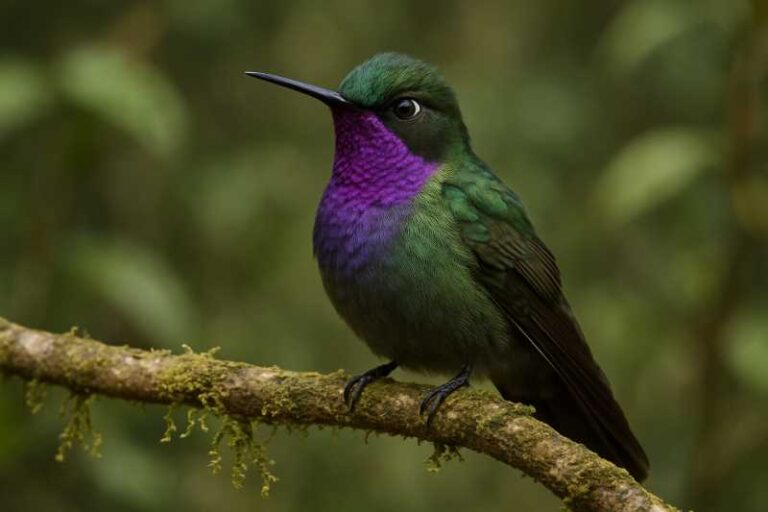
The Brown Violetear measures approximately 11–12 centimetres in length and weighs about 6.5–7 grams. Its body is mostly dull olive-brown or grey-brown, with a rufous-toned rump, a dusky tail and paler greyish underparts.
The most distinctive markings are the violet patches behind the eyes and the iridescent green-blue throat patch. The bill is relatively short, thin and almost straight. Both sexes are similar, although females usually have a smaller throat patch. Juveniles show more rufous or orange-edged plumage and little or no violet behind the eyes. (sta.uwi.edu)
Range and Habitat
The Brown Violetear has a broad but uneven distribution from Belize and Guatemala through Central America, and across parts of Colombia, Venezuela, Ecuador, Peru, Bolivia, Guyana, Suriname, Brazil and Trinidad. Its distribution is patchy in many regions, and isolated populations occur outside the main Andean range. (datazone.birdlife.org)
It commonly inhabits humid montane and foothill forest, tall secondary growth, forest edges, clearings and coffee plantations. During the breeding season it is generally associated with elevations of about 400–1,600 metres, although it can descend into lower areas outside the breeding period. The species is generally resident but may make local or altitudinal movements in response to flowering and seasonal conditions. (sta.uwi.edu)
Where to See This Species
Las Tángaras ProAves Reserve, Chocó, Colombia
Brown Violetears have been recorded at Las Tángaras ProAves Reserve, where humid premontane and lower montane forest provide suitable habitat. The reserve covers a broad elevational range, has forest trails and operates hummingbird-feeding stations, making it a realistic place to search for the species among forest edges, clearings and flowering plants. Visits should be arranged in advance, as access and transport within the reserve may require planning. (exoticbirding.com)
Nearby accommodation: The reserve itself provides lodge accommodation. Additional guest houses, small hotels and other practical accommodation are available in and around Carmen de Atrato.
Behaviour and Diet
Brown Violetears are usually solitary outside the breeding period. They forage at different levels of the forest, often feeding in the canopy or subcanopy but descending to edges and clearings when visiting flowers.
Their diet consists mainly of nectar from small flowers of trees, shrubs and epiphytes. They also take small insects and other arthropods, sometimes catching them in flight. Nectar-rich flowering plants may be defended aggressively, and individuals can spend considerable time chasing other hummingbirds from feeding areas.
The species is notably vocal for a hummingbird. Its call is a sharp, rough repeated note, and breeding males may gather in loose display groups or leks. Males perform aerial displays, including curved or U-shaped flights, while displaying their iridescent throat and ear patches. There is no lasting pair bond, and the male does not participate in nest construction or parental care. (sta.uwi.edu)
The female builds a small cup-shaped nest from plant fibres, moss and other soft material, usually on a branch about 1–3 metres above the ground. She lays a small clutch, usually two white eggs, and is solely responsible for incubation and feeding the young. (sta.uwi.edu)
Identification Tips
Look for a medium-sized hummingbird with an otherwise subdued brown or grey-brown appearance but bright violet patches behind the eyes. The green-blue throat patch can be difficult to see unless the bird turns towards the light.
Useful field marks include:
- A relatively short, thin and nearly straight bill.
- A pale or greyish underside contrasting with the darker upperparts.
- A rufous-toned rump and dusky tail.
- Violet ear patches that may appear raised or become conspicuous during display.
- A rapid, purposeful flight and a tendency to chase other hummingbirds from flowers or feeders.
The Brown Violetear can be confused with other Colibri species. It is generally browner and less brilliantly green than the Lesser Violetear, while the violet ear patches and subdued plumage help distinguish it from the more boldly coloured Sparkling Violetear. (ebird.org)
Conservation Status
The Brown Violetear is currently classified as Least Concern. Its broad geographic range means that it does not currently meet the thresholds for a threatened category, although forest clearance, agricultural expansion and the loss or degradation of flowering habitat remain potential local threats. Protecting humid forest, maintaining connected habitat and conserving shade-grown agricultural landscapes can benefit the species. (datazone.birdlife.org)
Frequently Asked Questions
Where does the Brown Violetear live?
It occurs patchily from Central America through northern and western South America, with isolated populations on Trinidad and in Bahia, Brazil. It is mainly associated with humid forest and forest-edge habitats at middle elevations.
What does a Brown Violetear look like?
It is mainly brown or grey-brown, with a rufous rump, pale underparts, violet patches behind the eyes and a green-blue throat patch. The bill is short and nearly straight.
What does the Brown Violetear eat?
It feeds mainly on nectar from small flowers of trees, shrubs and epiphytes. It also catches insects and other small arthropods, which provide an important source of protein.
Is the Brown Violetear migratory?
It is generally resident, but it may move locally or up and down mountain slopes as flowering conditions and seasons change. It does not normally migrate in large flocks.
Where can I see a Brown Violetear?
One documented wildlife-viewing location is Las Tángaras ProAves Reserve in Chocó, Colombia. Search humid forest edges, flowering plants, clearings and hummingbird-feeding areas, particularly during the morning.
Is the Brown Violetear endangered?
No. The species is currently assessed as Least Concern, although habitat loss and the degradation of forest and flowering resources can affect local populations.
References
- BirdLife International
- University of the West Indies, The Online Guide to the Animals of Trinidad and Tobago
- ProAves Colombia
Related posts