Introduction
The Buffy Helmetcrest (Oxypogon stuebelii) is a small, range-restricted hummingbird endemic to Colombia. It inhabits high-elevation páramo in the Central Andes, particularly around Nevado del Ruiz and within Los Nevados National Natural Park. Its peaked crest, contrasting beard and dependence on flowering páramo plants make it one of the most distinctive birds of this specialised ecosystem.
Physical Description
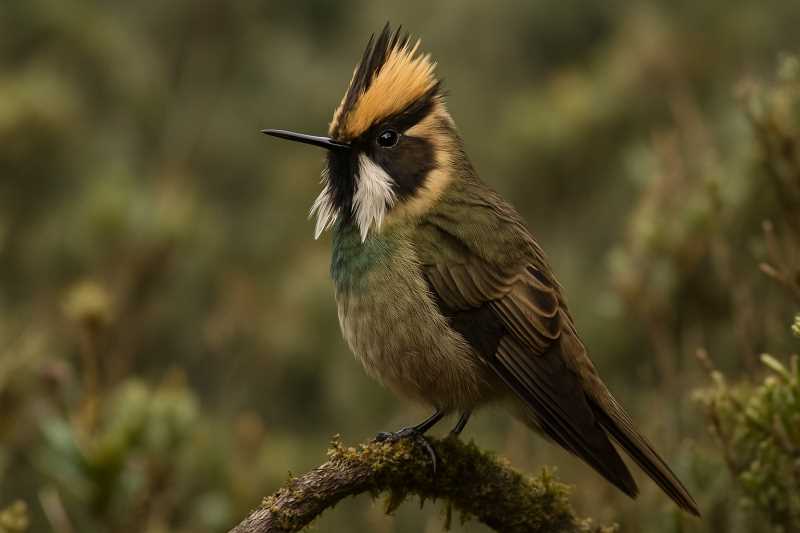
The Buffy Helmetcrest measures approximately 11.2–12.7 centimetres in length. It has a relatively large body, short straight bill, moderately long forked tail and bronzy-green upperparts. The outer tail feathers show pale markings, while the underparts range from buff and cinnamon to brownish tones.
Adult males have a conspicuous shaggy crest, black and buff head pattern, and a glittering green and blue beard or throat patch bordered by buffy tones. Adult females are more subdued and lack the full crest and beard. They have a darker head, bronzy back and warmer buff or brown underparts. Juveniles resemble females, although young males may gradually develop elements of the crest and beard.
Range and Habitat
The Buffy Helmetcrest is resident and endemic to Colombia. Its known range is concentrated in the Central Andes, especially the high páramos surrounding Nevado del Ruiz and adjoining sectors of Los Nevados National Natural Park. Most records come from elevations of roughly 3,200–4,600 metres, although occasional records have been reported outside this range.
It favours open, humid páramo and high-Andean shrubland with abundant frailejones and other flowering plants. The species is closely associated with vegetation dominated by plants such as Espeletia and other members of the daisy family. Its distribution is highly restricted and severely fragmented, making the condition of these high-altitude habitats particularly important.
Where to See This Species
Los Nevados National Natural Park, Caldas, Risaralda, Quindío and Tolima, Colombia
Los Nevados National Natural Park is the most reliable publicly accessible area for looking for the Buffy Helmetcrest. The species is documented from the park’s high páramo, including areas around Nevado del Ruiz, the Gualí sector and other sites with abundant frailejones. Search flowering plants and exposed shrubs at high elevation, particularly during periods of good weather and active flowering. Local access conditions can vary because of altitude, weather and volcanic hazards.
Nearby accommodation: Manizales and Murillo are practical gateway settlements, with hotels, guest houses, lodges and other accommodation suitable for visits to the surrounding páramo.
Behaviour and Diet
The Buffy Helmetcrest is diurnal and usually forages close to the ground or among low shrubs. It feeds on nectar and also takes insects, insect larvae and other small arthropods. Nectar is obtained by clinging to flowers rather than continuously hovering, and the bird may use its tail for support while feeding.
Its diet includes flowers of high-Andean plants, with recorded preferences for several Asteraceae, including Pentacalia species. Males may defend feeding areas when floral resources are concentrated, but their foraging strategy can change as flower availability changes. The species is also an important pollinator of páramo plants.
Breeding information remains limited. The timing of breeding is not well established, and detailed information about courtship, nesting success and parental care is still needed. A documented nest contained two eggs and was attached to a rock, but this observation should not be treated as evidence of a universal nesting pattern.
Identification Tips
- Look for a large, short-billed hummingbird in open páramo, especially around frailejones and flowering shrubs.
- Adult males are recognised by the shaggy peaked crest, dark-and-buff head, green and blue beard, bronzy-green back and buffy underparts.
- Females and juveniles lack the prominent male crest and beard. Their warmer buff or brown plumage and relatively short bill remain useful clues.
- The bird often perches or clings to flowers instead of hovering continuously, which can make it appear less typically hummingbird-like.
- Other helmetcrests may occur in different Colombian mountain ranges. The Buffy Helmetcrest is distinguished by its restricted Central Andean range and its buffy, rather than strongly white, head and body markings.
Conservation Status
The Buffy Helmetcrest is classified as Vulnerable on the IUCN Red List. BirdLife International describes its range as very restricted and severely fragmented, with a continuing decline in habitat quality and mature individuals.
The principal threats are degradation and loss of páramo habitat through cattle grazing, agricultural expansion, pasture formation and fire. Changes in the distribution and flowering of high-altitude plants may also reduce access to nectar and affect the species’ movements and breeding prospects.
Much of the known range lies within Los Nevados National Natural Park, which provides important legal protection. Effective conservation depends on protecting remaining frailejón páramo, preventing damaging fires and grazing, restoring degraded sites, and improving monitoring of population trends, habitat use and breeding biology.
Frequently Asked Questions
Where is the Buffy Helmetcrest found?
It is endemic to Colombia and is concentrated in the high páramos of the Central Andes, particularly around Nevado del Ruiz and Los Nevados National Natural Park.
What habitat does the Buffy Helmetcrest use?
It uses open, humid páramo and high-Andean shrubland with flowering plants, especially areas containing frailejones and other Asteraceae.
How can a male Buffy Helmetcrest be identified?
The adult male has a shaggy peaked crest, a dark-and-buff head, a glittering green and blue beard, bronzy-green upperparts and buffy underparts.
Do female Buffy Helmetcrests have a crest?
Females and juveniles are less brightly marked and lack the prominent crest and beard of adult males. Their warm buff or brown plumage and short bill are useful identification features.
What does the Buffy Helmetcrest eat?
It feeds mainly on nectar, but also takes insects, larvae and other small arthropods. It commonly clings to flowers while feeding rather than hovering continuously.
Is the Buffy Helmetcrest endangered?
It is currently assessed as Vulnerable. Its very small, fragmented range and the degradation of páramo habitat through grazing, agriculture and fire are the main conservation concerns.
References
- BirdLife International
- IOC World Bird List
- Universidad de Caldas
Related posts