Introduction
The Green-fronted Lancebill (Doryfera ludovicae) is a medium-sized hummingbird of humid montane forests in Central and South America. It is named for its long, straight, lance-like bill and the bright green frontal patch that is especially conspicuous in adult males. The species is closely related to the Blue-fronted Lancebill and is one of only two species in the genus Doryfera.
Physical Description
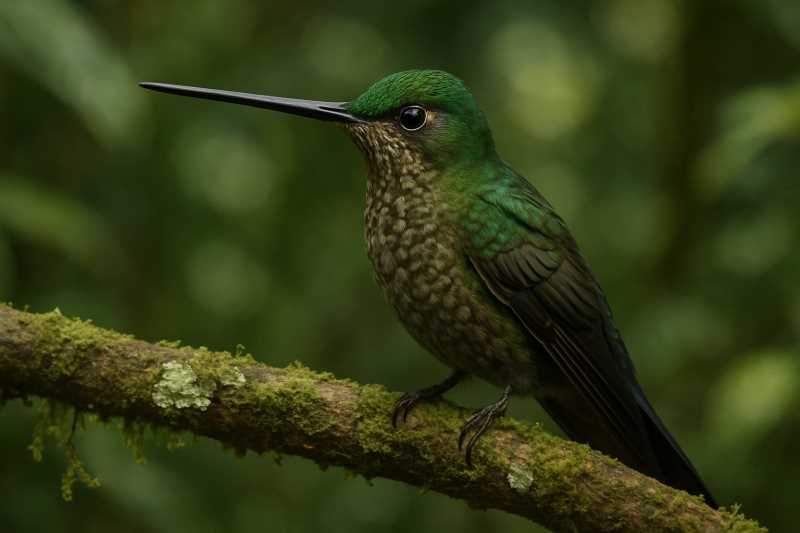
The Green-fronted Lancebill measures approximately 11–13 cm in length. It has a compact body, a long, straight bill and predominantly green upperparts. Adult males show a glittering green forehead and crown, while the underparts are generally greyish or dusky. The wings and tail are darker, creating a noticeable contrast with the brighter body plumage.
Females resemble males but are usually duller, with a less conspicuous or absent brilliant frontal patch. Juveniles are generally less brightly coloured and may show a less clearly defined forehead. The long, narrow bill is one of the most useful features for identification, particularly when the bird is seen feeding beside a stream or waterfall.
Range and Habitat
The species has a disjunct distribution. In Central America, it occurs from Costa Rica through western and eastern Panama. In South America, it ranges through the Andes from western Venezuela and Colombia southwards through Ecuador and Peru to northern Bolivia.
The Green-fronted Lancebill is associated with humid and wet montane forest, including cloud forest, mature evergreen forest and forest edges near fast-flowing streams, rivers and waterfalls. Published range information places it broadly from about 750 to 2,800 metres above sea level, although local records vary by region. It is not generally considered a long-distance migrant, but seasonal or local movements between elevations may occur in response to flowering and breeding conditions.
Two subspecies are commonly recognised: D. l. veraguensis in Costa Rica and western Panama, and the nominate D. l. ludovicae in eastern Panama and the Andes. Geographic variation is subtle and identification is best based on location as well as plumage.
Where to See This Species
Tapantí-Macizo de la Muerte National Park, Cartago, Costa Rica
Tapantí protects humid montane forest in the Costa Rican highlands and has documented records of Green-fronted Lancebill. Look along forest trails, stream corridors and other sheltered areas with dense epiphyte growth. The species may be difficult to find, so quiet observation near moving water is more productive than searching open, exposed areas.
Nearby accommodation: Orosi and the surrounding Cartago highlands provide guest houses, small hotels, lodges and self-catering accommodation.
Podocarpus National Park, Loja and Zamora-Chinchipe, Ecuador
Podocarpus contains extensive Andean montane forest within the species’ South American range, and Green-fronted Lancebill has been recorded in the park. The Cajanuma and eastern access areas offer different elevations and forest conditions, while streamside vegetation and flowering plants are suitable places to search.
Nearby accommodation: Visitors can use hotels and guest houses in Loja for the Cajanuma sector, or lodges and other accommodation in Zamora for eastern park access.
Manu National Park, Cusco and Madre de Dios, Peru
Manu protects a broad elevational range of Andean and foothill forest and includes Green-fronted Lancebill on published park bird lists. The species is most relevant to searches in humid montane and foothill forest rather than lowland floodplain habitats. Access is regulated and often requires advance arrangements with an authorised operator or park service.
Nearby accommodation: Cusco is a practical base for organised access through the Andes, while Puerto Maldonado and recognised Manu gateway settlements provide lodges, camps and other visitor accommodation for lower-elevation routes.
Behaviour and Diet
The Green-fronted Lancebill is active during daylight hours and usually forages alone. Like many hummingbirds, it obtains nectar by hovering at flowers and may defend profitable feeding areas from other hummingbirds. It is particularly associated with flowering plants in humid forest and may use regular traplines, visiting a sequence of flowering plants during the day.
Nectar is supplemented by small insects and other arthropods, which provide important protein. Adults may take insects in flight or from vegetation, and females feed insect prey to nestlings.
Breeding information is best documented from eastern Ecuador. The female builds the nest and undertakes incubation. Nests are made from moss, plant fibres and spider web, and are commonly suspended from roots, vines or other sheltered structures beside streams. Clutches usually contain one or two white eggs. Incubation lasts about 20–21 days, and nestlings remain in the nest for approximately 29–30 days.
Identification Tips
- Look for a medium-sized hummingbird with a very long, straight bill.
- Adult males show a brilliant green forehead that contrasts with the darker wings and dusky underparts.
- Search humid montane forest, especially beside rushing streams, waterfalls and dense epiphyte-covered vegetation.
- Females and juveniles are less vivid, so the bill shape, habitat and overall green upperparts are important clues.
- The similar Blue-fronted Lancebill (Doryfera johannae) has a blue rather than green frontal area. Its range also differs, although the two species can overlap in parts of the northern Andes.
Conservation Status
The Green-fronted Lancebill is currently classified as Least Concern. Its broad distribution and occurrence across several countries mean that it does not presently meet the thresholds for a threatened category. A precise global population estimate is not available.
The main conservation concern is the continuing loss and degradation of humid montane forest through deforestation, agricultural expansion, roads and other development. Protection of intact forest, stream corridors and elevational habitat is important because the species appears particularly dependent on wet forest sites near moving water. Maintaining connected montane forests also benefits the many other birds, plants and insects that share this habitat.
Frequently Asked Questions
Where does the Green-fronted Lancebill live?
It lives in humid montane and cloud forests from Costa Rica and Panama through the Andes of Venezuela, Colombia, Ecuador, Peru and northern Bolivia.
What does the Green-fronted Lancebill look like?
It is a compact green hummingbird with a long, straight bill. Adult males have a conspicuous glittering green forehead, while females and juveniles are generally duller.
Is the Green-fronted Lancebill migratory?
It is generally regarded as resident rather than a long-distance migrant. Local or seasonal movements between elevations may occur, particularly when flowering and breeding conditions change.
What does the Green-fronted Lancebill eat?
Its diet consists mainly of nectar, supplemented by small insects and other arthropods. Insects are particularly important when adults are feeding young.
Where is the best place to look for this species?
Search humid montane forest near fast-flowing streams, waterfalls and flowering plants. Tapantí-Macizo de la Muerte National Park in Costa Rica and Podocarpus National Park in Ecuador are documented viewing locations.
How does the Green-fronted Lancebill nest?
The female builds a small moss-and-fibre nest, often secured with spider web and suspended from roots, vines or another sheltered structure near a stream. The usual clutch is one or two white eggs.
References
- BirdLife International
- IOC World Bird List
- Ornitología Neotropical
Related posts