Introduction
The Sparkling-tailed Woodstar, also known as the Sparkling-tailed Hummingbird, is a small hummingbird in the family Trochilidae. Its scientific name is Tilmatura dupontii. It is the only recognised species in the genus Tilmatura and is distributed discontinuously from Mexico through parts of Central America.
Physical Description
The Sparkling-tailed Woodstar is a very small hummingbird, generally measuring about 6–10 cm in length. Males are larger and more distinctive than females, largely because of their elongated, deeply forked tails.
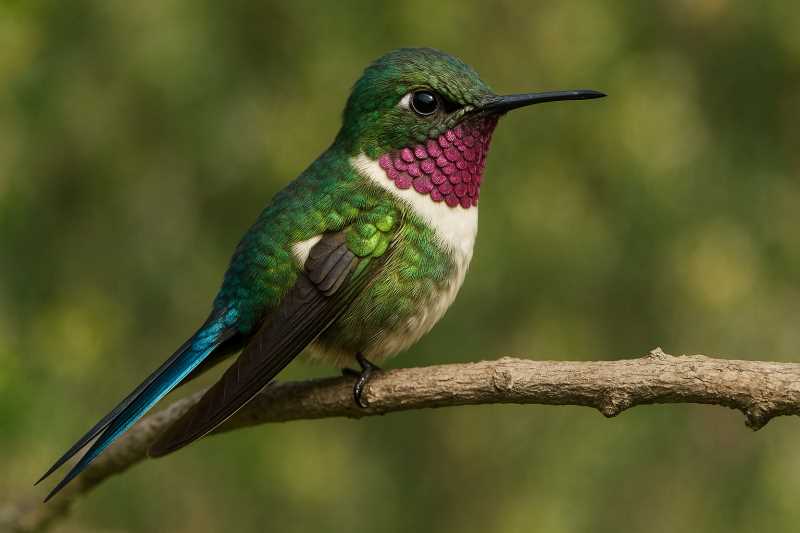
Adult males have metallic bronze-green upperparts, a greyish-white breast and belly, and a striking violet-blue throat. The long outer tail feathers are dark with contrasting pale or white markings, while the central feathers are shorter and metallic bronze-green. White patches on the sides of the rump are useful identification marks in both sexes.
Females are smaller, with a much shorter and less deeply forked tail. Their upperparts are bronze-green, while the underparts are cinnamon or rufous, often with paler areas on the breast. Immature males may resemble females before developing the adult male throat and tail pattern. Both sexes have a slender, mostly straight, dark bill.
Range and Habitat
The species has a discontinuous range extending from western and central Mexico, including areas from Sinaloa to Veracruz, south through Guatemala, El Salvador and Honduras to northern Nicaragua. It is not considered endemic to a single country.
The Sparkling-tailed Woodstar uses semi-open montane and foothill habitats, including pine-oak woodland edges, humid or seasonally dry forest margins, shrubby secondary growth and flowering clearings. It has been recorded across a broad elevational range, approximately from 500 to 2,500 metres, although local records vary considerably. In Mexico, it may also occur in tropical dry forest and disturbed woodland where flowering plants are available.
The species is generally regarded as resident rather than a long-distance migrant. Local or seasonal movements may occur in response to flowering conditions and changes in habitat resources.
Where to See This Species
Sierra de Huautla Biosphere Reserve, Morelos, Mexico
The Sparkling-tailed Woodstar has been documented in the Sierra de Huautla Biosphere Reserve. A published record from the reserve involved a male foraging on Firebush (Hamelia patens) in August, making flowering scrub and forest-edge vegetation especially useful places to search.
Nearby accommodation: Tepalcingo and surrounding communities provide the most practical base, with small guest houses, simple hotels and self-catering accommodation available in the wider area.
Lagunas de Montebello National Park, Chiapas, Mexico
A bird survey of Lagunas de Montebello National Park recorded the species in habitats including pine woodland, montane cloud forest and associated vegetation. Birders should concentrate on forest edges, open patches and flowering plants, particularly where woodland meets shrubby growth.
Nearby accommodation: The town of Comitán de Domínguez is the main practical accommodation base, with hotels, guest houses and self-catering options, while basic cabins and campsites are available closer to the park.
Behaviour and Diet
The Sparkling-tailed Woodstar is active during the day and usually forages alone. Like other hummingbirds, it can hover while feeding and manoeuvre rapidly between flowers. Its flight may appear relatively slow and insect-like when it is working scattered flowers.
Nectar forms the main part of its diet. The species visits a range of flowering shrubs and trees, and it also takes small insects and other arthropods, which provide protein and other nutrients. Individuals may move between separate flowering patches rather than remaining at one concentrated food source.
Males may defend productive feeding areas or display near flowers, but detailed information about territorial behaviour and courtship remains limited. The species’ breeding biology is poorly documented. Claims about exact incubation periods, clutch details and fledging times should therefore be treated cautiously, as the available evidence does not securely establish all of these details.
Identification Tips
Look for a tiny hummingbird in foothill or montane woodland, forest edge and flowering scrub. The most useful field marks are:
- A very small body with a slender dark bill.
- Distinctive white patches on the sides of the rump.
- In males, a brilliant violet-blue throat and a long, deeply forked tail.
- In females, cinnamon or rufous underparts and a shorter, only slightly forked tail.
- Contrasting pale or white markings in the outer tail feathers.
The long, ornate tail of the adult male is particularly distinctive. Females and immature birds can be more difficult to identify and should be assessed using the combination of size, rump patches, underpart colour, tail pattern and habitat rather than a single feature.
Conservation Status
The Sparkling-tailed Woodstar is currently assessed as Least Concern on the IUCN Red List. A reliable global population estimate and a well-supported global population trend are not available.
Local populations may be affected by the clearance and degradation of pine-oak woodland, montane forest edges, tropical dry forest and secondary vegetation. Agricultural expansion, loss of flowering plants and broader changes in land use can reduce feeding opportunities. Protecting forest remnants, maintaining native flowering vegetation and conserving habitat corridors are important practical measures, particularly in areas where the species is locally uncommon.
Frequently Asked Questions
Where can the Sparkling-tailed Woodstar be found?
It occurs discontinuously from Mexico through Guatemala, El Salvador and Honduras to northern Nicaragua. It is mainly associated with foothill and montane woodland, forest edges and flowering secondary growth.
What does the Sparkling-tailed Woodstar look like?
The male has metallic green upperparts, a violet-blue throat, pale breast and belly, and a long, deeply forked tail. The smaller female has bronze-green upperparts, cinnamon or rufous underparts and a much shorter tail.
What does the Sparkling-tailed Woodstar eat?
It feeds mainly on nectar from flowering plants and supplements this diet with small insects and other arthropods.
Is the Sparkling-tailed Woodstar migratory?
It is generally considered a resident species rather than a long-distance migrant. Local movements may occur when flowering conditions or habitat resources change.
How can the Sparkling-tailed Woodstar be identified in the field?
Look for a very small hummingbird with white patches on the sides of the rump. Adult males are especially distinctive because of their violet-blue throat and long, sparkling, deeply forked tail.
Is the Sparkling-tailed Woodstar endangered?
No. The species is currently classified as Least Concern, although habitat loss and degradation may create local pressures and conservation needs.
References
- Birds of the World
- IUCN Red List of Threatened Species
- Huitzil Revista Mexicana de Ornitología
Related posts