Introduction
The Red-faced Guan (Penelope dabbenei) is a medium-sized member of the Cracidae family, which includes guans, chachalacas and curassows. It is restricted to montane forests on the eastern slopes of the southern Andes, from southern Bolivia to north-western Argentina. Also known as Dabbene’s Guan and, in Argentina, the Aliso Forest Guan or Pava de Monte Alisera, it is a poorly known species associated with the southern Yungas.
Physical Description
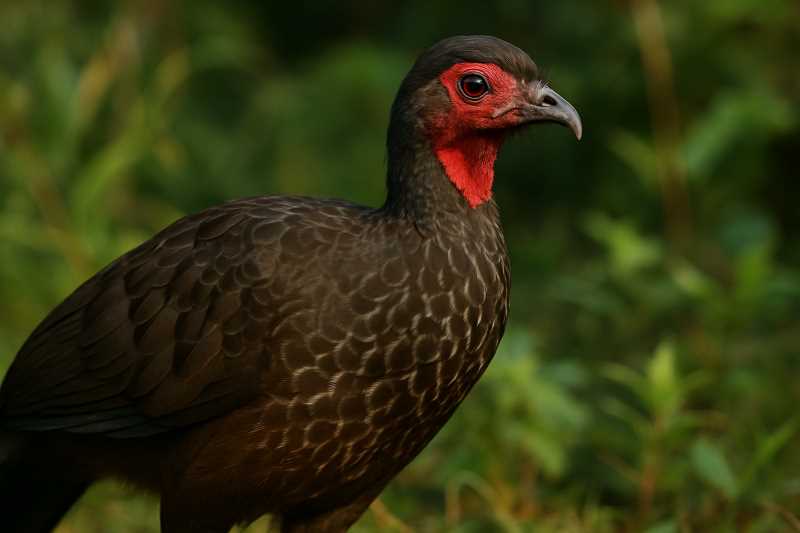
The Red-faced Guan measures approximately 63–75 cm in length. It has predominantly dark olive-brown to brown plumage, with pale or whitish edging on some feathers of the crown, neck, upper back, breast and wing coverts. The underparts are greyer brown, while the rump may show a reddish tone. The tail is long, broad and dark, sometimes with a greenish sheen.
The bare facial skin is pinkish-red, and the throat has a conspicuous red dewlap. The forehead is dark, and the bill and legs are brown. Available descriptions do not indicate marked sexual dimorphism, although detailed information on age-related plumage differences is limited.
Range and Habitat
The Red-faced Guan occurs along the eastern Andean slopes of southern Bolivia and north-western Argentina. In Bolivia, its range includes parts of Santa Cruz, Chuquisaca and Tarija. In Argentina, it is recorded mainly in Jujuy and northern Salta.
It inhabits humid montane and cloud forests of the southern Yungas, including forests dominated by alder (Alnus), podocarp (Podocarpus parlatorei) and other upper-montane trees. It may also use forest edges and nearby ravines containing Polylepis or Alnus woodland. Most records are from approximately 1,500–2,500 metres above sea level, although the species has occasionally been reported at lower or higher elevations.
The species has a patchy distribution and is associated with forested landscapes rather than open agricultural areas. There is no evidence of long-distance migration. Any seasonal or local movement along elevation gradients is poorly documented.
Behaviour and Diet
Red-faced Guans are usually observed in pairs or small groups and are primarily arboreal, although they may descend to the ground while feeding. Like other Penelope guans, they are likely to be most active during the morning and afternoon, but species-specific observations remain limited.
Fruits form the principal component of the known diet. A study in the Yungas of north-western Argentina recorded fruits from several tree species, including Viburnum seemenii, Citronella apogon, Ilex argentina and Celtis. The birds appeared to select some fruits rather than simply consuming the most abundant species available. Seeds passed through the digestive tract without obvious physical damage, indicating that the Red-faced Guan is an important potential seed disperser in montane Yungas forest.
The broader diet of cracids can include seeds, leaves, flowers and invertebrates, but detailed information on these items in the Red-faced Guan is scarce. Nesting information is also limited. The nest has been described as a platform of sticks and stems lined with leaves, with a clutch of three white eggs.
Identification Tips
Look for a large, long-tailed guan with mostly dark brown plumage, pale feather edging on the head and upper body, and clearly pinkish-red bare facial skin. The red throat dewlap is another useful feature, particularly when the bird is calling or displaying.
Where it overlaps with the Dusky-legged Guan (Penelope obscura), the Red-faced Guan can be distinguished by its pinkish-red facial skin, generally more montane distribution and less conspicuous pale feather edging. The Dusky-legged Guan has grey facial skin and often shows stronger white edging on the scapulars and wing coverts. Identification can be difficult in poor light or when the bird is partly concealed in foliage.
Conservation Status
The Red-faced Guan is currently assessed globally as Least Concern on the IUCN Red List. This global category does not mean that the species is secure throughout its range. It has a relatively restricted and fragmented distribution, and regional assessments in Argentina have treated it as threatened or vulnerable.
The principal documented threats are forest clearing, habitat fragmentation and hunting. These pressures are particularly concerning because guans are relatively large forest birds, reproduce slowly compared with many smaller birds and may be vulnerable to local depletion. Reports from southern Bolivia also describe the species as rare or uncommon in parts of its range, with populations affected by hunting and forest conversion.
Conservation priorities include protecting remaining Yungas forest, maintaining connectivity between forest blocks, reducing hunting pressure and improving knowledge of the species’ distribution, population size, breeding biology and habitat requirements. Protected areas in north-western Argentina and southern Bolivia provide important habitat, but continued field surveys are needed to evaluate their effectiveness.
Frequently Asked Questions
Where does the Red-faced Guan live?
It lives in humid montane and cloud forests on the eastern slopes of the southern Andes, from southern Bolivia to the provinces of Jujuy and Salta in north-western Argentina.
What does the Red-faced Guan eat?
Fruits are the main documented food. It may also consume seeds, leaves, flowers and invertebrates, but species-specific information about these additional foods remains limited.
How can the Red-faced Guan be identified?
It is a large brown guan with a long tail, pale feather edging on parts of the head and upper body, pinkish-red bare facial skin and a red throat dewlap.
Is the Red-faced Guan endangered?
Globally, it is classified as Least Concern by the IUCN. However, it has a restricted range and faces local threats from deforestation, habitat fragmentation and hunting. It is considered more threatened in some national assessments, particularly in Argentina.
Does the Red-faced Guan migrate?
Long-distance migration has not been documented. The species is generally considered resident, although local or seasonal movements between elevations may occur and are not well understood.
Why is the Red-faced Guan important to the forest?
By eating fruit and passing intact seeds through its digestive system, the Red-faced Guan can disperse plants away from parent trees. This may assist forest regeneration and maintain plant populations in the Yungas.
References
- BirdLife International. 2020. Penelope dabbenei. The IUCN Red List of Threatened Species. Taxon assessment 22678373. Available at: https://www.iucnredlist.org/species/22678373. Accessed 8 September 2026.
- Gill, F., Donsker, D. and Rasmussen, P. (eds). 2026. IOC World Bird List, version 15.2. International Ornithologists’ Union. Available at: https://www.worldbirdnames.org/new/.
- Hellmayr, C. E. and Conover, H. B. 1942. Catalogue of Birds of the Americas and the Adjacent Islands, Part 1, Number 1. Field Museum of Natural History, Zoological Series 13: 154. Species description and original nomenclature for Penelope dabbenei.
- Ruggera, R. A., Álvarez, M. E. and Blendinger, P. G. 2011. Diet of the Red-faced Guan (Penelope dabbenei) in a montane forest in northwestern Argentina. Ornitología Neotropical 22: 615–621. Available at: https://sora.unm.edu/sites/default/files/ON%2022(4)%20615-621.pdf.
- Sistema de Información de Biodiversidad, Administración de Parques Nacionales, Argentina. n.d. Penelope dabbenei, Pava de Monte Alisera, Red-faced Guan. Available at: https://sib.gob.ar/especies/penelope-dabbenei. Accessed 8 September 2026.
- Fundación CEBio. n.d. Proyecto Pavas de Monte. Fundación para la Conservación de la Biodiversidad. Available at: https://cebio.org.ar/programas/pavas-de-monte/. Accessed 8 September 2026.
- Álvarez, M. E. and Blendinger, P. G. 2005. Dieta de la Pava de Monte Alisera (Penelope dabbenei) en la Yungas de Argentina. XI Reunión Argentina de Ornitología, presentation abstract. Available at: https://rao.avesargentinas.org.ar/sobre/xi-rao/dieta-de-la-pava-de-monte-alisera-penelope-dabbenei-en-la-yungas-de-argentina/. Accessed 8 September 2026.
- Strahl, S. D. et al. 2000. Status Survey and Conservation Action Plan for Cracids 2000–2004. IUCN/SSC Cracid Specialist Group and World Pheasant Association. IUCN, Gland, Switzerland. Available at: https://portals.iucn.org/library/efiles/documents/2000-015.pdf.
Related posts