Introduction
The Emerald-spotted Wood Dove, Turtur chalcospilos, is a small African dove recognised by the metallic green patches on its folded wings. It is a resident species of eastern and southern Africa, where it inhabits dry woodland, savanna, thickets and other areas with suitable ground cover and food.
Physical Description
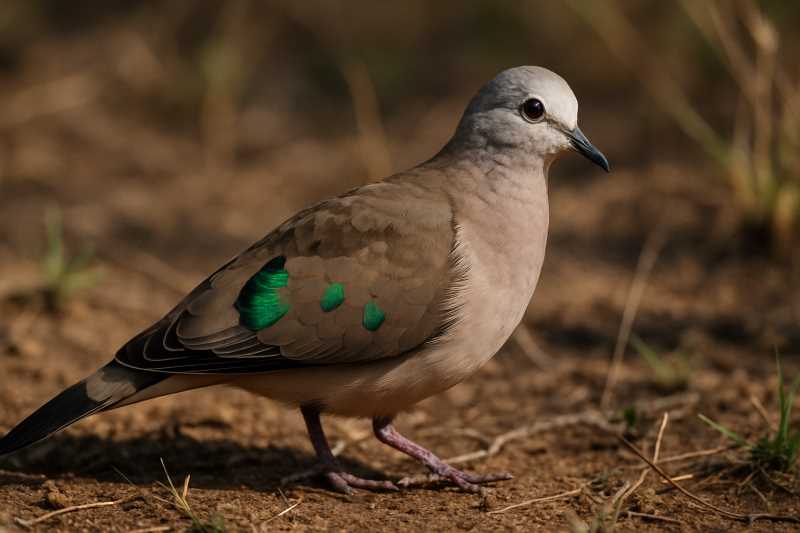
The Emerald-spotted Wood Dove is a compact, plump dove measuring about 20 centimetres in length. Its upperparts are generally grey-brown, while the head is bluish-grey and the throat and breast may show soft pinkish or mauve tones. The underparts are paler, and dark markings occur on the lower back and tail.
Its most distinctive feature is the pair of metallic green to bronze-green patches on the folded wings. These patches can be difficult to see when the bird is standing quietly, but become conspicuous when it moves or takes flight. The sexes are broadly similar in appearance, although individual variation in colour and the intensity of the wing patches can occur.
Range and Habitat
The species occurs across much of eastern and southern Africa, from Ethiopia, Somalia and Kenya southwards through Tanzania, Mozambique, Zimbabwe, Botswana, Eswatini and South Africa, with additional records in parts of central Africa. It is resident rather than a long-distance migrant, although local or seasonal movements may occur in response to rainfall and food availability.
It favours open, dry or semi-dry habitats, including deciduous woodland, savanna, thornveld, thickets, dry sand forest, valley bushveld, gardens and orchards. It generally avoids dense evergreen rainforest and the most arid desert environments. The species has been recorded from lowlands to elevations of approximately 2,000 metres. (doi.org)
Where to See This Species
Kruger National Park, Limpopo and Mpumalanga, South Africa
The Emerald-spotted Wood Dove is included on the official Kruger National Park bird checklist. Look for it in dry woodland, savanna and areas of open ground, particularly where fallen seeds and fruit are available. It is usually easier to detect by its calls or by watching quiet tracks and clearings during the cooler parts of the day. (sanparks.org)
Nearby accommodation: Accommodation is available at Kruger’s rest camps, private lodges and campsites, with additional guest houses and lodges in gateway towns such as Phalaborwa, Hazyview and Malelane.
Addo Elephant National Park, Eastern Cape, South Africa
The species is recorded on the Addo Elephant National Park bird checklist. The park’s wooded valleys, thicket and open areas provide suitable habitat, although the dove can be inconspicuous among dense vegetation. Early morning drives and walks near suitable woodland are the most practical times to search. (gobirding.birdlife.org.za)
Nearby accommodation: Visitors can use the park’s camps and cottages or stay in guest houses, hotels, lodges and self-catering accommodation around Addo village and the wider Sundays River Valley.
Gonarezhou National Park, Masvingo Province, Zimbabwe
Gonarezhou’s official management plan lists the Emerald-spotted Wood Dove among the birds recorded in the park. Its dry woodland, mopane, riverine vegetation and open bush areas are appropriate places to look, especially during the wetter periods when food is more readily available. (zimparks.org.zw)
Nearby accommodation: Accommodation is available in park camps and safari lodges, while Chiredzi is the principal gateway town for additional hotels, lodges and guest houses.
Behaviour and Diet
The Emerald-spotted Wood Dove is most often encountered alone or in pairs. It usually forages on the ground beneath woodland or scrub, walking quietly through sparsely vegetated areas while searching among leaf litter and bare soil. Small groups may gather where food is plentiful.
Its diet consists mainly of fallen grass and herb seeds, fallen fruit and other plant material. It may also take termites, small molluscs and other invertebrates. The species is generally cautious and relies on stillness, camouflage and dense cover when approached.
The call is a soft, repeated series of cooing notes, often heard from concealed birds during the morning or late afternoon. Breeding may occur in more than one season, depending on local rainfall and food conditions. The nest is a fragile platform of twigs, stems and roots, usually placed in a tree, shrub or aloe between about 0.5 and 6 metres above the ground. A clutch normally contains one or two eggs. Incubation lasts approximately 17 days, and young birds leave the nest after about 15 to 17 days. (biodiversityexplorer.info)
Identification Tips
- Look for a small, compact dove with a short-looking tail and muted grey-brown plumage.
- The metallic green or green-bronze patches on the folded wings are the key field mark.
- The head is usually bluish-grey, with pinkish tones on the throat and breast.
- Search on the ground beneath dry woodland, thickets and savanna rather than high in the canopy.
- The similar Blue-spotted Wood Dove, Turtur afer, has blue wing spots rather than the emerald-green patches of the Emerald-spotted Wood Dove. Careful views of the wing pattern are therefore important.
Conservation Status
The Emerald-spotted Wood Dove is currently assessed as Least Concern on the IUCN Red List. Its range is extremely large, the population is considered stable, and no quantified global population estimate is available. Localised habitat loss caused by agricultural expansion, development, woodland clearance and changes in land management may affect particular populations, but these pressures have not resulted in a global threat classification. (doi.org)
Conservation depends primarily on retaining native woodland, thicket and savanna, maintaining habitat diversity and protecting larger areas of connected natural vegetation. Continued monitoring is useful because local declines may occur even where the species remains widespread overall.
Frequently Asked Questions
Where does the Emerald-spotted Wood Dove live?
It lives mainly in eastern and southern Africa, occupying dry woodland, savanna, thickets, thornveld, gardens and orchards with suitable ground cover.
What does the Emerald-spotted Wood Dove look like?
It is a small grey-brown dove with a bluish-grey head, pale underparts and distinctive metallic green or green-bronze patches on the folded wings.
What does the Emerald-spotted Wood Dove eat?
Its diet consists mainly of fallen seeds, grass and herb seeds, fallen fruit and some invertebrates, including termites and small molluscs.
Is the Emerald-spotted Wood Dove migratory?
It is generally resident, although local or seasonal movements may occur when rainfall, food availability or habitat conditions change.
Where can I see the Emerald-spotted Wood Dove?
Reliable birding locations include Kruger National Park and Addo Elephant National Park in South Africa, as well as Gonarezhou National Park in Zimbabwe. It is usually found in dry woodland, savanna and scrub, often feeding on the ground.
References
- IUCN Red List of Threatened Species
- SANParks
- Biodiversity Explorer
Related posts