Introduction
The See-see Partridge (Ammoperdix griseogularis) is a small, ground-dwelling gamebird of dry, open country in south-western and Central Asia. It belongs to the pheasant family, Phasianidae, and is a resident species rather than a long-distance migrant. Its range extends broadly from south-eastern Türkiye through parts of the Middle East and Central Asia to Afghanistan and Pakistan. (ww.worldbirdnames.org)
Physical Description
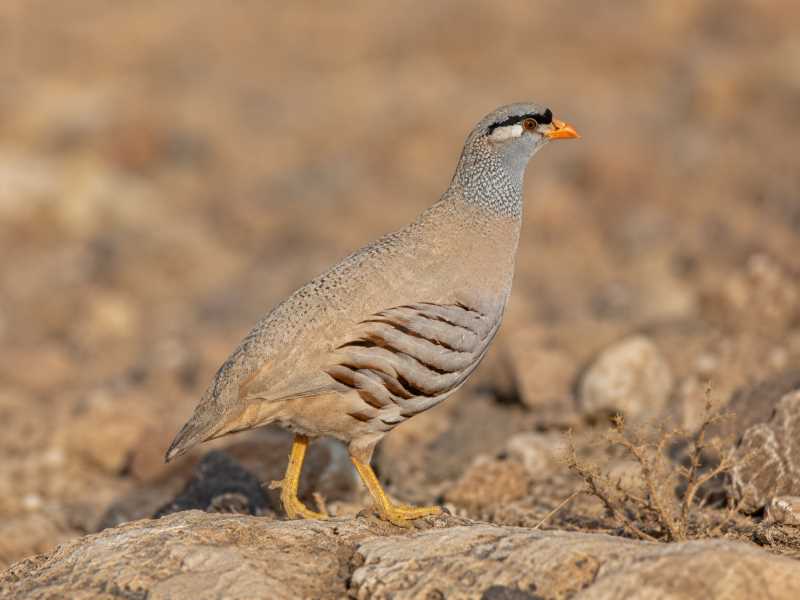
The See-see Partridge is a compact, rounded bird measuring approximately 22–25 cm in length. It has sandy-brown upperparts, finely marked underparts and contrasting, wavy white and brown barring on the flanks. The wings are short and rounded, allowing rapid but usually brief flights, while the strong legs are suited to running over rocky ground.
The male has a grey head with a conspicuous black stripe through the eye, a white cheek or ear patch, and pale speckling on the sides of the neck. The bill is orange to reddish-orange. Females are duller and more washed-out, with a much weaker head pattern. Juveniles are generally less distinct than adult males and can be difficult to identify away from the species’ normal range. (ebird.org)
Range and Habitat
The species occurs from south-eastern Türkiye, northern Syria and Iraq eastwards through Iran and parts of the southern Caucasus and Central Asia to Afghanistan and sub-Himalayan Pakistan. Some distribution sources also record scattered populations in southern Turkmenistan, Uzbekistan, Tajikistan and adjacent areas. The See-see Partridge is not primarily an Arabian Peninsula species, where the closely related Sand Partridge (Ammoperdix heyi) is more characteristic, although limited records have been reported from the northern edge of the peninsula. (avibase.bsc-eoc.org)
It favours dry, open and often hilly habitats, including rocky slopes, stony foothills, arid plateaus, wadis and semi-desert scrub. It may occur from lowland plains into mountainous areas, where suitable open ground, sparse vegetation and access to food are available. The species is resident, with local movements possible in response to seasonal conditions and water availability.
Behaviour and Diet
See-see Partridges usually remain on the ground and often run when disturbed. If closely approached, they may fly rapidly for a short distance before landing again. They are commonly encountered in pairs or small groups, although larger gatherings may form where food and water are concentrated. Outside the breeding season, family groups and small coveys provide some protection from predators.
The diet consists mainly of seeds and other plant material, including leaves and underground plant parts. Insects and other small invertebrates are also eaten, particularly by growing young birds. Feeding takes place mostly on the ground, and the birds may use their bills and feet to uncover suitable food in loose soil or among stones. (birdforum.net)
Breeding takes place in spring and during other locally suitable periods, depending on climate and elevation. The nest is a shallow scrape on the ground, usually placed beneath a rock, shrub or other cover. Reported clutch sizes vary, with approximately 8–16 eggs recorded in standard species accounts. The female undertakes most incubation, while the precocial chicks leave the nest soon after hatching and are led by the adults while feeding.
Identification Tips
Look for the following combination of features:
- A small, stocky, sandy-brown partridge in barren hills, rocky foothills or wadis.
- Strongly contrasting, wavy barring on the flanks.
- In the male, a grey head, black eye-stripe and white cheek patch.
- An orange or reddish-orange bill.
- A tendency to run rather than fly when disturbed.
- A short, rapid flight on rounded wings when it finally takes off.
The most relevant comparison is the closely related Sand Partridge, Ammoperdix heyi. The two species are similar in size, shape and habitat, but their ranges are generally different. Male See-see Partridges usually show a distinctive grey head, black eye-stripe and white cheek patch, while females of both species are considerably less distinctive. Geographic location is therefore an important part of identification. (ebird.org)
Conservation Status
The See-see Partridge is assessed as Least Concern at global level. It has a broad distribution and remains locally common, although reliable population estimates and long-term trend data are limited. Regional assessments indicate that its status can vary between countries and habitats. (portals.iucn.org)
Potential pressures include habitat degradation, overgrazing, agricultural expansion, disturbance, unsustainable hunting in some areas and changes in the availability of food and water. Climate change may increase these pressures by intensifying drought and altering the productivity of arid habitats. Conservation measures should focus on maintaining connected areas of rocky and semi-desert habitat, managing grazing sustainably, monitoring hunting pressure and protecting important breeding sites.
Frequently Asked Questions
Where does the See-see Partridge live?
It occurs from south-eastern Türkiye through Syria, Iraq and Iran to parts of Central Asia, Afghanistan and sub-Himalayan Pakistan. It is associated mainly with dry, open and rocky country.
Is the See-see Partridge migratory?
No. It is generally a resident species, although local movements may occur when birds respond to seasonal changes in food, rainfall or water availability.
What does the See-see Partridge eat?
Adults feed mainly on seeds and other plant material, including leaves and underground plant parts. Insects and other small invertebrates are also eaten, especially by young birds.
How can the See-see Partridge be identified?
The male is recognised by its grey head, black stripe through the eye, white cheek patch, sandy-brown body and barred flanks. Females are duller and more difficult to distinguish.
Does the See-see Partridge live in the Arabian Peninsula?
Its principal range lies north and east of the Arabian Peninsula. The related Sand Partridge is the more characteristic Ammoperdix species in much of Arabia, although some sources record the See-see Partridge from limited areas near the peninsula’s northern margin.
What is the conservation status of the See-see Partridge?
The species is currently assessed as Least Concern globally. Local populations may nevertheless be affected by habitat degradation, excessive grazing, hunting and changing climatic conditions.
References
- AviList Core Team. 2025. AviList: The Global Avian Checklist, Version 2025. International Ornithologists’ Union. https://doi.org/10.2173/avilist.v2025
- BirdLife International. 2021. Ammoperdix griseogularis (See-see Partridge). European Red List of Birds species account. BirdLife International. https://birdlifedata.blob.core.windows.net/sub-global/130_ammoperdix_griseogularis.pdf. Accessed 8 September 2026.
- Gill, F., Donsker, D. and Rasmussen, P., eds. 2026. IOC World Bird List, Version 15.2. International Ornithologists’ Union. https://www.worldbirdnames.org/. Accessed 8 September 2026.
- Madge, S. and McGowan, P. 2002. Pheasants, Partridges and Grouse: A Guide to the Pheasants, Partridges, Quails, Grouse, Guineafowl, Buttonquails and Sandgrouse of the World. Christopher Helm.
- OSME. 2020. The State of the Middle East’s Birds: Regional Red List, Part A, Non-passerines. Ornithological Society of the Middle East, the Caucasus and Central Asia. https://www.osme.org/wp-content/uploads/2020/06/ORL-6.1-Part-A-Non-passerines.pdf
- Rasmussen, P. C. and Anderton, J. C. 2005. Birds of South Asia: The Ripley Guide. Smithsonian Institution and Lynx Edicions.
- eBird. n.d. See-see Partridge, Ammoperdix griseogularis. Cornell Lab of Ornithology. https://ebird.org/species/sespar1. Accessed 8 September 2026.
- International Union for Conservation of Nature. 2025. IUCN Red List of Threatened Species: Arabian Region Red List assessment materials. IUCN. https://portals.iucn.org/library/sites/library/files/documents/RL-53-004.pdf. Accessed 8 September 2026.
Related posts