Introduction
Salvin’s Curassow, Mitu salvini, is a large, ground-dwelling member of the curassow family, Cracidae. It occurs in the western Amazon Basin of Colombia, eastern Ecuador and northern Peru, where it inhabits humid lowland forests. Although it is often difficult to observe, the species is an important component of tropical forest food webs and is affected by both hunting and habitat loss.
Physical Description
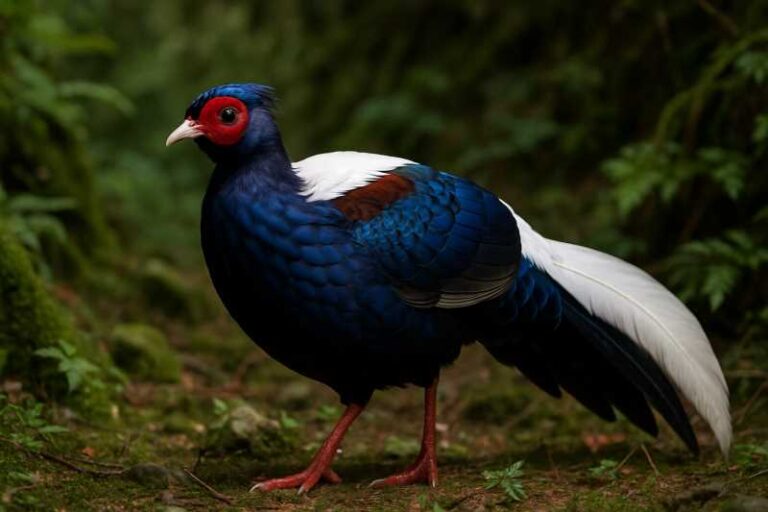
Salvin’s Curassow measures approximately 75–89 centimetres in length. Adults are predominantly glossy black, with a blue or greenish sheen on the upperparts in good light. The species has a short, recurved crest, a vermilion-red bill that is paler towards the tip, dark grey legs and feet, and conspicuous white feathers on the lower abdomen, vent and undertail-coverts. The tail also has pale tips.
The species is not known for the large casque seen in some other curassows. Published field descriptions do not establish a marked difference in plumage between adult males and females, and reliable sex-specific measurements are limited. Young birds have less glossy plumage and may show more subdued colouration than adults.
Range and Habitat
Salvin’s Curassow is distributed east of the Andes in southern Colombia, eastern Ecuador and northern Peru. It is a resident species rather than a long-distance migrant, although individuals make regular local movements through their home ranges.
The species is associated with humid tropical forest, including mature terra firme forest, riparian forest, seasonally flooded forest and some dense secondary or successional vegetation. It generally forages on the forest floor and may use several habitat types within the same home range. A study in Tinigua National Park, Colombia, recorded a family group using an area of approximately 72–150 hectares, with habitat use changing as fruit availability changed.
The original article described the species as being restricted to elevations below 500 metres. More broadly supported sources describe it as a lowland forest bird, but the precise upper elevational limit is not sufficiently consistent across available sources to state as a fixed boundary.
Behaviour and Diet
Salvin’s Curassow is mainly terrestrial and is usually seen alone, in pairs or in small family groups. It is shy and often detected by movement or vocalisation before it is seen. The species is generally sedentary, but local movements may be substantial. One field study recorded daily movements of roughly 630–3,750 metres, depending partly on the distribution of food.
Fallen fruit and seeds form the main part of the diet. The species also consumes flowers, leaves, cotyledons and a variety of invertebrates, including worms, crabs, termites, snails and beetles. Small vertebrates and eggs have also been recorded in the diet, particularly in observations involving young birds. Invertebrate food may be especially important for growing chicks.
Although curassows can transport and pass viable seeds, Salvin’s Curassow is generally regarded as an important seed predator rather than a major seed disperser. Its feeding habits nevertheless influence plant recruitment and the movement of seeds through the forest. The species may also consume grit or small stones to assist digestion.
Pairs and family groups use deep, resonant calls, particularly at quiet periods of the day. Detailed information on nesting and breeding remains limited, although field observations indicate that breeding groups can include adults and dependent young. Seasonally flooded forest may provide important nesting habitat in parts of the range.
Identification Tips
- Look for a large, turkey-like bird moving quietly along the forest floor.
- Adults are mainly glossy black, with a short recurved crest and a noticeable white area around the vent and undertail.
- The vermilion-red bill contrasts strongly with the black plumage, while the legs and feet are dark grey rather than bright red.
- Pale tail tips can be visible when the bird walks away or raises its tail.
- Listen for deep, booming calls in dense forest, especially around dawn or dusk.
- Do not confuse the species with the Razor-billed Curassow, Mitu tuberosum, which is generally larger and has a much more strongly laterally compressed bill. Salvin’s Curassow lacks the conspicuous bill shape that gives the Razor-billed Curassow its common name.
Conservation Status
The current IUCN Red List category for Salvin’s Curassow is Least Concern. This category does not mean that local populations are secure. The species is vulnerable to forest clearance, agricultural expansion, habitat fragmentation and hunting for meat. Its dependence on extensive forest and its use of several habitat types may make it particularly sensitive to the loss of connected forest landscapes.
The species occurs in a number of protected areas, but effective conservation also depends on maintaining large, connected tracts of lowland forest, protecting seasonally flooded and riparian habitats, and reducing unsustainable hunting. More field research is needed to clarify population trends, breeding success and the effects of hunting across different parts of its range.
Frequently Asked Questions
Where does Salvin’s Curassow live?
It occurs in southern Colombia, eastern Ecuador and northern Peru, mainly in humid lowland forests east of the Andes.
What does Salvin’s Curassow eat?
Its diet consists mainly of fallen fruit and seeds, supplemented by leaves, flowers, cotyledons, invertebrates and occasional small vertebrates or eggs.
Is Salvin’s Curassow a good seed disperser?
It can disperse some seeds, but it is generally considered more important as a seed predator than as a major seed-dispersing bird.
How can Salvin’s Curassow be identified?
Adults are large, mainly glossy black birds with a short recurved crest, a red bill, dark grey feet, white feathers around the vent and undertail, and pale tail tips.
Is Salvin’s Curassow endangered?
The species is currently assessed as Least Concern by the IUCN. Nevertheless, hunting, deforestation and habitat fragmentation remain important conservation concerns.
Does Salvin’s Curassow migrate?
It is regarded as resident rather than migratory. Individuals and family groups make local movements through their forest home ranges, often in response to food availability.
References
- Gill, F., Donsker, D. and Rasmussen, P. (eds.). 2026. IOC World Bird List, version 15.2. International Ornithologists’ Union. Available from the IOC World Bird List website. Accessed 8 September 2026.
- International Union for Conservation of Nature. n.d. Salvin’s Curassow, Mitu salvini. IUCN Red List of Threatened Species. Current category: Least Concern. Accessed 8 September 2026.
- Parra, J. L., Agudelo, M., Molina, Y. and Londoño, G. 2001. Use of space by a pair of Salvin’s Curassows (Mitu salvini) in northwestern Colombian Amazon. Ornitología Neotropical 12: 189–204.
- del Hoyo, J., Elliott, A. and Sargatal, J. (eds.). 1994. Handbook of the Birds of the World, Volume 2: New World Vultures to Guineafowl. Lynx Edicions, Barcelona.
- Schulenberg, T. S., Stotz, D. F., Lane, D. F., O’Neill, J. P. and Parker III, T. A. 2010. Birds of Peru: Revised and Updated Edition. Princeton University Press, Princeton.
- Begazo, A. J. and Kirwan, G. M. 2026. Salvin’s Curassow, Mitu salvini. In Billerman, S. M., Keeney, B. K., Rodewald, P. G. and Schulenberg, T. S. (eds.), Birds of the World. Cornell Lab of Ornithology. DOI: https://doi.org/10.2173/bow.salcur1.02. Accessed 8 September 2026.
- Ordway Lab of Ecosystem Conservation. n.d. Past Studies: Curassows and fruit resources. Florida Museum of Natural History, University of Florida. Accessed 8 September 2026.
- World Bird Names. n.d. Salvin’s Curassow, Mitu salvini. IOC-based species account. Accessed 8 September 2026.
Related posts