The Unspotted Saw-whet Owl: A Mysterious Avian Gem of the Americas
In the dense, untouched forests of Central America, an elusive bird silently navigates the night. The Unspotted Saw-whet Owl (Aegolius ridgwayi), though less renowned than its northern counterpart, the Northern Saw-whet Owl, holds a unique place in the avian world. This article delves into the enchanting life and ecological significance of this mysterious owl species.
A Brief Introduction
The Unspotted Saw-whet Owl is a small, nocturnal bird of prey belonging to the Strigidae family. With its scientific name Aegolius ridgwayi, this owl is native to the humid montane forests of Central America, particularly found in countries like Costa Rica, Panama, and Honduras. Its habitat is often characterized by dense, mossy canopies and a rich understory, providing an ideal environment for this secretive bird.
Physical Characteristics
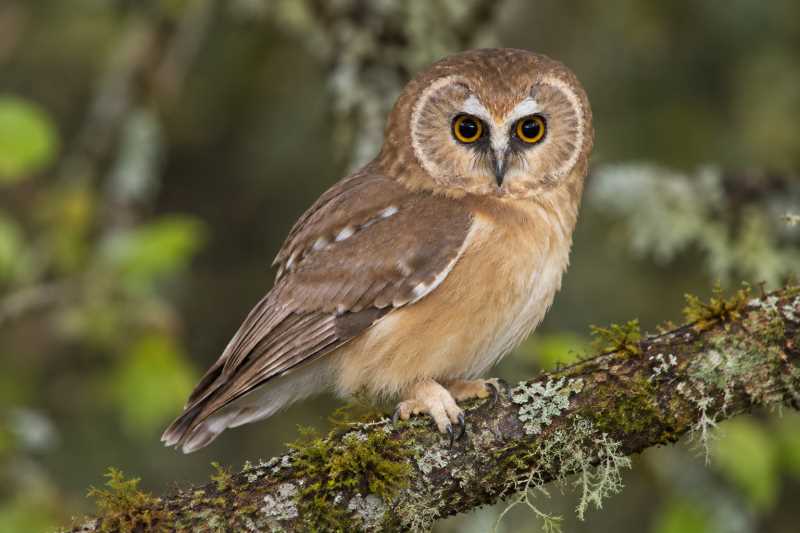
True to its name, the Unspotted Saw-whet Owl is distinct from other members of the Saw-whet genus due to its lack of white spotting on its plumage. This owl sports a uniform dark brown coloration, which provides excellent camouflage amidst the forest shadows. It has a rounded head with no ear tufts, large yellow eyes that enhance its night vision, and a short tail. At approximately 17-19 cm in length and with a wingspan of about 45 cm, it is a petite owl, yet it commands a presence in its natural habitat.
Behavior and Diet
Primarily nocturnal, the Unspotted Saw-whet Owl is most active during the twilight hours. Its diet consists mainly of small mammals, insects, and occasionally other birds. With acute hearing and exceptional night vision, it is well-equipped for hunting in the dark. Its call, a series of high-pitched toot-toot-toot notes, can be heard resonating through its forest domain.
Unlike many owl species, the Unspotted Saw-whet does not migrate, which means it has adapted to survive within its specific ecological niche year-round. This adaptation speaks volumes about its resilience and the stability of its habitat, although it also makes the species particularly vulnerable to environmental changes.
Conservation Status
The Unspotted Saw-whet Owl is listed as ‘Near Threatened’ on the International Union for Conservation of Nature (IUCN) Red List. The primary threat to this species is habitat loss due to deforestation and land-use changes. As forests are cleared for agriculture, urbanization, and other developments, the owl’s habitat is increasingly fragmented, leading to a decline in population.
Conservation efforts are crucial to preserving the Unspotted Saw-whet Owl. Protecting its natural habitat through sustainable land management practices and expanding protected areas are vital steps in ensuring the survival of this enigmatic bird. Additionally, raising awareness about the importance of forest ecosystems in Central America can help foster a broader commitment to conservation.
Ecological Significance
Owls play a critical role in their ecosystems as both predators and prey. The Unspotted Saw-whet Owl helps control the populations of small mammals and insects, maintaining a balance within the forest environment. By understanding its role in the ecosystem, researchers and conservationists can better appreciate the interconnectedness of species and the importance of biodiversity.
Research and Observation
Studying the Unspotted Saw-whet Owl presents unique challenges due to its elusive nature and the dense habitats it occupies. However, advancements in technology, such as remote audio recording devices and motion-sensitive cameras, have allowed researchers to gather more data on this species. These tools help scientists monitor population trends, behavior, and habitat use.
Citizen science initiatives also play a significant role in gathering information about the Unspotted Saw-whet Owl. Birdwatchers and local communities contribute valuable data that can aid in the conservation and understanding of this species. Public engagement not only enhances research efforts but also helps foster a deeper appreciation for this remarkable owl.
Conclusion
The Unspotted Saw-whet Owl is a testament to the incredible biodiversity found within Central America’s forests. While it remains one of the lesser-known owl species, its significance cannot be understated. Protecting this owl and its habitat is crucial to preserving the ecological balance of its environment. As efforts towards conservation and research continue, the hope is that future generations will continue to marvel at the haunting call of the Unspotted Saw-whet Owl echoing through the night.
Related posts