Introduction
The Red-crested Pochard (Netta rufina) is a large diving duck of the family Anatidae. It breeds mainly across southern Europe, North Africa and Central Asia, with many populations moving south or west to winter on suitable wetlands. The species is best known for the male’s orange-red head, bright red bill and contrasting black, white and brown plumage.
Physical Description
The Red-crested Pochard is a large, robust duck measuring approximately 53–57 cm in length. It has a rounded head, heavy body and broad wings. In flight, a broad white wing panel is conspicuous against the darker forewing.
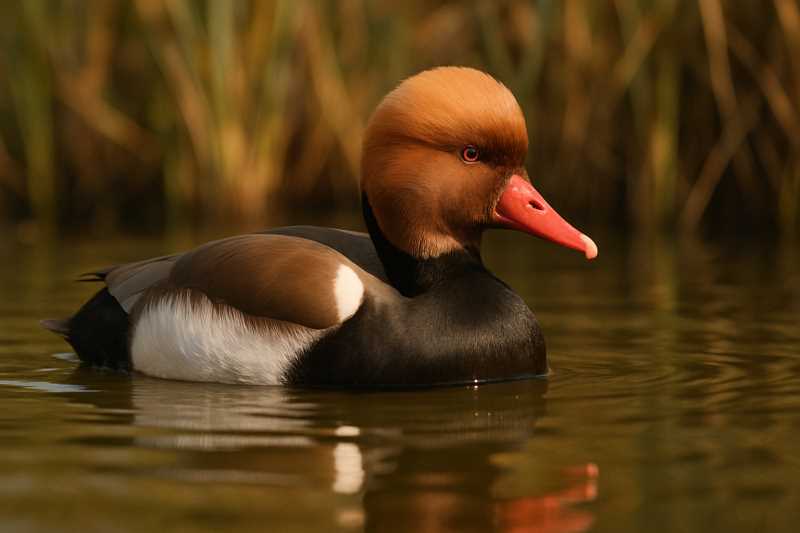
The adult male has a rich orange-red head with a rounded crest, a bright red bill, a black breast and dark back, and pale grey to white flanks. The female is much duller, with brownish-grey plumage, a darker crown and back, and pale cheeks. Her bill is darker and less vividly coloured than the male’s.
Males in eclipse plumage become considerably duller after breeding, but the red bill and red eye help distinguish them from females. Juveniles resemble females and generally have less contrasting plumage.
Range and Habitat
The species has a broad but uneven distribution from southern and eastern Europe through the Black Sea region and Central Asia to parts of Mongolia and western China. It also occurs in North Africa and reaches the Indian subcontinent during the non-breeding season. Populations differ in their movements: some are largely resident, while others are migratory or partially migratory.
Red-crested Pochards favour freshwater lakes, shallow reservoirs, marshes, lagoons and slow-moving waters with abundant submerged or emergent vegetation. Breeding sites commonly include reed beds and other dense marginal vegetation. During winter, birds may gather on larger lakes, reservoirs, coastal lagoons and irrigated wetlands.
The species is not endemic to one country or region. Its range is fragmented in some areas, and local populations may be affected by changes in water levels, wetland management and the availability of aquatic vegetation.
Behaviour and Diet
Red-crested Pochards are generally social and may form large flocks outside the breeding season. They feed by diving, dabbling and up-ending in shallow water. Their diet is primarily plant-based and includes aquatic vegetation, algae, roots, stems and seeds. Small aquatic invertebrates and other animal material may also be taken, particularly during the breeding season.
Pairs commonly form during the winter or spring. Breeding may occur in isolated pairs or loose colonies. The nest is usually placed on or close to the water among reeds or other dense vegetation and is lined with plant material and down. The female normally incubates the eggs and raises the ducklings. Clutch size is commonly about 6–14 eggs, with incubation lasting approximately 26–28 days.
Red-crested Pochards often remain close to vegetated margins when feeding, although they are capable divers and may forage in deeper water when conditions allow. Their movements between breeding, moulting and wintering wetlands can cover considerable distances.
Identification Tips
- Look for a large, deep-bodied diving duck with a rounded head and a broad, pale flank.
- An adult male is unmistakable at close range: the orange-red head, bright red bill, black breast and white sides form a strong colour pattern.
- A female is brownish-grey with pale cheeks and a darker crown. She is larger and heavier-looking than many dabbling ducks.
- In flight, the broad white wing panel is an important feature.
- Eclipse males resemble females, but usually retain a red bill and red eye.
- The species can be confused with the Common Pochard, but the Common Pochard male has a grey body, black breast and reddish head without the Red-crested Pochard’s orange crest and vivid red bill. Females of the two species also differ in head pattern and overall structure.
Conservation Status
The Red-crested Pochard is currently assessed as Least Concern on the global IUCN Red List. This category does not mean that all populations are secure. European assessments have identified declining or locally vulnerable populations in some areas, while other populations have increased or expanded.
The principal threats are the drainage and degradation of wetlands, changes to natural water flows, pollution, disturbance and unsustainable or illegal hunting in some parts of the range. Loss of reed beds and submerged vegetation can reduce both breeding opportunities and food availability. Climate-related changes to rainfall, drought frequency and wetland water levels may add further pressure, although the effects vary geographically.
Important conservation measures include protecting breeding and wintering wetlands, maintaining natural or suitable water regimes, preventing pollution, managing reed beds and aquatic vegetation carefully, and monitoring populations along migration routes. Protected wetlands and coordinated waterbird surveys are particularly valuable for identifying important sites and tracking population changes.
Frequently Asked Questions
Where does the Red-crested Pochard live?
It occurs across parts of southern Europe, North Africa and Central Asia. Many birds move south or west in winter, reaching the Mediterranean region, Africa and the Indian subcontinent.
What does a Red-crested Pochard look like?
The male has an orange-red head and crest, a bright red bill, a black breast and pale flanks. The female is brownish-grey with pale cheeks and a darker crown and back.
What does the Red-crested Pochard eat?
It mainly eats aquatic plants, algae, roots, stems and seeds. Small aquatic invertebrates and other animal material may also be taken, especially during the breeding season.
Is the Red-crested Pochard migratory?
Some populations are resident, while others are migratory or partially migratory. Movements vary according to geography, climate and local wetland conditions.
Where does the Red-crested Pochard nest?
It usually nests close to freshwater among reeds or other dense vegetation. The nest may be placed on the ground near the water or within marginal aquatic vegetation.
Is the Red-crested Pochard endangered?
Globally, it is classified as Least Concern. Nevertheless, habitat loss, wetland degradation, pollution, disturbance and hunting can threaten local populations, and some regional populations are declining.
References
- BirdLife International. 2021. European Red List of Birds: Netta rufina, Red-crested Pochard. BirdLife International, Cambridge. https://birdlifedata.blob.core.windows.net/sub-global/469_netta_rufina.pdf. Accessed 8 September 2026.
- BirdLife International. 2024. Species factsheet: Red-crested Pochard Netta rufina. BirdLife DataZone. https://datazone.birdlife.org/species/factsheet/red-crested-pochard-netta-rufina. Accessed 8 September 2026.
- British Trust for Ornithology. n.d. Red-crested Pochard. BTO BirdFacts. https://www.bto.org/learn/about-birds/birdfacts/red-crested-pochard. Accessed 8 September 2026.
- British Waterfowl Association. n.d. Red-crested Pochard, Netta rufina. https://www.waterfowl.org.uk/wildfowl/true-ducks/red-crested-pochard/. Accessed 8 September 2026.
- Gill, F., Donsker, D. and Rasmussen, P. (eds). 2026. IOC World Bird List, version 15.2. International Ornithologists’ Union. https://www.worldbirdnames.org/. Accessed 8 September 2026.
- Gooders, J. and Boyer, T. 1986. The Cornell Lab of Ornithology’s Guide to North American Ducks, as cited for published measurements and species biology in later ornithological accounts. Cornell University Press.
- Mukherjee, A., Pal, S. and colleagues. 2020. “Diurnal time-activity budget and foraging techniques of red-crested pochards (Netta rufina) wintering at the wetlands of West Bengal, India.” Turkish Journal of Zoology 44(5). https://journals.tubitak.gov.tr/zoology/vol44/iss5/4/. Accessed 8 September 2026.
- Rajković, D. and colleagues. 2024. “The genome sequence of the red-crested pochard, Netta rufina (Pallas, 1773).” G3: Genes, Genomes, Genetics. https://pmc.ncbi.nlm.nih.gov/articles/PMC11561386/. Accessed 8 September 2026.
Related posts