Introduction
The Green-legged Partridge (Tropicoperdix chloropus) is a shy, ground-dwelling member of the pheasant family, Phasianidae. It is also known as the Scaly-breasted Partridge or Green-legged Hill-partridge. The species inhabits dense evergreen forests across mainland Southeast Asia and the Malay Peninsula, where it is usually detected by its clear whistles before it is seen.
Its taxonomy has changed in recent decades. It was formerly placed in the genus Arborophila, but molecular research supported recognition of Tropicoperdix as a separate genus. The Green-legged Partridge is now generally treated as a distinct species from the Chestnut-necklaced Partridge (Tropicoperdix charltonii), although the treatment of some regional forms and subspecies has varied between taxonomic authorities.
Physical Description
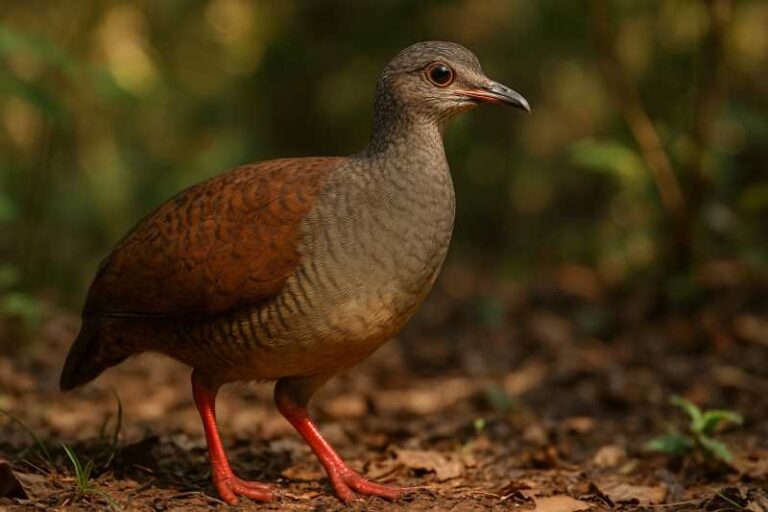
The Green-legged Partridge is a relatively small, compact galliform weighing approximately 260–350 g. It has a rounded body, short tail and strong legs adapted to walking through leaf litter and dense undergrowth.
Its plumage is predominantly brown, olive-brown and rufous, providing effective camouflage in forest shade. The head, throat and sides of the neck are pale, with dark markings that create a finely spotted or scaled appearance. The breast is brownish and usually marked with dark barring or scale-like patterning, while the flanks and belly are buff to brown with darker markings. The legs are greenish or greenish-yellow, and the bill may show greenish, yellowish or reddish tones depending on the individual and geographic form.
Males and females are broadly similar in appearance, with no strong sexual dimorphism that can be relied upon for field identification. Regional variation in the intensity of the rufous, olive and brown plumage is reported across the species’ range. Detailed information on juvenile plumage is limited, and young birds are likely to appear duller and less distinctly marked than adults.
Range and Habitat
The Green-legged Partridge occurs in mainland Southeast Asia and the Malay Peninsula. Its range includes parts of Myanmar, Thailand, Malaysia, Laos, Cambodia and Vietnam, although the boundaries and taxonomic treatment of some populations differ between authorities. Sumatra is associated primarily with the Chestnut-necklaced Partridge rather than the Green-legged Partridge.
It is largely resident rather than migratory. The species favours dense lowland and submontane evergreen forest, including seasonally wet evergreen forest, forest with a well-developed understorey and some forest-edge habitats. It has been recorded to approximately 1,000 m above sea level in ecological studies, and some regional sources report occurrences at higher elevations.
The species depends on intact or relatively continuous forest with thick ground cover, leaf litter and woody vegetation. In southern Vietnam, habitat studies found that it used forested landscapes and generally avoided steep slopes and bamboo-dominated areas, although habitat use can vary between regions.
Behaviour and Diet
The Green-legged Partridge is primarily terrestrial and spends most of its time walking through leaf litter beneath the forest canopy. It is secretive and often remains concealed in dense vegetation. Birds may occur singly, in pairs or in small family groups, but their social organisation is not fully documented throughout the range.
Its diet includes seeds, berries and other plant material, together with small invertebrates such as termites and other litter-dwelling insects. This mixed diet makes it an omnivorous forest-floor forager. Birds probe and scratch among fallen leaves and low vegetation while feeding.
The species is usually sedentary. Its vocalisations include clear whistles and more complex whistled or trilled sequences, which may be the most reliable way to detect it in dense forest.
Breeding in Khao Yai National Park, Thailand, occurred mainly during the rainy season, from May to September. Nests were shallow scrapes on the ground, usually positioned between the buttresses of a large tree and lined with dead leaves and feathers. Recorded clutches contained two to four eggs, with a mean clutch size of approximately three eggs. Incubation lasted about 18–20 days, and the female incubated alone. The young are precocial and leave the nest soon after hatching.
Identification Tips
- Look for a small, rounded partridge walking quietly through dense forest undergrowth rather than flying through the canopy.
- The combination of greenish legs, brown and olive upperparts, pale head and throat, and dark scaling or spotting on the breast is characteristic.
- The bird’s compact shape, short tail and strong legs help distinguish it from longer-tailed pheasants and other forest galliforms.
- Listen for clear whistles or short whistled sequences. Calls may reveal the bird before it emerges from cover.
- Do not rely on leg colour alone. Lighting, mud and regional variation can make the legs appear yellowish, grey-green or dull green.
- The Chestnut-necklaced Partridge (Tropicoperdix charltonii) is a genuine comparison species in parts of the Malay Peninsula. Careful attention to the breast, neck and overall pattern is required because the two species can appear similar and have historically been treated differently by some taxonomic authorities.
Conservation Status
The Green-legged Partridge is currently assessed as Least Concern at global level. This status does not mean that local populations are secure. The species is affected by deforestation, forest degradation and conversion of forest to agriculture. Hunting may also be significant in parts of its range, particularly where ground-dwelling galliforms are regularly taken.
The species’ continued conservation depends on protecting evergreen forest, maintaining connected habitat and managing hunting pressure. Protected areas and national parks are important, but effective enforcement and monitoring are also needed. More field research is required on population trends, regional variation, distribution and the effects of habitat fragmentation.
Frequently Asked Questions
Where does the Green-legged Partridge live?
It lives in dense evergreen and seasonally wet forest across mainland Southeast Asia and the Malay Peninsula, including parts of Myanmar, Thailand, Malaysia, Laos, Cambodia and Vietnam.
Is the Green-legged Partridge migratory?
No. It is generally regarded as a resident species, although individuals may make local movements within suitable forest habitat.
What does the Green-legged Partridge eat?
Its diet includes seeds, berries and other plant material, as well as small invertebrates such as termites and other insects found in leaf litter.
Why is it called the Green-legged Partridge?
The name refers to its greenish or greenish-yellow legs, which are one of its useful field characters. It is also called the Scaly-breasted Partridge because of the dark scale-like markings on the breast.
When does the Green-legged Partridge breed?
In a detailed study in Thailand, breeding took place mainly during the rainy season, from May to September. The exact breeding period may vary geographically with rainfall and food availability.
Is the Green-legged Partridge endangered?
It is currently assessed as Least Concern globally, but habitat loss, forest degradation and hunting remain important threats, and local populations may be declining.
References
- BirdLife International. 2024. Handbook of the Birds of the World and BirdLife International Digital Checklist of the Birds of the World, version 9. BirdLife International and Lynx Edicions. Available from the BirdLife International taxonomy resources: https://datazone.birdlife.org/about-our-science/taxonomy. Accessed 8 September 2026.
- Chen, D., Liu, Y., Davison, G. W. H., Dong, L., Chang, J., Gao, S., Li, S.-H. and Zhang, Z. 2015. Revival of the genus Tropicoperdix Blyth 1859 (Phasianidae, Aves) using multilocus sequence data. Zoological Journal of the Linnean Society, 175(2): 429–438. https://doi.org/10.1111/zoj.12273.
- Gill, F., Donsker, D. and Rasmussen, P., eds. 2026. IOC World Bird List, version 15.2. International Ornithologists’ Union. https://www.worldbirdnames.org/. Accessed 8 September 2026.
- Integrated Taxonomic Information System. n.d. Tropicoperdix chloropus Blyth, 1859, Taxonomic Serial No. 1193688. United States Geological Survey and ITIS. https://www.itis.gov/servlet/SingleRpt/SingleRpt?search_topic=TSN&search_value=1193688. Accessed 8 September 2026.
- Ong-in, T., Pierce, A. J., Gale, G. A., Browne, S. J. and Savini, T. 2016. Nesting ecology and nest site selection of green-legged partridge. Raffles Bulletin of Zoology, 64: 89–97. https://lkcnhm.nus.edu.sg/app/uploads/2017/06/64rbz089-097.pdf.
- Tobias, J. A., Montgomerie, R. and Lyon, B. E. 2021. Handbook of Bird Identification: Birds of the World. Lynx Edicions. Species information for Tropicoperdix chloropus is also reflected in recognised modern bird databases and field resources.
- eBird. n.d. Scaly-breasted Partridge, Green-legged group, Tropicoperdix chloropus. Cornell Lab of Ornithology. https://ebird.org/species/scbpar3. Accessed 8 September 2026.
Related posts