Introduction
The Black-throated Brilliant (Heliodoxa schreibersii) is a medium-sized hummingbird of western Amazonia and the eastern Andean foothills. It is found in humid forest from the lowlands into foothill habitats, where it feeds on nectar and small arthropods. The species is locally uncommon and can be difficult to locate, despite its distinctive dark throat and iridescent plumage.
Physical Description
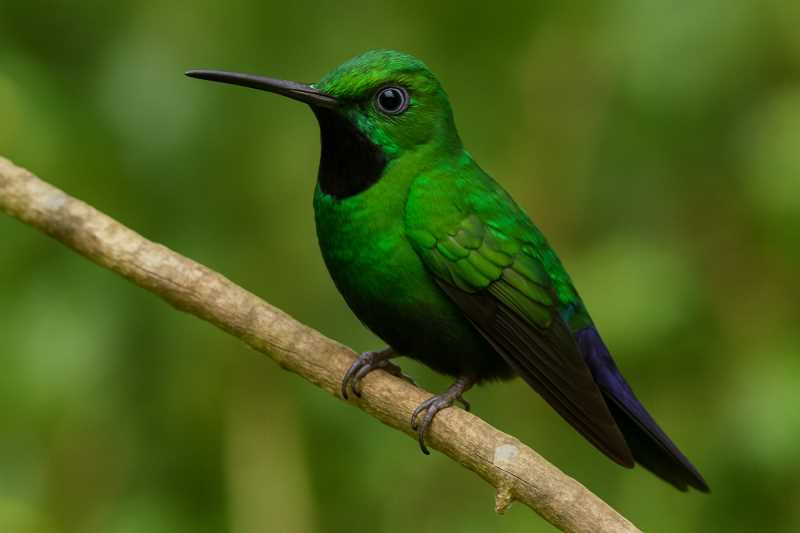
The Black-throated Brilliant is about 12.5 centimetres long, although size varies between populations and subspecies. It has predominantly green upperparts, a long, straight bill and a moderately forked, blue-toned tail.
Adults are recognised by the dark throat and upper breast, which may show iridescent violet, blue or green tones depending on the light. The lower underparts are generally dark, with green iridescence around the lower throat and breast. The forehead and crown may also show bright green or bronze reflections.
Males and females are broadly similar in appearance, although males may show stronger colour saturation and a deeper, more clearly iridescent throat. Juveniles are duller and may lack the full intensity of adult throat markings. The dark throat, long bill and forked bluish tail are useful field characters when the bird is seen briefly in forest shade.
Range and Habitat
The Black-throated Brilliant occurs in Brazil, Colombia, Ecuador and Peru. Its distribution is centred on western Amazonia and the eastern slopes of the Andes, with records from humid lowland forest, foothill forest and other well-wooded habitats.
In the Andean foothills it is often recorded between approximately 600 and 1,250 metres, while in parts of the Amazonian lowlands it occurs at lower elevations. It favours humid primary forest, forest edges, clearings and flowering areas, but its local distribution can be patchy.
The species is generally regarded as resident rather than migratory. Taxonomic treatment varies slightly between authorities. The population traditionally called Heliodoxa schreibersii whitelyana is treated as a subspecies by some checklists but as the separate Black-breasted Brilliant by others.
Where to See This Species
Podocarpus National Park, Zamora-Chinchipe, Ecuador
The lower Bombuscaro sector of Podocarpus National Park has documented records of Black-throated Brilliant in humid foothill forest. The species is not necessarily common, so observers should concentrate on flowering trees, forest edges and quiet trails at lower elevations. Early morning visits and local guidance can improve the chances of finding it.
Nearby accommodation: Zamora is the principal gateway town, with hotels, guest houses, lodges and other small-scale accommodation. Accommodation is also available near the park entrances.
Allpahuayo-Mishana National Reserve, Loreto, Peru
Black-throated Brilliant has been recorded in the Allpahuayo-Mishana area, a protected landscape near Iquitos that includes humid lowland forest and distinctive white-sand forest habitats. The species can be localised, so guided walks and visits to established trails are advisable rather than relying on casual roadside sightings.
Nearby accommodation: Iquitos is the practical gateway, with hotels, guest houses, river lodges and organised forest accommodation available for visits to the reserve.
Behaviour and Diet
Like other hummingbirds, the Black-throated Brilliant feeds mainly on flower nectar. Its long bill allows it to exploit tubular or deep flowers that may be less accessible to shorter-billed species. While feeding, it transfers pollen between flowers and contributes to forest pollination.
It also takes small insects and spiders, either by making short aerial sallies or by gleaning prey from vegetation. These animal foods provide important protein and other nutrients, particularly during periods of energetic demand.
Individuals may defend productive flowers or feeding areas from other hummingbirds. Chases and rapid aerial manoeuvres are most likely where nectar is concentrated. The species is usually encountered alone or in pairs rather than in large flocks.
Detailed information about its breeding season and nesting biology is limited. As in other hummingbirds, the female is expected to build and tend the nest and to incubate the eggs, but species-specific observations remain comparatively scarce.
Identification Tips
- Look for a medium-sized hummingbird with green upperparts, a long straight bill and a forked bluish tail.
- The dark throat and upper breast are the key features, although iridescent violet, blue and green reflections can be difficult to see in poor light.
- The species is often identified more reliably when the bird pauses on a perch between feeding flights.
- The Black-throated Brilliant can be confused with the Violet-fronted Brilliant in parts of its range. The latter normally shows a conspicuous violet forehead, whereas the Black-throated Brilliant is defined by its dark throat and breast.
- Do not rely on colour alone. Viewing angle, shade and the bird’s age can substantially alter the apparent pattern.
Conservation Status
The Black-throated Brilliant is currently assessed as Least Concern. It has a relatively broad distribution across four countries, but it is uncommon or locally distributed in parts of its range.
Deforestation, forest conversion, mining, agricultural expansion and the degradation of flowering habitat may affect local populations. Protecting humid forest, maintaining habitat corridors and retaining native flowering plants are important conservation measures. More information is also needed on population trends, breeding biology and the effects of habitat fragmentation.
Frequently Asked Questions
Where is the Black-throated Brilliant found?
It occurs in Brazil, Colombia, Ecuador and Peru, mainly in western Amazonia and the eastern Andean foothills.
What habitat does the Black-throated Brilliant prefer?
It is associated with humid forest, including lowland rainforest, foothill forest, forest edges, clearings and flowering areas.
How can the Black-throated Brilliant be identified?
Look for a green hummingbird with a long straight bill, a forked bluish tail and a dark, often iridescent throat and upper breast.
What does the Black-throated Brilliant eat?
Its diet consists mainly of nectar, supplemented by small insects and spiders.
Is the Black-throated Brilliant migratory?
It is generally regarded as a resident species. Local movements may occur in response to flowering and food availability, but regular long-distance migration is not known.
Is the Black-throated Brilliant endangered?
No. The species is currently classified as Least Concern, although habitat loss and forest degradation remain important local threats.
References
- BirdLife International
- IOC World Bird List
- Birds of Peru
Related posts