Introduction
The Madagascar Pochard (Aythya innotata) is a critically endangered diving duck endemic to Madagascar. Once considered extinct, it was rediscovered in 2006 at Lake Matsaborimena in the Bemanevika region. Captive breeding, wetland restoration and carefully managed releases have since established a second wild population at Lake Sofia.
Physical Description
The Madagascar Pochard is a medium-sized diving duck, about 42–56 centimetres long. Adults are predominantly dark brown, with a paler belly, white undertail coverts and a conspicuous white wing-bar visible in flight. The bill and legs are dark grey, with a black tip to the bill.
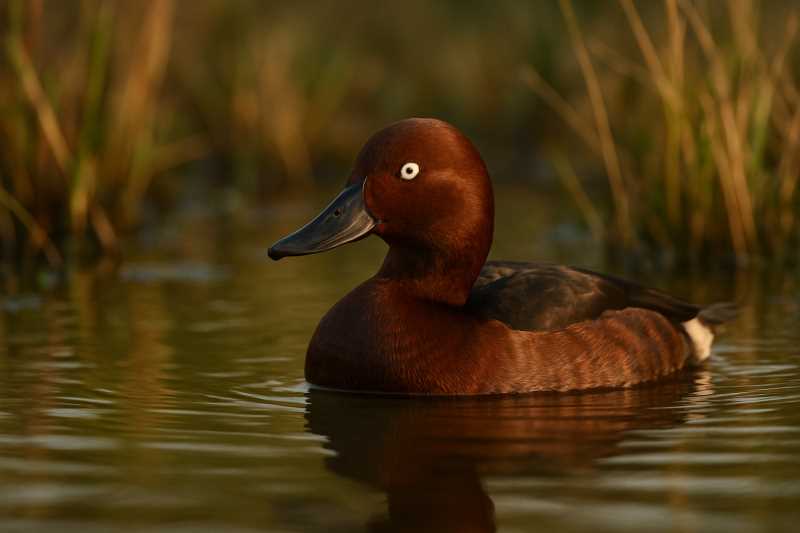
Breeding males have a rich chestnut-brown head, neck and breast, contrasting with darker upperparts. Their most distinctive feature is a white iris, which gives the species its Malagasy name and helps separate adult males from females. Females are generally duller and browner, with dark brown eyes. Juveniles resemble females but are paler and less sharply marked, with less extensive white on the undertail.
Range and Habitat
The Madagascar Pochard is endemic to Madagascar. It formerly occurred in parts of the central highlands, including the Lake Alaotra basin, but disappeared from much of its historical range as wetlands were converted for rice cultivation and degraded by introduced fish, fishing, hunting, grazing, deforestation and siltation.
The surviving wild population was rediscovered at the Bemanevika lake complex in northern Madagascar, where birds use several deep volcanic lakes. Lake Matsaborimena is especially important because it is the only site where nesting and ducklings were recorded in the original wild population. Birds have also been observed at Lakes Andriakanala and Matsaborimaitso, with seasonal differences in lake use.
Lake Sofia, in the Sofia Region, was selected as a reintroduction site after surveys identified suitable wetland habitat, including emergent vegetation used for nesting. The species is resident rather than a regular long-distance migrant, although individuals move between nearby lakes and may shift their use of wetlands seasonally.
Where to See This Species
Bemanevika Protected Area, Sofia Region, Madagascar
Bemanevika is the principal site for observing the remaining naturally occurring population. The birds are associated with the protected area’s forest-fringed volcanic lakes, especially Lake Matsaborimena. Access is remote and normally requires a four-wheel-drive vehicle, local guides and careful planning. Roads can become difficult during the rainy season, generally from December to May.
Nearby accommodation: Basic locally arranged lodging or camping is available around Bemanevika and its research facilities. Antsohihy is the nearest practical regional town for more conventional guest-house accommodation and supplies.
Lake Sofia, Sofia Region, Madagascar
Lake Sofia is the main reintroduction and wetland-restoration site for the species. Captive-bred Madagascar Pochards were first released there in 2018, and the birds subsequently bred in the wild. The lake contains marsh and emergent vegetation suitable for the species, but water levels and habitat condition require continuing management. Visits should be arranged through recognised conservation or local partners rather than treated as an unsupervised birdwatching destination.
Nearby accommodation: Basic village lodging or camping may be possible by prior local arrangement. Antsohihy is the most practical regional base for guest houses, transport and supplies.
Fotsimaso Interpretation Centre, Antsohihy, Sofia Region, Madagascar
The Fotsimaso Interpretation Centre was established as part of the Madagascar Pochard conservation-breeding programme. It offers a more accessible opportunity to see the species in managed conditions and to learn about the captive-breeding, reintroduction and wetland-restoration work. This is not a wild population, so visitors should distinguish captive birds at the centre from birds at Bemanevika and Lake Sofia.
Nearby accommodation: Antsohihy has the region’s most practical choice of hotels, guest houses and other basic town accommodation.
Behaviour and Diet
The Madagascar Pochard spends most of its time on water and feeds by diving. Its diet includes aquatic invertebrates and other small organisms obtained underwater. The species depends on wetlands that provide adequate food, suitable water depth and vegetated margins or floating vegetation for shelter and nesting.
It is generally encountered singly or in pairs rather than in large flocks. Birds may move between lakes according to season, water conditions and food availability. At Bemanevika, Lake Matsaborimena is used throughout the year, while other lakes appear to be used more seasonally.
Females build nests among emergent vegetation and incubate the eggs. Nesting has been recorded at Lake Matsaborimena, where the original wild population produced ducklings. Captive breeding began after eggs were collected from the wild in 2009, and the first captive-bred ducklings hatched in 2011. The first major release of captive-bred birds into the wild took place at Lake Sofia in 2018.
Identification Tips
- Look for a dark, compact diving duck sitting low in the water, often with the tail partly submerged.
- Adult males have a rich chestnut head and breast, dark upperparts, pale lower underparts and a striking white eye.
- Females are duller brown and have dark eyes.
- The white undertail coverts may show when the bird is swimming or diving.
- In flight, the dark wings show a conspicuous white wing-bar.
- The Madagascar Pochard is the only pochard native to Madagascar, so confusion with another resident Aythya species is unlikely. Identification should nevertheless be based on the combination of dark brown plumage, body shape, white undertail and, in adult males, the white iris.
Conservation Status
The Madagascar Pochard is classified as Critically Endangered on the IUCN Red List. It was formerly considered extinct after decades without confirmed records, but a small population was rediscovered at Bemanevika in 2006.
Major threats include wetland loss, rice cultivation, deforestation, siltation, altered water levels, introduced fish, fishing practices, hunting and the degradation of aquatic food supplies. The species is also vulnerable because its distribution remains extremely restricted and its population has a limited genetic and demographic safety margin.
Conservation measures include captive breeding, genetic management, wetland restoration, community-based management, monitoring of wild birds and the reintroduction of captive-bred individuals. Lake Sofia has required particularly intensive management, including work to stabilise water levels and improve conditions for both wildlife and surrounding communities. The species remains at very high risk despite the progress made since its rediscovery.
Frequently Asked Questions
Where is the Madagascar Pochard found?
It is endemic to Madagascar. The main wild sites are the Bemanevika lake complex in the north of the island and Lake Sofia in the Sofia Region, where captive-bred birds were reintroduced.
Was the Madagascar Pochard really extinct?
It was widely treated as extinct after prolonged absence from known sites, but a surviving population was rediscovered at Lake Matsaborimena in 2006. It is therefore better described as having been presumed extinct rather than confirmed extinct.
What does the Madagascar Pochard eat?
It feeds mainly underwater, taking aquatic invertebrates and other small aquatic organisms. Healthy wetlands with sufficient food are essential for successful breeding and survival.
How can the species be identified?
Adult males are dark brown with a chestnut head and breast and a distinctive white iris. Females are duller brown with dark eyes. Both sexes have pale lower underparts, white undertail coverts and a white wing-bar visible in flight.
Can visitors see Madagascar Pochards in the wild?
Yes, but wild viewing is difficult. Bemanevika is remote and requires local arrangements, suitable transport and a guide. Lake Sofia is also a conservation-managed site. The Fotsimaso Interpretation Centre in Antsohihy provides a more accessible opportunity to see birds in captivity.
Why is the Madagascar Pochard important?
It is one of Madagascar’s most threatened endemic birds and an indicator of the condition of the island’s freshwater wetlands. Its conservation also benefits other wetland wildlife and the communities that depend on functioning lakes and marshes.
References
- IOC World Bird List
- IUCN Red List of Threatened Species
- Durrell Wildlife Conservation Trust
Related posts