
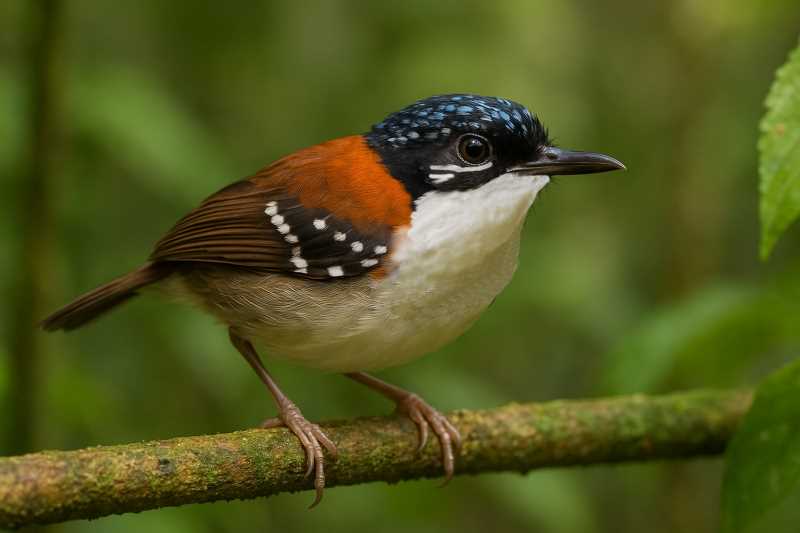
Wallace’s Fairywren (Sipodotus wallacii) is one of the most distinctive and least-known members of the Australo-Papuan fairywren family (Maluridae). Found in the humid lowland and foothill forests of New Guinea, this small, elusive bird is the sole representative of the genus Sipodotus, a lineage that reveals much about the evolutionary complexity of New Guinea’s avifauna. Named in honor of the famed British naturalist Alfred Russel Wallace, this species continues to intrigue ornithologists due to its unique vocalizations, behavior, and ecological niche.
Taxonomy and Classification
Wallace’s Fairywren holds a singular place in the taxonomy of Australasian wrens. While most fairywrens belong to the genera Malurus, Chenorhamphus, or Clytomyias, Sipodotus wallacii is the only species in its genus. Its anatomical and vocal features set it apart from other wrens, suggesting a long evolutionary separation. Though it shares many traits with typical fairywrens, including small size and insectivorous habits, it differs significantly in its nesting behavior and vocalizations.
Previously, some authorities grouped this bird with the Broad-billed Fairywren of northern Australia, but molecular analyses and morphological differences have solidified its independent status.
Physical Description
Wallace’s Fairywren is a small bird, about 11 to 12 centimeters in length, with a slender build and a long tail. Its plumage is subdued but attractive, featuring earthy browns on the upperparts and paler buff or whitish underparts. The crown and nape are a pale bluish-grey in males, providing a slight iridescent sheen in good light, while females are plainer overall with similar body structure.
Unlike many fairywrens, Wallace’s Fairywren shows limited sexual dimorphism, with males and females being relatively similar in color, particularly outside the breeding season. The bill is short and pointed—well-adapted for gleaning insects from leaves and bark.
Range and Habitat
This species is widely distributed across New Guinea and adjacent offshore islands, including parts of Indonesia’s West Papua and Papua New Guinea. It is typically found at elevations ranging from sea level to around 1,200 meters, favoring dense lowland rainforest, forest edges, secondary growth, and bamboo thickets.
Wallace’s Fairywren is most commonly encountered in the undergrowth and mid-canopy, where it actively forages and sings. Due to the dense and remote nature of its preferred habitat, the species is more often heard than seen.
Behavior and Ecology
Wallace’s Fairywren exhibits behaviors that distinguish it from other fairywrens. It is generally encountered in pairs or small family groups, flitting actively through dense vegetation. The species forages for small insects and other arthropods, using its fine bill to probe among leaves, bark, and foliage.
A defining characteristic is its unique and melodious vocalization. Unlike the sharp, buzzy calls of Australian fairywrens, Wallace’s Fairywren produces a sweet, clear song often described as fluty or bell-like. These songs are used for both territory defense and mate communication and can be heard throughout the day in suitable habitat.
Interestingly, the species may not engage in cooperative breeding—a behavior common among many of its Australian relatives. It instead appears to follow a more traditional monogamous breeding system, with nesting pairs defending small territories.
Breeding and Nesting
Very little is known about the nesting habits of Wallace’s Fairywren, although it is presumed to build dome-shaped nests similar to other Maluridae members. These nests are typically constructed low in the vegetation, often hidden in thick undergrowth or vines.
Breeding likely coincides with the local wet season when insect abundance increases. More field research is needed to document egg clutch sizes, incubation periods, and fledging success, all of which remain largely undocumented.
Conservation Status
The IUCN currently lists Wallace’s Fairywren as a species of Least Concern, owing to its broad distribution and the relative inaccessibility of its forested habitat. However, ongoing threats such as logging, habitat fragmentation, and development—particularly in lowland areas—could pose risks to localized populations.
While not currently under immediate threat, the species’ secretive nature and reliance on intact forest underscore the importance of preserving New Guinea’s lowland rainforest ecosystems. Future conservation efforts should aim to monitor population trends and protect critical habitats.
Scientific and Cultural Significance
Wallace’s Fairywren not only honors one of the most influential figures in natural history, Alfred Russel Wallace, but also stands as a living testament to the evolutionary richness of New Guinea. Its isolated lineage and distinctive behaviors make it a high-priority species for further ornithological study.
For birdwatchers, Wallace’s Fairywren remains a sought-after species—its elusive nature and unique song offering a rewarding challenge. For scientists, it provides clues into biogeographic patterns, speciation, and forest ecosystem dynamics in the Australo-Papuan region.
Related posts


