Introduction
The Seychelles Swiftlet (Aerodramus elaphrus) is a small, endemic swift of the Seychelles archipelago in the western Indian Ocean. It belongs to the swift family Apodidae and spends much of its life in flight, catching insects above forests, wetlands, gardens and other habitats. It is also one of the few birds known to use echolocation, particularly when moving through dark breeding caves.
Physical Description
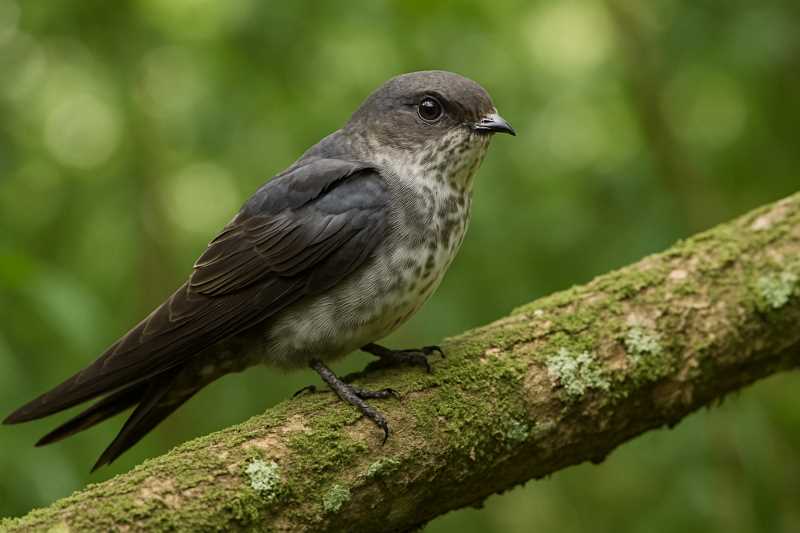
The Seychelles Swiftlet is about 10–12 cm long. It has a streamlined body, long pointed wings and a slightly forked tail. The upperparts are dark grey-brown, with a somewhat paler rump, while the underparts are pale grey-brown and darker around the undertail-coverts. The bill and legs are black.
Males and females are not known to show obvious differences in plumage. The species is usually seen in flight, often as a small group of fast-moving, dark birds above forest edges, rocky slopes or open ground.
Range and Habitat
The Seychelles Swiftlet is endemic to Seychelles. It breeds on Mahé, Praslin and La Digue, and may occasionally be seen on other islands. Its habitat use is broad, extending from coastal areas and lowland wetlands to mountain forest. It can also forage over gardens, agricultural land and urban areas where flying insects are available.
Breeding colonies are associated with caves, crevices and other sheltered rocky sites. The species has a limited breeding distribution, and some colonies may be concentrated in only a small number of suitable caves.
Where to See This Species
Morne Seychellois National Park, Mahé, Seychelles
Morne Seychellois National Park contains extensive forest, mountain slopes, wetlands and rocky areas, and the park authority lists the cave swiftlet among its birdlife. The species is most likely to be detected in flight over forest clearings, gullies and higher ground, particularly during active feeding periods.
Nearby accommodation: Victoria and the settlements along the Sans Souci Road provide practical access to guest houses, hotels and self-catering accommodation.
Vallée de Mai Nature Reserve, Praslin, Seychelles
The Vallée de Mai is a publicly accessible reserve containing well-preserved palm forest and supporting swiftlets among its endemic wildlife. Swiftlets may be seen hawking for insects above the forest and along open edges, although sightings are not guaranteed.
Nearby accommodation: Baie Sainte Anne and Grand Anse are the main accommodation areas, with hotels, guest houses and self-catering options.
Fond Ferdinand Nature Reserve, Praslin, Seychelles
Fond Ferdinand is a publicly accessible forest reserve and a recognised birdwatching site on Praslin. The Seychelles Bird Records Committee identifies the reserve as a useful area for observing swiftlets in suitable forest and open habitats.
Nearby accommodation: Baie Sainte Anne is the nearest practical gateway, with guest houses, hotels and self-catering accommodation.
Behaviour and Diet
The Seychelles Swiftlet is an agile aerial insectivore. It catches small flying insects in flight, with hymenopterans such as ants forming an important part of the diet. Feeding groups are most noticeable in the morning, late afternoon or during cloudy weather, when the birds may fly closer to the ground.
The species spends much of its time airborne and is usually encountered as individuals or small groups. In caves, it uses soft clicking sounds for echolocation, allowing it to navigate in darkness.
Breeding is colonial and takes place in caves. The small cup-shaped nest is attached to a cave wall or ceiling and is made from plant material held together with saliva. A clutch normally contains one egg, although two eggs have been recorded. Incubation is not precisely documented, but is thought to last about 25–30 days. Both adults feed the chick, which may remain in the nest for approximately 42 days before fledging.
Identification Tips
- Look for a small, dark, fast-flying bird with long pointed wings and a slightly forked tail.
- The plumage is generally all brown or grey-brown, with a subtly paler rump and paler underparts.
- The species is usually identified by its flight pattern and habitat rather than by detailed plumage features.
- Feeding birds may form loose groups above forest clearings, valleys, wetlands, gardens and mountain roads.
- A soft twittering call may be heard from birds in flight, while metallic clicking sounds are associated with movement inside caves.
- The Seychelles Swiftlet should not be confused with larger swifts or hirundines. Its small size, long narrow wings and almost constant aerial activity are useful field characters.
Conservation Status
The Seychelles Swiftlet is classified as Vulnerable. A population estimate from studies conducted in 1996–1997 suggested approximately 2,500–3,000 individuals, including an estimated 1,700–2,000 mature birds. These figures are historical and should not be treated as a current census.
The principal concerns are the species’ small range, limited number of known breeding caves, disturbance at nesting sites, pesticide use, habitat modification and predation by introduced cats and Barn Owls. Conservation measures include protecting breeding caves, retaining insect-rich forest and wetland habitat, limiting disturbance and improving knowledge of the species’ population and breeding distribution.
Frequently Asked Questions
Where is the Seychelles Swiftlet found?
It is endemic to Seychelles and breeds mainly on Mahé, Praslin and La Digue. It may sometimes be seen on other islands.
What does the Seychelles Swiftlet eat?
It feeds on small flying insects caught in the air. Ants and other hymenopterans are important components of its diet.
Can the Seychelles Swiftlet echolocate?
Yes. It uses clicking sounds to navigate in dark caves, particularly around its nesting and roosting sites.
Where does the Seychelles Swiftlet nest?
It nests communally in caves, crevices and other sheltered rocky sites. Its small nest is made from plant material bound with saliva and attached to a cave surface.
When is the best time to look for this bird?
Early morning, late afternoon and cloudy conditions can be productive because feeding birds may fly lower and become easier to observe. Sightings are still dependent on local weather, insect activity and the presence of nearby colonies.
Is the Seychelles Swiftlet threatened?
Yes. It is classified as Vulnerable because of its restricted island range, small population, limited breeding sites and threats including cave disturbance, pesticides and introduced predators.
References
- BirdLife International
- Nature Seychelles
- Seychelles Bird Records Committee
Related posts