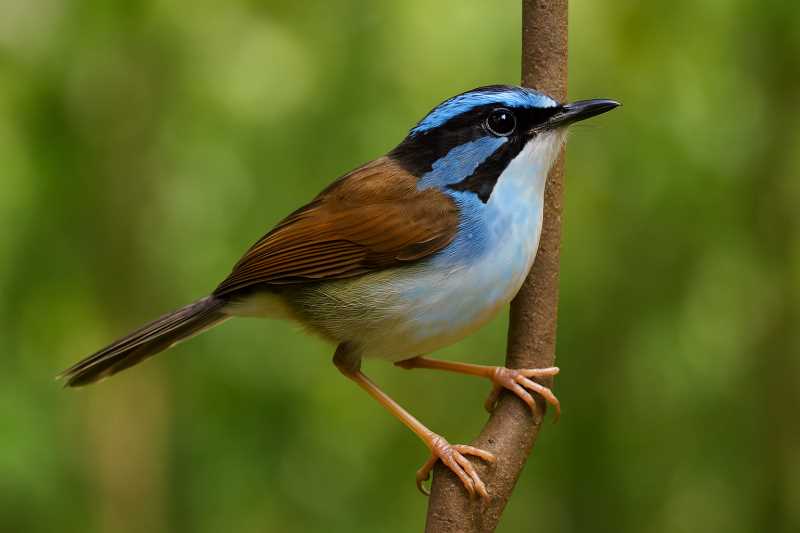
Campbell’s Fairywren (Chenorhamphus campbelli) is one of Australia’s most elusive and least-known songbirds, hidden deep within the tropical lowland rainforests of Cape York Peninsula in Far North Queensland. A close relative of the Broad-billed Fairywren, this recently recognized species stands as a symbol of how much there is still to learn about Australia’s northern avian fauna. With its secretive habits, restricted range, and beautifully subtle plumage, Campbell’s Fairywren captures the imagination of ornithologists and birdwatchers alike.
Taxonomy and Discovery
Campbell’s Fairywren was formerly grouped with the Broad-billed Fairywren (Chenorhamphus grayi) and considered a single species alongside New Guinea’s White-shouldered Fairywren. However, a taxonomic revision in 2011—based on genetic, vocal, and morphological evidence—split the Australian birds into two distinct species: C. grayi and C. campbelli. The two occupy separate regions of Cape York and exhibit key differences in plumage and vocal behavior.
The species is named in honor of naturalist Archibald Campbell, who contributed significantly to early ornithological studies in Australia.
Physical Description
Campbell’s Fairywren exhibits subtle but beautiful plumage characteristics that distinguish it from other fairywrens. The adult male in breeding plumage displays a combination of deep black on the crown, face, and chest, offset by soft bluish-gray on the upperparts, shoulders, and wings. Unlike the Broad-billed Fairywren, the male of this species lacks prominent white shoulder patches and instead features a more understated coloration.
Females and non-breeding males are dressed in warm rufous-brown tones, with pale underparts and a slightly lighter eye-ring. Both sexes share the characteristic broad, flat bill that defines the Chenorhamphus genus, an adaptation likely suited for gleaning insects in dense foliage.
Range and Habitat
Campbell’s Fairywren is restricted to the southern portion of Cape York Peninsula, including areas around the Iron Range and Kutini-Payamu National Park. Its preferred habitat is tropical lowland rainforest and dense vine thickets, often in regions with closed canopy and a rich understory.
The species is highly habitat-specific and shows little inclination to move into drier or more open woodland areas. As a result, its distribution is fragmented and confined to undisturbed forest tracts, making it susceptible to environmental pressures.
Behavior and Ecology
This fairywren is notoriously difficult to observe due to its quiet demeanor and preference for staying within dense vegetation. Pairs or small family groups forage near ground level, using their broad bills to glean insects and other invertebrates from leaves and branches. Like its relatives, Campbell’s Fairywren exhibits cooperative breeding behaviors, with offspring from previous broods potentially helping to raise the next generation.
Vocalizations are soft and high-pitched, typically consisting of short trills and contact calls. These subtle sounds make them challenging to detect, even for experienced birders. Territorial behavior has been observed, though much of the species’ social ecology remains undocumented due to the difficulty of field observation in its remote habitat.
Breeding and Nesting
Breeding is believed to occur during the early wet season, when insect abundance peaks. Nests are typically dome-shaped and hidden within low shrubbery or dense vines. The female is responsible for building the nest and incubating the eggs, while the male—and possibly helper birds—assist in feeding the young after hatching.
The reproductive behavior of Campbell’s Fairywren remains under-studied, with most observations based on inferences from closely related species. Future fieldwork is likely to uncover additional insights into its breeding strategies and group dynamics.
Conservation Status
Although Campbell’s Fairywren is not currently listed as threatened, it is classified as Near Threatened by BirdLife International due to its very limited range and reliance on intact rainforest habitats. Deforestation, altered fire regimes, and climate change represent ongoing threats to its long-term viability. Mining, road construction, and the encroachment of feral animals could also affect the delicate ecological balance of its environment.
Fortunately, parts of its range fall within protected areas such as Kutini-Payamu National Park, offering some buffer against habitat degradation. Conservation efforts should focus on preserving rainforest corridors, controlling invasive species, and conducting further surveys to clarify the species’ true distribution and population size.
A Window into a Forgotten World
Campbell’s Fairywren is more than just a beautiful bird—it is a representative of a unique evolutionary lineage that evolved in isolation within the forests of northern Australia. Its cryptic habits and limited range highlight the importance of rainforest preservation in Cape York, one of the continent’s last true wilderness frontiers.
For birdwatchers, glimpsing a Campbell’s Fairywren is an elusive prize, often requiring patience, local knowledge, and luck. For scientists, it represents a fascinating example of speciation and adaptation in tropical ecosystems. And for conservationists, it is a call to action to safeguard the fragile habitats that nurture such rare and remarkable life.
Related posts