The Elusive Speckled Antshrike: A Hidden Gem of the Neotropics
The Speckled Antshrike (Xenornis setifrons) is a remarkable bird species native to the lush forests of Central and South America. Despite its understated presence in the ornithological world, this enigmatic bird captivates researchers and birdwatchers alike with its unique characteristics and ecological significance. This article delves into the life and habits of the Speckled Antshrike, highlighting its habitat, behavior, conservation status, and the ongoing efforts to study and protect this elusive species.
Habitat and Distribution
The Speckled Antshrike is primarily found in the lowland and foothill forests of Panama and Colombia. Its range is relatively limited, making it a focal species for conservationists concerned about habitat loss in these regions. The bird prefers dense, humid forests, thriving in areas rich with tangled undergrowth and a dense canopy. These environments not only provide ample food resources but also offer the cover essential for its survival.
Within its limited range, the Speckled Antshrike is considered somewhat elusive, often remaining hidden from plain sight. Its preference for dense underbrush makes it a challenge for birdwatchers to spot, but its distinctive vocalizations often give away its presence. The bird’s call, a series of sharp, raspy notes, can be heard echoing through the forest, serving as a guide for those trying to catch a glimpse of this secretive species.
Physical Characteristics
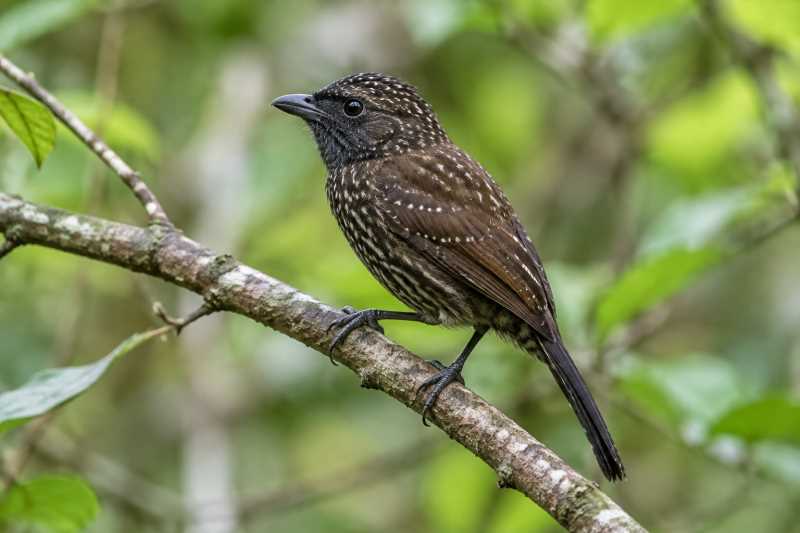
The Speckled Antshrike is a small bird, measuring about 16 centimeters in length. Its plumage is predominantly brown, with speckles and streaks that provide superb camouflage against the forest floor and foliage. This cryptic coloration is not only visually striking but also crucial for avoiding predators. The bird’s sturdy, hooked bill is well-adapted for its diet, which consists primarily of insects and other small invertebrates.
Both male and female Speckled Antshrikes share similar plumage, making it difficult to distinguish between the sexes in the field. This monomorphic trait is relatively uncommon among birds, where sexual dimorphism is often pronounced. The bird’s inconspicuous appearance and muted colors are key adaptations that facilitate its stealthy lifestyle.
Behavior and Ecology
The Speckled Antshrike is an insectivore, feeding largely on ants and other arthropods found within its forest habitat. It forages by gleaning insects from leaves and branches, often moving methodically through the underbrush in search of prey. The bird’s feeding habits play a crucial role in controlling insect populations, thereby contributing to the ecological balance of its habitat.
Socially, the Speckled Antshrike is known to be a solitary bird, typically seen alone or in pairs rather than in large flocks. During the breeding season, however, pairs become more territorial, engaging in vocal displays to ward off intruders. Little is known about their nesting habits, but it is believed that they build their nests low to the ground, nestled among dense vegetation to protect their young from predators.
Conservation Status
Currently, the Speckled Antshrike is classified as Near Threatened on the International Union for Conservation of Nature (IUCN) Red List. The primary threat to its survival is habitat destruction due to logging, agriculture, and urban development. As forests are cleared or degraded, the bird’s natural habitat is shrinking, leading to population declines.
Conservation efforts are underway to protect the remaining habitats of the Speckled Antshrike. These initiatives include the establishment of protected areas, reforestation projects, and community outreach programs aimed at promoting sustainable land use practices. Scientists and conservationists are also advocating for more research to better understand the species’ ecology and to develop more effective conservation strategies.
Research and Observation
Despite its elusive nature, the Speckled Antshrike continues to be a subject of interest for ornithologists and bird enthusiasts. Field studies are crucial for uncovering more about its behavior, breeding patterns, and ecological needs. Recent advances in technology, such as bioacoustic monitoring and remote sensing, are aiding researchers in tracking the movements and population dynamics of this secretive bird.
Citizen science projects also play a role in gathering valuable data. Birdwatchers and local communities contribute to databases by logging sightings and vocalizations, providing researchers with a broader understanding of the bird’s distribution and abundance.
Conclusion
The Speckled Antshrike, with its subtle beauty and ecological importance, serves as a reminder of the intricate biodiversity found within the world’s tropical forests. Protecting this species not only ensures its survival but also helps preserve the complex ecosystems it inhabits. As conservationists and researchers continue to unravel the mysteries of Xenornis setifrons, their work highlights the critical need for preserving the planet’s natural wonders for future generations.
By raising awareness about the Speckled Antshrike and its habitat, we can foster a deeper appreciation for the biodiversity that enriches our world, inspiring action to safeguard these precious resources.
Related posts