The Blue-necked Jacamar: A Jewel of the Amazon
The Amazon rainforest, a vast and diverse ecosystem, is home to many unique and captivating bird species. Among these avian wonders is the Blue-necked Jacamar (Galbula cyanicollis), a striking bird known for its vivid coloration and intriguing behavior. This article delves into the characteristics, habitat, behavior, and conservation status of this remarkable species, offering a comprehensive overview for ornithologists and bird enthusiasts alike.
Characteristics and Appearance
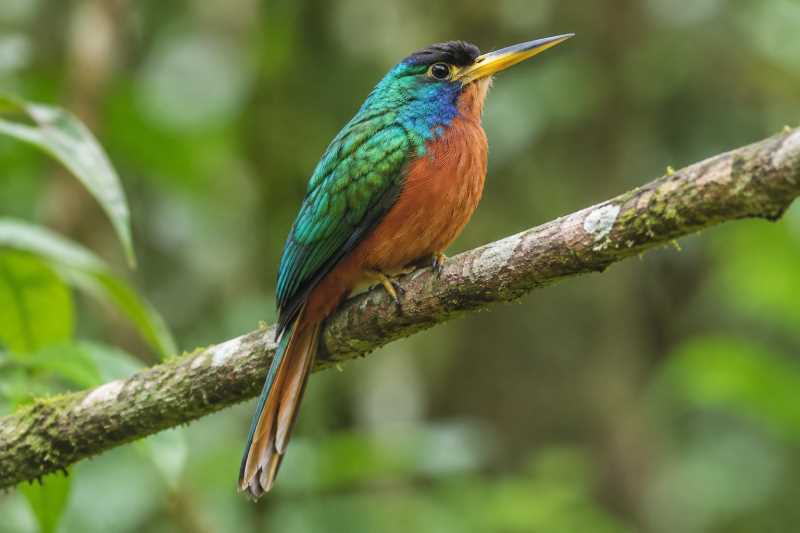
The Blue-necked Jacamar is a medium-sized bird, measuring approximately 18 to 23 centimeters in length. It is distinguished by its iridescent plumage, which showcases a stunning combination of emerald green and azure blue, particularly around its neck and breast, giving the species its name. The jacamar’s slender body is complemented by a long, sharp bill, perfectly adapted for catching insects in flight. Its wings are rounded, and its tail is relatively long, enhancing its agility in the dense forest canopy.
The sexual dimorphism in Blue-necked Jacamars is subtle but notable. Males and females share similar color patterns, but females tend to have a slightly duller hue compared to their male counterparts. This dimorphism aids in camouflage, particularly important for females during nesting periods.
Habitat and Range
The Blue-necked Jacamar is endemic to the Amazon Basin, thriving in the tropical and subtropical moist lowland forests of Brazil, Bolivia, Colombia, Ecuador, and Peru. It favors the dense understory and edge habitats, often near water bodies, where it can easily find its preferred prey. The species is most commonly observed in regions with abundant insect life, as its diet primarily consists of flying insects such as butterflies, moths, and dragonflies.
These jacamars are non-migratory, although they may exhibit some local movements in response to food availability or environmental changes. Their reliance on specific forest habitats makes them sensitive indicators of ecosystem health in the Amazon.
Behavior and Diet
The Blue-necked Jacamar is an adept aerial hunter, renowned for its impressive hawking technique. Perched quietly on a branch, the bird surveys its surroundings with keen eyesight. Upon spotting a potential meal, it swiftly launches into the air, capturing insects with remarkable precision. After a successful hunt, the jacamar returns to its perch to consume its prey, often beating it against the branch to subdue it.
In addition to its hunting prowess, the Blue-necked Jacamar is known for its vocalizations. Its calls are sharp and repetitive, serving both territorial and mate-attraction purposes. These vocal displays are crucial in maintaining pair bonds and delineating territory boundaries within the dense forest.
Breeding and Nesting
Breeding season for the Blue-necked Jacamar coincides with the onset of the rainy season, typically from September to December. During this period, pairs engage in elaborate courtship displays, which include synchronized flights and vocal exchanges. Once a pair bond is established, they collaborate in selecting a suitable nesting site.
Unlike many birds that build nests in trees, jacamars excavate burrows in sandy or clay banks, often near rivers or other water bodies. Both parents participate in the excavation, creating a tunnel that can extend up to one meter in length. At the end of this tunnel, a small chamber serves as the nesting site, where the female lays a clutch of two to four white eggs.
Both parents share incubation duties, and once the eggs hatch, they continue to care for and feed the chicks. The fledgling period lasts around three weeks, after which the young birds leave the nest to fend for themselves.
Conservation Status and Threats
The International Union for Conservation of Nature (IUCN) currently classifies the Blue-necked Jacamar as a species of Least Concern. However, like many inhabitants of the Amazon, it faces threats from deforestation, habitat fragmentation, and environmental degradation. The expansion of agriculture, logging activities, and infrastructure development continue to encroach upon its natural habitat, posing a significant risk to its population.
Conservation efforts focused on preserving the Amazon rainforest are crucial for the survival of the Blue-necked Jacamar and countless other species. Initiatives aimed at sustainable land use, reforestation, and the establishment of protected areas are essential components in safeguarding this delicate ecosystem.
Conclusion
The Blue-necked Jacamar is a testament to the incredible biodiversity of the Amazon rainforest. Its vibrant plumage, agile hunting skills, and complex social behavior make it a fascinating subject of study for ornithologists and nature lovers alike. As we continue to explore and understand the intricate web of life within this vital ecosystem, the importance of conservation becomes ever more apparent. By protecting the habitats of species like the Blue-necked Jacamar, we are not only preserving the natural beauty of the Amazon but also ensuring the health and resilience of our planet’s ecosystems for future generations.
In conclusion, the Blue-necked Jacamar is more than just a bird; it is a symbol of the vibrant life that flourishes in the world’s largest tropical rainforest. Its story is a reminder of the delicate balance that sustains our natural world and the ongoing efforts needed to protect it.
Related posts