Introduction
The White-winged Nightjar (Eleothreptus candicans) is a rare nocturnal member of the nightjar family, Caprimulgidae. It is associated mainly with open Cerrado habitats in Brazil, Paraguay and Bolivia. The species is difficult to study because it is active after dark and occurs in a small number of widely separated populations.
Physical Description
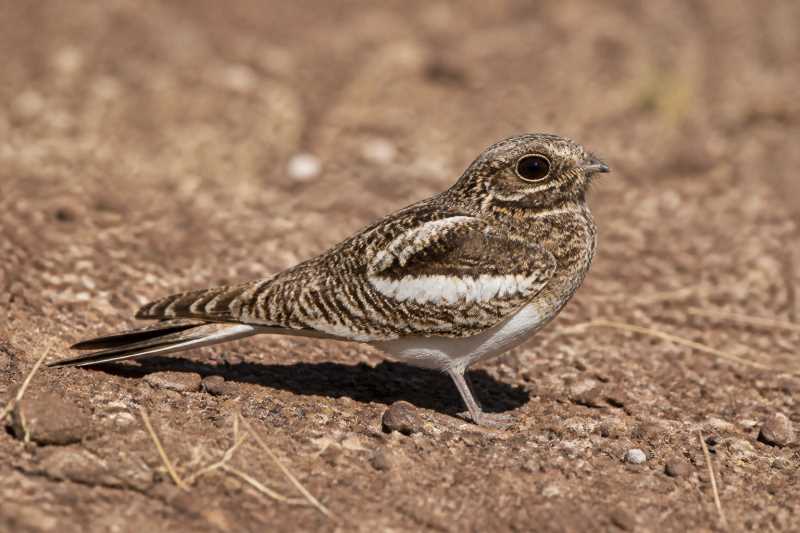
The White-winged Nightjar is a compact nightjar measuring approximately 20–23 cm in length. It has a large head, prominent eyes, relatively short tail and rounded wings. The upperparts are mainly brown, rufous and grey, providing effective camouflage against dry grass, leaf litter and bare ground.
Adult males are distinctive in flight. They show conspicuous white areas in the wings and tail, creating a strong black-and-white contrast. Females are browner and more subdued, with little or no obvious white in the wings and tail. Juveniles resemble females and can be greyer overall. Young birds lack the bold adult male markings until they moult into adult plumage.
The species has a characteristic broad pale supercilium and pale malar area. When perched, its large-headed, short-tailed appearance can be useful for identification, although females and immature birds require particular care.
Range and Habitat
The White-winged Nightjar has a fragmented distribution in the Cerrado region of central and south-central Brazil, eastern Paraguay and northern Bolivia. In Brazil, the most consistently documented population is in and around Emas National Park in Goiás and adjacent areas. In Paraguay, important records come from the Mbaracayú Forest Nature Reserve and the Laguna Blanca area. The species has also been recorded at the Beni Biological Station in Bolivia.
It favours open and semi-open Cerrado formations, including campo sujo, grassy savanna, low shrubland and open areas with scattered vegetation. Habitat preferences vary between localities. At Laguna Blanca, birds have been associated with shallow, grassy valleys and low shrub communities, while at Mbaracayú they have been recorded in Cerrado with dwarf palms. The species may also forage over nearby fields and other open areas, but habitat conversion can reduce the quality and continuity of suitable sites.
The White-winged Nightjar is generally treated as a resident at its known localities. The extent of any seasonal movement remains poorly documented.
Where to See This Species
Parque Nacional das Emas, Goiás and Mato Grosso do Sul, Brazil
Parque Nacional das Emas is one of the most important protected areas for the species and is the principal confirmed Brazilian stronghold. Its extensive open Cerrado, including grasslands and campo sujo, provides suitable habitat. The species is included in the park’s official list of threatened birds. Night-time access and some activities may require an authorised guide or prior arrangements.
Nearby accommodation: Chapadão do Céu and Mineiros provide hotels, guest houses and other practical accommodation, with camping and rural lodging also available in the wider park area.
Reserva Natural del Bosque Mbaracayú, Canindeyú, Paraguay
The Mbaracayú Forest Nature Reserve protects one of the best-known Paraguayan populations, particularly around the Aguara Ñu area. Open Cerrado within the reserve supports the species alongside the reserve’s extensive Atlantic Forest. Visitors should arrange access and a local guide in advance, as suitable nightjar habitat may be away from the main visitor facilities.
Nearby accommodation: Villa Ygatimí is the main gateway settlement, and the reserve itself has lodge and camping accommodation associated with Mbaracayú Lodge.
Reserva Natural Laguna Blanca, San Pedro, Paraguay
Laguna Blanca is a recognised birding site for the White-winged Nightjar and supports suitable open Cerrado, including low shrubland and grassy areas. Birds are most likely to be located around dusk or after dark, often during guided night drives or carefully organised searches. Access is through a private ecotourism area, so arrangements should be made before visiting.
Nearby accommodation: The Laguna Blanca tourism area provides basic rooms and lodge-style accommodation, while Santa Rosa del Aguaray is the practical nearby service town for additional hotels and guest houses.
Behaviour and Diet
The White-winged Nightjar is primarily nocturnal, becoming active around dusk and remaining active during the night. It is usually quiet and unobtrusive when perched, but its slow, tilting and gliding flight can be distinctive once learned. Males may perform display flights that reveal the white wing and tail markings. Displaying birds may also produce audible wing sounds.
The species feeds mainly on flying insects, including moths and other nocturnal insects captured in the air. It forages with rapid changes of direction as well as slower, floating flight, and may hunt over open ground, low vegetation and nearby fields.
Breeding has been documented during the rainy season in Paraguay, although timing may vary between localities. The female lays eggs directly on the ground rather than building a conventional nest. Eggs and young rely heavily on camouflage. Fledglings may remain motionless on low termite mounds or among dry vegetation when approached.
Identification Tips
- Look for a small, compact nightjar with a large head, short tail and rounded wings.
- Adult males are unmistakable in flight when the broad white wing and tail markings are visible.
- Females and juveniles are browner and lack the dramatic white pattern, so note the large-eyed appearance, broad pale supercilium and short-tailed shape.
- The flight can appear relaxed and floating, with noticeable tilting and gliding rather than consistently fast, direct flight.
- In Paraguay, the Little Nightjar (Setopagis parvula) is a potential comparison. It is generally longer-tailed and more direct in flight, often perches on roads, and shows a different wing pattern without the White-winged Nightjar’s extensive adult male white markings.
- Identification should be based on several features, especially for females and immature birds, because pale markings can be difficult to see in poor light.
Conservation Status
The White-winged Nightjar is classified as Endangered on the IUCN Red List. Its population is considered to be declining, and the known distribution is highly fragmented.
The principal threats are the loss, fragmentation and degradation of Cerrado habitat through agricultural expansion, cattle ranching, plantations and other land-use changes. Uncontrolled or poorly timed burning can also damage breeding and foraging areas, particularly where fire removes the low vegetation structure used by the birds. Small, isolated populations are vulnerable to further habitat deterioration and local disturbance.
Conservation depends on protecting remaining Cerrado, maintaining suitable open habitat through carefully planned management, preventing conversion of key sites and improving knowledge of population size, breeding ecology and seasonal movements. Emas National Park, Mbaracayú Forest Nature Reserve and Laguna Blanca are important sites for the species, but protection outside reserves is also relevant because suitable habitat can occur across private land and fragmented landscapes.
Frequently Asked Questions
Where is the White-winged Nightjar found?
It occurs in scattered Cerrado localities in central and south-central Brazil, eastern Paraguay and northern Bolivia. Important known sites include Emas National Park, Mbaracayú Forest Nature Reserve and Laguna Blanca.
Is the White-winged Nightjar endangered?
Yes. The species is classified as Endangered because it has a fragmented range, a declining population and continuing loss of suitable Cerrado habitat.
What does the White-winged Nightjar eat?
It feeds mainly on flying insects, especially moths and other nocturnal insects captured during aerial foraging.
How can a male White-winged Nightjar be identified?
An adult male is recognised by the extensive white markings in the wings and tail, which are especially conspicuous during display or normal flight. Its compact body, large head and rounded wings are also useful clues.
When is the best time to look for this species?
The best opportunity is around dusk and during the first hours of darkness, when the birds become active. Local guidance is particularly valuable because the species is scarce and may occur only in specific patches of suitable Cerrado.
Does the White-winged Nightjar migrate?
It is generally treated as resident at its known sites, but its seasonal movements are not well understood. Further field research is needed to determine whether some populations make regular local or regional movements.
References
- BirdLife International
- IUCN Red List of Threatened Species
- Instituto Chico Mendes de Conservação da Biodiversidade
Related posts