Introduction
The Spot-winged Wood Quail, Odontophorus capueira, is a secretive, ground-dwelling member of the New World quail family, Odontophoridae. It occurs mainly in eastern South America, where it inhabits dense forest and mature secondary vegetation. The species is resident rather than migratory and is more often heard than seen. It is also known regionally as the Uru or Uru-capoeira.
Physical Description
The Spot-winged Wood Quail is a compact, robust bird measuring approximately 24–30 cm in length. Reported adult weights are generally around 396–425 g, although measurements vary between sources and populations.
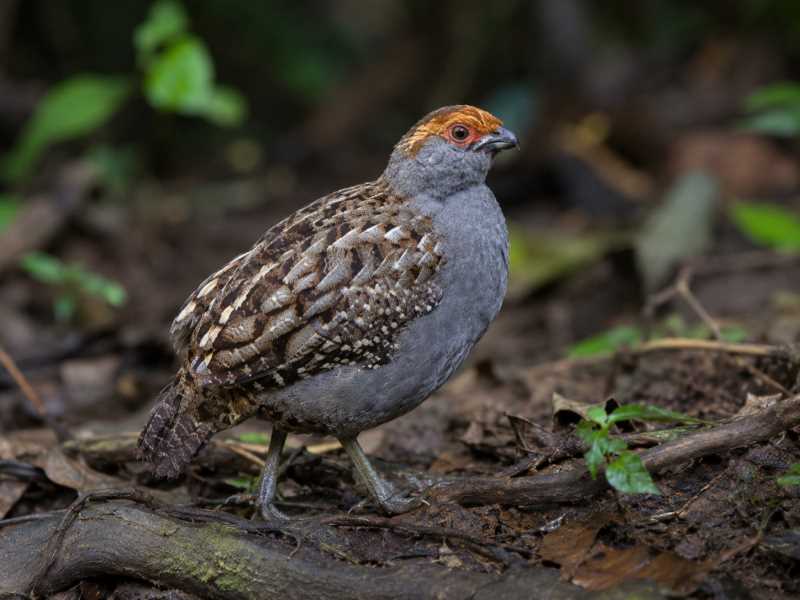
Adults have predominantly grey-brown and chestnut plumage, with darker vermiculation and streaking across the upperparts. The head is warm brown to rufous, with a loose crest, a strong dark bill and a narrow area of bare reddish skin around the eye. The underparts are generally slate-grey, while the rump and upper tail-coverts are more uniformly buff or brown.
The wing-coverts carry conspicuous pale or white spotting, especially noticeable when the bird moves or takes flight. This pattern gives the species its English name. The legs and feet are dark grey. Males and females are broadly similar, although males may have a slightly larger or more prominent crest and females may be marginally smaller. Juveniles resemble adults but usually show broader, more obvious upperpart streaking, warmer brown tones below and a paler or reddish bill.
Range and Habitat
The Spot-winged Wood Quail is distributed through eastern Brazil, eastern Paraguay and north-eastern Argentina, particularly in the Atlantic Forest region and adjacent forest habitats. Some taxonomic treatments recognise a northern Brazilian form, Odontophorus capueira plumbeicollis, while others discuss the distinctiveness of this population separately. It is important not to confuse the restricted conservation situation of this northern form with the global assessment of the species as a whole.
The species is non-migratory. It favours dense, humid forest, including Atlantic Forest, mature secondary woodland, forest edges, clearings with heavy cover, Araucaria woodland and some drier forest types. It usually remains on or close to the forest floor, where leaf litter and undergrowth provide cover. Records extend from lowlands into foothill and montane forest, with some sources reporting occurrences up to approximately 1,500–1,600 m.
Habitat quality is important. Although the species can use mature secondary vegetation, it is most strongly associated with continuous or well-developed forest that provides dense ground cover and reliable food resources.
Behaviour and Diet
This is a diurnal and predominantly terrestrial quail. It usually walks or runs through leaf litter and dense undergrowth, and often remains concealed when disturbed. When alarmed, it commonly escapes by running rather than flying, although it can make a short, rapid flight when necessary.
Spot-winged Wood Quails are social and are usually encountered as pairs, small groups or family coveys. Groups may contain several adults and younger birds, and neighbouring groups can be territorial. Their distinctive calls help maintain contact through dense vegetation. Calling may occur in duets, choruses or exchanges between groups, particularly around dawn and dusk and during the breeding period.
The diet consists mainly of fallen fruits, berries, seeds and other plant material collected from the forest floor. Documented or frequently reported food items include palm fruits, berries and Araucaria seeds. Small invertebrates, including insects and other arthropods, may supplement the diet, especially when feeding young.
The species nests on the ground, usually in a concealed site among leaves, dense vegetation or another form of cover. Reports describe nests formed from dry leaves and, in some cases, the use of shallow cavities or existing shelters. Available information on clutch size, incubation and parental care is limited and varies between sources, so precise figures should be treated cautiously. The chicks are nidifugous and leave the nest soon after hatching, remaining with the adults while they develop.
Identification Tips
Look for the following combination of features:
- A compact, heavy-bodied forest quail with a short tail.
- Grey-brown and chestnut plumage with strong dark streaking on the upperparts.
- A loose crest, reddish bare skin around the eye and a dark bill.
- Slate-grey underparts contrasting with warmer brown tones on the head and back.
- Pale spots on the wing-coverts, most apparent when the bird moves or flies.
- A preference for running through dense cover rather than flying into the open.
- Repeated, far-carrying calls given by pairs or groups, often from concealed birds or nearby perches.
In eastern South American forests, the combination of the crest, grey underparts, reddish eye-ring and spotted wing-coverts helps separate it from other forest quails. Identification should also take account of location, since several Odontophorus species have overlapping habitat preferences in parts of South America.
Conservation Status
The Spot-winged Wood Quail is assessed globally as Least Concern by the IUCN Red List and BirdLife International. The species has a broad geographic range and remains locally common in parts of it, but its population is considered to be declining.
The principal threats are loss and fragmentation of forest, agricultural expansion, logging and hunting. These pressures are particularly significant in the Atlantic Forest and in the restricted northern Brazilian populations. The form O. c. plumbeicollis, where recognised, has a much more limited distribution and faces greater local conservation concern, including habitat loss and hunting.
Conservation priorities include protecting remaining forest, maintaining habitat connections between forest fragments, managing hunting pressure and improving knowledge of population trends and the status of regional forms. Protected areas and well-managed private reserves are important because the species depends on structurally complex forest and ground cover.
Frequently Asked Questions
Where does the Spot-winged Wood Quail live?
It occurs mainly in eastern Brazil, eastern Paraguay and north-eastern Argentina, especially in and around the Atlantic Forest region.
Is the Spot-winged Wood Quail migratory?
No. It is regarded as a resident species and does not undertake regular long-distance migration.
What does the Spot-winged Wood Quail eat?
Its diet is based mainly on fallen fruits, berries, seeds and other plant material. Invertebrates such as insects and other arthropods may also be eaten.
Is the Spot-winged Wood Quail easy to see?
Usually not. It is secretive, remains close to the ground and moves through dense vegetation. Observers often detect it by its calls before seeing it.
How does the Spot-winged Wood Quail escape predators?
It commonly runs through leaf litter and undergrowth, using its camouflage and the density of the vegetation for protection. It can fly when necessary but generally avoids prolonged flight.
Is the Spot-winged Wood Quail endangered?
The species is globally assessed as Least Concern, but local populations may be threatened by forest clearance, fragmentation and hunting. The northern Brazilian form, when treated as O. c. plumbeicollis, has a considerably more restricted range and requires particular conservation attention.
References
- BirdLife International. 2026. “Spot-winged Wood-quail Odontophorus capueira Species Factsheet.” BirdLife DataZone. Accessed 8 September 2026. https://datazone.birdlife.org/species/factsheet/spot-winged-wood-quail-odontophorus-capueira
- Gill, F., Donsker, D. and Rasmussen, P. (eds). 2026. IOC World Bird List, version 15.2. International Ornithologists’ Union. Accessed 8 September 2026. https://www.worldbirdnames.org/
- del Hoyo, J., Collar, N. J., Christie, D. A., Elliott, A. and Fishpool, L. D. C. 2014. Illustrated Checklist of the Birds of the World, Volume 1: Non-passerines. Lynx Edicions, Barcelona.
- Ribeiro, M. R. de O. 2022. Distribuição biogeográfica e modelagem de nicho potencial da ave ameaçada Odontophorus capueira plumbeicollis Cory, 1915: compreendendo seu presente e passado para conservar seu futuro. Monografia, Universidade Federal do Ceará, Fortaleza. http://repositorio.ufc.br/handle/riufc/69577
- Oiseaux.net. n.d. “Tocro uru, Odontophorus capueira.” Accessed 8 September 2026. https://www.oiseaux.net/oiseaux/tocro.uru.html
- WikiAves. n.d. “Uru, Odontophorus capueira.” Accessed 8 September 2026. https://www.wikiaves.com.br/wiki/uru
- Avibase. n.d. “Spot-winged Wood-Quail, Odontophorus capueira.” Accessed 8 September 2026. https://avibase.bsc-eoc.org/species.jsp?avibaseid=46499ABFE6E4CB38&lang=EN
Related posts