The Enigmatic Cuckoo-Roller: A Glimpse into the Life of Leptosomus discolor
In the lush, vibrant forests of Madagascar and the Comoros Islands, an elusive avian species captures the curiosity of ornithologists and bird enthusiasts alike—the Cuckoo-Roller (Leptosomus discolor). This medium-sized bird, the sole representative of the family Leptosomidae, is a unique creature, not only due to its solitary position in its family but also because of its intriguing behaviors and striking appearance.
Taxonomy and Classification
The Cuckoo-Roller’s taxonomy is as fascinating as the bird itself. Belonging to the order Leptosomiformes, the Cuckoo-Roller is a testament to the rich biodiversity of Madagascar. The bird’s evolutionary lineage remains a subject of scientific interest, as it displays characteristics that align it with various avian groups, including the rollers and cuckoos, hence its name. Despite these affiliations, its distinct features set it apart, warranting its classification in a family all its own.
Physical Characteristics
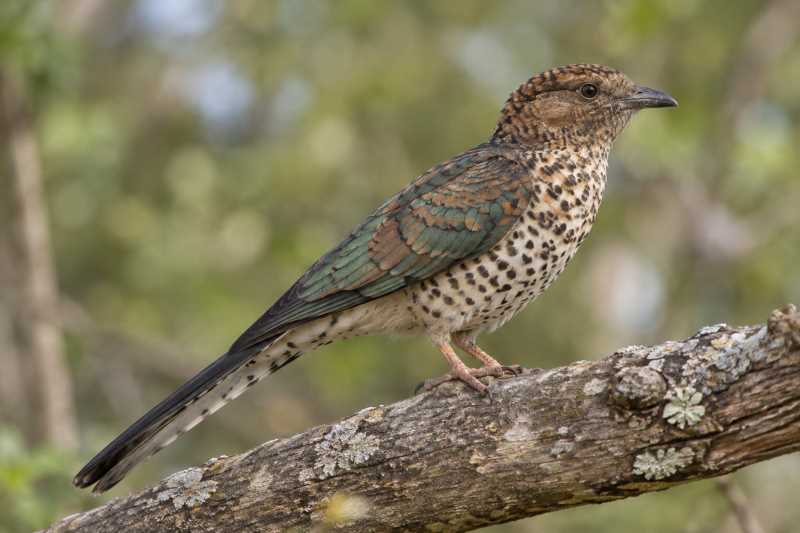
The Cuckoo-Roller is a medium-sized bird, measuring about 40-50 cm in length. Its most notable characteristic is its sexually dimorphic plumage. Males boast an iridescent green and blue coloration on their upperparts with a white belly, while females exhibit a more subdued brown plumage with speckled patterns that provide camouflage among the trees. Both sexes possess a robust body, a short neck, and a distinctive broad head, with eyes positioned to offer a nearly 360-degree field of vision—ideal for spotting prey in the dense canopy.
The bird’s zygodactyl feet, with two toes facing forward and two backward, equip it to adeptly maneuver through the forest, clinging to branches with ease. The Cuckoo-Roller’s beak is strong and curved, adapted for its predatory lifestyle.
Habitat and Distribution
The Cuckoo-Roller is endemic to Madagascar and the nearby Comoros Islands, thriving primarily in humid forest environments. These birds are highly arboreal, favoring the upper canopy of tropical and subtropical forests, but can occasionally be spotted at the forest edge or in secondary growth areas. Their presence is often an indicator of healthy, undisturbed forest ecosystems.
Behavior and Diet
Known for their secretive nature, Cuckoo-Rollers are typically solitary or found in pairs. They are most active during the early morning and late afternoon, spending much of their time searching for food or perched quietly in the foliage.
Their diet primarily consists of insects, particularly large ones such as locusts, grasshoppers, and beetles. They are also known to prey on small reptiles and amphibians. The Cuckoo-Roller employs a sit-and-wait hunting strategy, remaining still and silent until prey comes within reach, then making swift, precise strikes to capture it.
Reproduction and Lifespan
Breeding habits of the Cuckoo-Roller are not extensively documented, which adds to the intrigue surrounding this species. It is known that they nest in tree cavities, where the female typically lays two to three eggs. The incubation period and fledging process are not well-studied, but it is believed that both parents partake in rearing the young.
The lifespan of the Cuckoo-Roller in the wild is not well-documented, though it is believed to be similar to other medium-sized birds, potentially living up to 10 years or more under natural conditions.
Conservation Status
Currently, the Cuckoo-Roller is classified as a species of Least Concern by the International Union for Conservation of Nature (IUCN). However, its habitat is under constant threat from deforestation and human encroachment. Conservation efforts are crucial to ensure the preservation of Madagascar’s rich biodiversity, including the enigmatic Cuckoo-Roller.
Preserving large tracts of forest, enforcing anti-logging laws, and promoting sustainable land-use practices are vital strategies to protect this unique species and its habitat. Additionally, increased research and monitoring efforts are necessary to better understand the Cuckoo-Roller’s ecology and population dynamics.
Conclusion
The Cuckoo-Roller stands as a symbol of Madagascar’s unique biological heritage. Its distinctive features and behaviors continue to intrigue scientists and bird watchers, highlighting the importance of conserving such extraordinary species. As we delve deeper into the study of the Cuckoo-Roller, we uncover not only the mysteries of this single species but also broader ecological insights that can inform conservation strategies for the entire region.
As stewards of the Earth’s biodiversity, it is our responsibility to ensure that the Cuckoo-Roller and its habitat are protected for future generations to admire and study. By fostering a deeper understanding and appreciation of this remarkable bird, we can contribute to the broader efforts to preserve the natural wonders of Madagascar.
Related posts