Introduction
The Sulawesi Pitta, Erythropitta celebensis, is a small, vividly coloured forest bird in the pitta family, Pittidae. It is endemic to Indonesia, with its principal range on Sulawesi and additional populations on several nearby islands. The species is a resident rather than a long-distance migrant, and it is most often associated with humid forest, dense undergrowth and shaded ground where it searches for invertebrate prey. (doi.org)
Its taxonomy has changed in recent decades. The Sulawesi Pitta was formerly treated as part of the Red-bellied Pitta complex, but molecular and morphological studies supported recognition of several geographically distinct forms. Current IOC and BirdLife-linked treatments recognise Erythropitta celebensis as a species and include three subspecies, although some older or alternative lists may still use different arrangements. (researchgate.net)
The bird is an attractive target for visitors to Sulawesi, but it is not usually an easy species to see. Pittas spend much of their time on or close to the forest floor, where they can remain hidden among fallen leaves, roots and dense vegetation. Their short, direct flights are often followed by long periods of silence and stillness.
Physical Description
The Sulawesi Pitta is a compact, short-tailed bird measuring approximately 16 to 18 centimetres in length. It has the characteristic proportions of a forest pitta: a relatively large head, sturdy body, strong legs, short tail and a straight, slightly elongated bill suited to picking prey from leaf litter and soft ground. The available Indonesian identification literature gives a length of around 16–18 cm, while detailed taxonomic work describes the species as relatively small within the Red-bellied Pitta complex. (geopark-ijen.jatimprov.go.id)
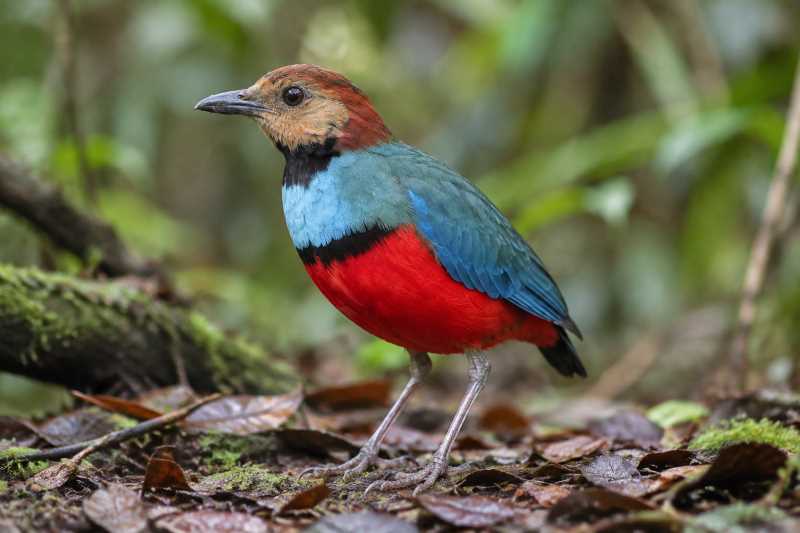
Adult plumage is highly distinctive when seen well. The crown is brownish or rufous-brown and is crossed by a narrow, bright blue central stripe. This blue crown stripe is bordered by darker, often blackish bands that extend towards the rear of the crown. The hindneck may show maroon, ferruginous or rusty colouring, although the strength of this feature varies between individuals and populations. The back and wings are predominantly green, producing a strong contrast with the blue and dark markings on the head. (researchgate.net)
The sides of the head, chin and upper throat are comparatively pale, often greyish or grey-brown with a warm rufous cast. A dark band crosses the lower throat or upper breast. Below this, the breast is blue, with green tones on the sides, followed by another dark horizontal band. The belly and lower underparts are reddish to crimson, although the exact balance of red, blue, green and black varies with subspecies, plumage wear and viewing conditions.
The wing pattern is usually visible only briefly, especially when the bird flies across a trail. Taxonomic descriptions note a distinct pale or blue-white speculum on the inner primaries, forming a narrow bar across the folded wing or a flashing patch in flight. This wing marking can be useful when a bird disappears rapidly into vegetation. (researchgate.net)
The sexes are broadly similar in colour and pattern. There is no well-established, obvious field character that reliably separates males from females at a distance. Differences reported in pittas may involve body size, plumage intensity or condition, but these are not dependable identification features for ordinary field observation. A calling male on territory may be more conspicuous than a female, particularly during the breeding season, but this reflects behaviour rather than a clear plumage difference.
Juveniles are less brightly marked than adults. Young birds generally show duller brown, green and buff tones, with reduced blue and red coloration. The clean, high-contrast crown pattern and vivid red underparts develop with maturity. Juveniles can therefore be mistaken for other small, brownish forest birds when glimpsed briefly on the ground. Documented juvenile records include observations from September, late November and early January, but the timing of juvenile plumage and moult is not fully described. (bioone.org)
Range and Habitat
The Sulawesi Pitta is endemic to Indonesia. Its core distribution covers Sulawesi, where it occurs in suitable forest across parts of the island, together with records from the Togian Islands and other nearby islands. The currently recognised subspecies include the nominate form, E. c. celebensis, from Sulawesi and associated islands; E. c. palliceps from Siau and Tahulandang; and E. c. caeruleitorques from the Sangihe Islands. The last two forms were formerly treated as separate species, the Siau Pitta and Sangihe Pitta, but the 2025 BirdLife and IUCN-linked treatment places them within E. celebensis because of shallow genetic divergence and limited phenotypic separation. (itis.gov)
This taxonomic arrangement is important when interpreting older records. A bird reported in the Sangihe or Siau island groups may appear under a former species name in earlier literature, while current databases may list it as a subspecies of the Sulawesi Pitta. Taxonomic databases should therefore be checked for the version and classification being used.
The species is principally associated with humid tropical forest, especially primary forest with a dense understorey. It also occurs in secondary forest, degraded forest, scrub, bamboo thickets, plantations and forest remnants where ground cover remains sufficiently dense. The IUCN assessment describes primary forest as preferred but notes that the bird can persist in secondary habitats. It is usually recorded below about 900 metres, although observations have been made as high as approximately 2,100 metres. (doi.org)
The most important habitat features are probably structural rather than simply altitudinal. Sulawesi Pittas need shaded ground, leaf litter, concealed foraging areas and enough moisture to support soil invertebrates. They may occur close to streams, on damp slopes and in forest with thick fallen leaves, but the species should not be described as restricted to wetlands or river margins. It is a terrestrial forest bird rather than a water-dependent species.
The species is non-migratory and is regarded as resident. Local movements may occur in response to food, breeding activity, disturbance or changes in habitat condition, but there is no evidence of a regular long-distance migration. (doi.org)
Sulawesi has experienced extensive forest loss, fragmentation, agricultural expansion, logging and other land-use changes. These pressures are relevant to the Sulawesi Pitta because the species depends on forest structure and the quality of the understorey, even though it can use some modified habitats. The continued presence of the bird in secondary forest should not be interpreted as evidence that all degraded habitat is equally suitable.
Geographic variation and taxonomy
Three subspecies are recognised in the current BirdLife and IOC-linked treatments. The nominate subspecies occupies Sulawesi and several nearby islands. The island forms historically called the Siau Pitta and Sangihe Pitta are now included within E. celebensis by the 2025 IUCN assessment, although national lists and older field guides may retain the former names. (itis.gov)
The forms differ subtly in crown, throat, breast and underpart coloration. Such variation is most useful when studying specimens, photographs or well-documented populations. It is usually unsafe to assign a subspecies to a brief field sighting without knowing the exact island location.
Where to See This Species
Tangkoko Batuangus Nature Reserve, North Sulawesi, Indonesia
Tangkoko Batuangus Nature Reserve is one of the most realistic publicly accessible places to look for the Sulawesi Pitta. The reserve protects extensive lowland and hill forest near Bitung and is a recognised destination for observing Sulawesi endemics. Local bird lists and birding records specifically document Sulawesi Pitta in the reserve, including along forest trails and in areas of suitable ground cover. (birdforum.net)
Early morning is generally the most productive period for searching forest-floor birds. Visitors should concentrate on quiet trails through shaded forest, especially places with leaf litter, low vegetation and limited human disturbance. A local guide is strongly recommended, both because the species is elusive and because guides know regular feeding areas and can help locate calls without excessive playback.
Nearby accommodation: Batuputih village is the practical gateway, with forest homestays, guest houses and small lodges. Bitung and Manado provide a wider range of hotels, but are less convenient for repeated dawn visits.
Kepulauan Togean National Park, Central Sulawesi, Indonesia
The Togian or Togean Islands fall within the recognised range of the Sulawesi Pitta. A conservation project in the Togean Islands documented Erythropitta celebensis among the birds recorded during field surveys, confirming that the species is not merely inferred there from its broad island distribution. The species is associated with the islands’ remaining forest and terrestrial habitats rather than only their better-known marine environments. (ruffordorg.s3.amazonaws.com)
This is a more logistically demanding location than Tangkoko. Sightings may depend on visiting forested islands with suitable habitat and arranging local transport or guiding in advance. Because island populations can be localised, a record from the archipelago does not mean that the bird will be present around every coastal settlement or beach accommodation area.
Nearby accommodation: Wakai is the principal gateway for many visits to the Togean Islands, while village guest houses, small island lodges and simple self-catering accommodation are available in several island communities.
Behaviour and Diet
The Sulawesi Pitta is primarily terrestrial. It moves through leaf litter and low vegetation with short hops and quick steps, often pausing upright before making a sudden dash. Its compact shape and short tail are well suited to manoeuvring beneath shrubs and between roots, but less suited to sustained flight. When alarmed, it may fly low into cover rather than rising into the canopy.
The species is usually encountered alone or in pairs. Pittas are generally territorial during the breeding season, and singing males have been recorded holding territories from January to March. The available evidence suggests that breeding activity may continue to at least October, although the full annual cycle is not known. (bioone.org)
The call is important for detection. A calling bird may remain invisible even when it is close to a trail, and sound often provides the first indication of its presence. Calls can carry through dense forest but may be difficult to locate because of echoes, background insects, moving leaves and the bird’s habit of calling from concealed cover. Observers should approach slowly and avoid trampling the leaf litter around likely feeding areas.
The diet is thought to consist mainly of soil and leaf-litter invertebrates. Reported food items include insects and their larvae, earthworms and other small terrestrial prey. Some plant material may also be taken, but the species should be regarded primarily as an invertebrate-feeding forest bird. (birdforum.net)
Foraging behaviour is likely influenced by moisture and soil condition. Damp forest floors can support earthworms and other prey, while thick leaf litter provides both food and concealment. This helps explain why a forest can appear suitable from the canopy yet produce few sightings if the understorey has been cleared, the ground is heavily disturbed or the leaf layer is frequently removed.
Breeding information remains limited. Published records describe singing males on territory, nestlings in early March and juveniles in several months of the year. One nest was reported in a hole excavated in the slope of a riverbank and made from twigs and leaves bound with fibrous plant material. Other accounts describe domed nests made from vegetation and placed on or near the ground, although nesting sites may vary and some records have involved elevated locations. (bioone.org)
Because the breeding biology is poorly documented, details such as clutch size, incubation periods, nest attendance and fledging success should be treated cautiously. Observers should never approach a suspected nest closely, remove vegetation to obtain a better view or use repeated playback around a territorial pair.
Identification Tips
Look for a small, compact bird moving on the forest floor rather than a canopy bird. The most useful combination of features is:
- a bright blue central crown stripe;
- dark bands bordering the crown stripe;
- green upperparts;
- a pale greyish or warm brown face and throat;
- a dark band across the lower throat or upper breast;
- blue on the breast;
- vivid red or crimson lower underparts; and
- a short tail and sturdy legs.
The bird’s colours can look surprisingly dull in shade. In poor light, the green back may appear olive, the blue breast may look grey and the red belly may be hidden by vegetation. A bird seen only from behind may show little more than a green back and a brief flash of blue or pale wing marking.
Flight views can be diagnostic if the bird exposes the pale wing patch, but they are usually too brief for a confident identification. A recording of the call, a photograph or a detailed note of the crown pattern can be more useful than an attempt to identify the bird from a fleeting flight.
The Sulawesi Pitta can be confused with other small pittas in the wider region, particularly where older field guides use the former Red-bellied Pitta complex. The narrow blue crown stripe bordered by dark bands, combined with the green back and blue-and-red underparts, is more useful than any single colour patch. The island and locality are also important, since several geographically restricted Erythropitta forms have historically been treated as separate species.
It should not be confused with the much more widespread Elegant Pitta, Pitta elegans, which also occurs in parts of Sulawesi and nearby islands. The Elegant Pitta has a different overall pattern, including a more obvious buff or pale supercilium and a different balance of blue, green and reddish plumage. A clear view of the head is usually enough to separate the two.
Conservation Status
The Sulawesi Pitta is currently assessed as Least Concern on the IUCN Red List. The latest assessment was published in 2025. Although the global population size is not available, the assessment records a decreasing population trend and continuing decline in the area, extent or quality of habitat. (doi.org)
The main conservation concern is habitat loss and degradation. Forest clearance for agriculture, logging, fragmentation, settlement expansion and the progressive simplification of understorey vegetation can reduce the quality of habitat available to a ground-foraging pitta. The species’ use of secondary forest may provide some resilience, but it does not remove the need to protect mature forest and connected habitat.
The species occurs in protected areas, and conservation sites have been identified across part of its range. However, formal protection is not uniform across Sulawesi and nearby islands, and protected forests can still be affected by encroachment, illegal extraction, fire, invasive plants and disturbance. The IUCN assessment records no systematic monitoring scheme and no species-specific recovery plan, highlighting the need for better information on distribution, population density, breeding success and habitat use. (doi.org)
The former Sangihe and Siau forms deserve particular attention because island populations can be vulnerable to small-range threats even when the combined species is assessed as Least Concern. Taxonomic lumping can improve consistency in global assessments, but it may also conceal differing conservation conditions among geographically isolated populations. Protecting remaining forest, improving monitoring and maintaining responsible local ecotourism are important measures for the species and its island forms.
For visitors, responsible observation means staying on established trails, using playback sparingly or not at all, avoiding nests and feeding sites, and following the instructions of local guides and reserve staff. These practices reduce disturbance to a bird that is difficult to study precisely because it is quiet, secretive and closely tied to the forest floor.
Frequently Asked Questions
Where is the Sulawesi Pitta found?
The Sulawesi Pitta is endemic to Indonesia. Its main range is on Sulawesi, with additional populations on nearby islands including the Togian Islands, Siau, Tahulandang and Sangihe under the current three-subspecies treatment. (itis.gov)
Is the Sulawesi Pitta migratory?
No. It is considered a resident, non-migratory species. Local movements may occur, but there is no evidence of a regular long-distance migration. (doi.org)
What habitat does the Sulawesi Pitta use?
It prefers humid forest with dense undergrowth and shaded ground, especially primary forest, but it can also occur in secondary forest, scrub, bamboo thickets, plantations and remnant forest. It is usually recorded below 900 metres, although higher-elevation observations have been reported. (doi.org)
What does the Sulawesi Pitta eat?
Its diet consists mainly of terrestrial invertebrates, including insects, larvae and earthworms. It searches through leaf litter and low vegetation, and may occasionally take small amounts of plant material. (birdforum.net)
Where is the best place to see a Sulawesi Pitta?
Tangkoko Batuangus Nature Reserve in North Sulawesi is one of the best-documented and most accessible places to look for the species. The Togean Islands also fall within its confirmed range and have produced survey records, although they are more difficult to reach and may require local guiding. (birdforum.net)
Is the Sulawesi Pitta endangered?
The species is currently classified as Least Concern, but its population is considered to be decreasing and its forest habitat continues to decline in quality and extent. Least Concern does not mean that local populations are secure, particularly on small islands. (doi.org)
References
- IUCN Red List of Threatened Species
- IOC World Bird List
- Bulletin of the British Ornithologists’ Club
Related posts