Introduction
The Black-billed Cuckoo (Coccyzus erythropthalmus) is a secretive, long-tailed bird of eastern North America. It breeds in Canada and the United States, migrates through much of eastern North America, and spends the non-breeding season in Central and South America. Its distinctive staccato song and preference for dense vegetation often reveal its presence before the bird itself is seen.
Physical Description
The Black-billed Cuckoo is a slender, dove-sized bird measuring approximately 28–31 cm in length, with a wingspan of about 34–40 cm and a typical weight of 40–65 g.
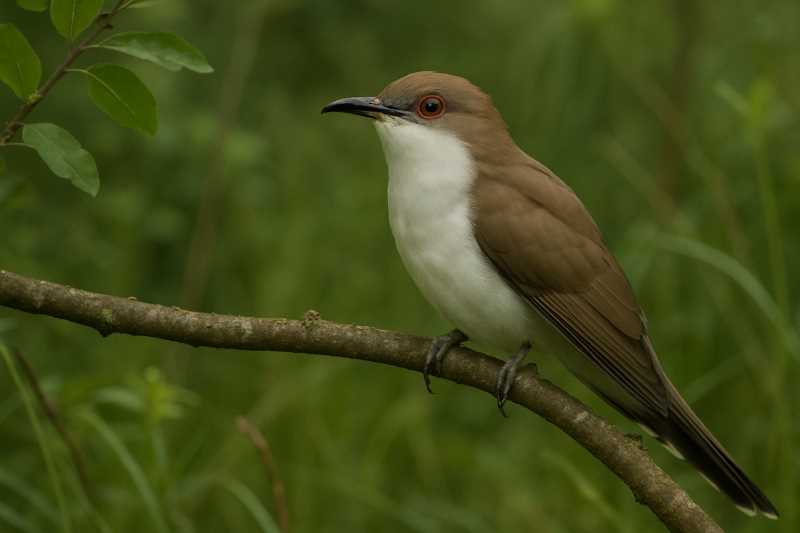
Adults have plain warm brown upperparts, whitish underparts, a long graduated tail and a slightly curved black bill. The tail shows small white tips on the underside, which can be useful when the bird is flying or flicking its tail. A red orbital ring around the eye is especially noticeable on adults. The wings are long and pointed, and the bird often adopts a slightly hunched posture when perched.
Males and females are similar in appearance, with little obvious sexual dimorphism. Juveniles are generally duller, with less conspicuous eye colour and tail markings. The species is easily overlooked because it often remains motionless among leaves and branches.
Range and Habitat
The Black-billed Cuckoo breeds across eastern and central Canada and the United States, with its breeding range extending farther west in parts of the northern Great Plains. It migrates through much of eastern North America and winters in forest, woodland and scrub habitats in Central and South America.
During the breeding season, it favours deciduous and mixed woodlands, woodland edges, streamside vegetation, regenerating forest, orchards and dense thickets. It is often associated with areas containing a well-developed understorey and abundant insect prey. The species may occur in both mature forest and younger, shrubby woodland, provided that suitable cover and feeding opportunities are available.
Black-billed Cuckoos are migratory and are usually present in North America from late spring through summer. Their abundance can vary considerably between years, partly because local numbers respond to outbreaks of caterpillars and other large insects.
Where to See This Species
Black-billed Cuckoos are elusive, so even at reliable migration sites they are more often heard than seen. Look and listen in dense woodland, shrubby edges and sheltered migration habitat, particularly from late spring through summer.
Magee Marsh Wildlife Area, Ohio, United States
The Magee Marsh area is a recognised birdwatching site on the Lake Erie migration route. Its woodland, marsh-edge vegetation and dense spring migration habitat have documented records of Black-billed Cuckoo. The species is most likely during spring migration and can also occur in summer, although it remains uncommon and difficult to locate.
Nearby accommodation: Oak Harbor, Port Clinton and the surrounding Lake Erie communities offer hotels, guest houses, cabins and campsites.
Cape May Point State Park, New Jersey, United States
Cape May Point State Park contains forest, freshwater wetlands, meadows, dunes and other habitats used by migrating birds. The park’s official bird checklist includes Black-billed Cuckoo, making it a realistic location to search during spring and autumn migration. Dense vegetation and sheltered woodland edges are more promising than open beach areas.
Nearby accommodation: Cape May and Cape May Point provide hotels, guest houses, bed-and-breakfast accommodation, self-catering rentals and campsites in the wider area.
Central Park, New York, United States
Central Park has documented records of Black-billed Cuckoo, particularly as an uncommon migrant. Woodland edges, dense shrubbery and quiet areas around the park’s larger natural habitats can provide suitable stopover cover during spring and autumn migration. Sightings are irregular, and patient listening is often more productive than searching open lawns.
Nearby accommodation: Manhattan and the wider New York City area offer hotels, hostels, guest houses and self-catering accommodation.
Behaviour and Diet
Black-billed Cuckoos are generally solitary or occur in pairs during the breeding season. They move quietly through dense foliage, often perching motionless for long periods before hopping or flying to another concealed position. Their flight is direct and graceful, with long pointed wings.
The species feeds mainly on large insects, especially caterpillars, including tent caterpillars and fall webworms. It also takes katydids, cicadas, grasshoppers and other invertebrates. Fruit and seeds may form a larger part of the diet on the wintering grounds. When eating hairy or spiny caterpillars, a cuckoo may beat the prey against a branch before swallowing it.
The Black-billed Cuckoo usually builds its own nest. Both adults help construct a flimsy, shallow nest of twigs, grasses and plant material, usually placed low in a deciduous tree, shrub or tangle. The female generally lays two to five greenish-blue eggs. Both parents incubate the eggs and feed the young. Nestlings develop quickly and may leave the nest at about six or seven days, before they are capable of sustained flight.
Unlike the Common Cuckoo of Eurasia, the Black-billed Cuckoo is not an obligate brood parasite. It occasionally lays an egg in another bird’s nest, but this behaviour is unusual compared with its normal practice of raising its own young.
Identification Tips
- Look for a slender, long-tailed bird with plain brown upperparts and clean white underparts.
- Check for the long black bill and red eye ring on an adult bird.
- In flight, look for small white tips on the underside of the tail feathers.
- The species often appears hunched and may remain completely still in dense foliage.
- Its staccato cuckoo song can be heard during the day and sometimes at night, especially in summer.
- The Black-billed Cuckoo is generally less richly coloured than the Yellow-billed Cuckoo. The Yellow-billed Cuckoo usually shows a yellow lower mandible and warmer rufous tones in the wings, while the Black-billed Cuckoo has a wholly dark bill and plainer brown wings.
Conservation Status
The Black-billed Cuckoo is currently assessed as Least Concern globally. This category reflects its broad distribution and large range, but it does not mean that the species is free from conservation concern.
North American monitoring indicates a long-term decline, although numbers can fluctuate substantially between years in response to food availability. Important threats include the loss and fragmentation of deciduous woodland, the removal of dense shrub habitat and the degradation of stopover and wintering areas. Changes in insect abundance, land use and climate may also affect breeding success and migration.
Conservation measures include protecting mature and regenerating woodland, retaining dense native understorey, safeguarding riparian and woodland-edge habitat, and maintaining connected stopover areas along migration routes. Continued monitoring is important because the species is secretive and can be under-recorded in conventional surveys.
Frequently Asked Questions
Where does the Black-billed Cuckoo live?
It breeds mainly in eastern and central Canada and the United States, migrates through eastern North America, and winters in Central and South America.
What does the Black-billed Cuckoo eat?
Its diet consists mainly of large insects, particularly caterpillars, tent caterpillars, fall webworms, cicadas, katydids and grasshoppers. It also eats fruit and seeds, especially during the non-breeding season.
Is the Black-billed Cuckoo a brood parasite?
Usually not. It normally builds its own nest and raises its own young, although occasional egg-laying in other birds’ nests has been recorded.
How can the Black-billed Cuckoo be identified?
Look for a slender brown bird with white underparts, a long tail, a black bill, a red eye ring and small white tail tips. Its distinctive staccato song is often easier to detect than the bird itself.
When is the best time to see a Black-billed Cuckoo?
In most of its North American range, late spring and summer are the best periods. Migration sites can be productive in spring and autumn, but the bird remains uncommon and secretive throughout the year.
Is the Black-billed Cuckoo endangered?
It is not currently classified as endangered globally and is assessed as Least Concern. However, monitoring indicates a long-term decline, so protecting woodland, thickets and migration habitat remains important.
References
- Cornell Lab of Ornithology
- BirdLife International
- Ohio Department of Natural Resources
Related posts