Introduction
The Whiskered Pitta, Erythropitta kochi, is a striking forest-floor bird endemic to Luzon in the Philippines. It belongs to the pitta family, Pittidae, and is currently recognised as a valid species by the IOC World Bird List. The species is also known as Koch’s Pitta in some older literature, reflecting its former scientific combination, Pitta kochi. (ww.worldbirdnames.org)
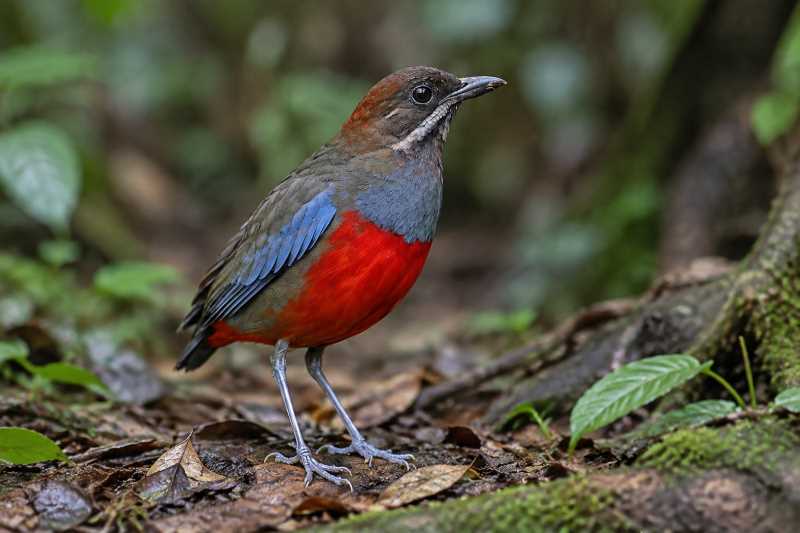
Despite its vivid plumage, the Whiskered Pitta is difficult to observe. It inhabits dense, humid forest, usually moves through undergrowth rather than the canopy, and often remains hidden even when calling nearby. Its most distinctive features are the broad pale facial stripe resembling a whisker, a slate-blue breast band, and bright scarlet underparts. Luzon’s montane forests are its only known home, making the species an important part of the island’s endemic bird fauna.
The species has been recorded across several forested mountain systems on Luzon, including the Sierra Madre, the Cordillera, and mountains in southern Luzon. Although it is locally difficult to find, surveys have demonstrated that it is more widely distributed than early records suggested. Current conservation assessments list it as Least Concern, but this classification should not be interpreted as evidence that the species is secure everywhere. Forest clearance, agricultural expansion, logging, mining and hunting continue to affect suitable habitat within its range. (datazone.birdlife.org)
Physical Description
The Whiskered Pitta is a large pitta, measuring about 22–23 centimetres in length. Published mass estimates are approximately 113–116 grams, although measurements may vary between individuals and sources. It is among the largest pittas recorded in the Philippines.
Adults have a compact, powerful body, a short tail, relatively long legs and a strong, slightly hooked bill suited to taking invertebrate prey. The upperparts are generally dark olive-green or brownish olive. The rear crown and nape have a warm rufous to rusty-orange tone, which contrasts with the darker forehead and face.
The most diagnostic facial marking is the broad pale greyish, buff or ash-coloured malar stripe. It begins around the base of the bill and extends backwards along the lower cheek and side of the neck. This conspicuous marking gives the bird its English name and is particularly useful when the bird is seen at close range in shadowy forest. The area below the malar stripe is darker, creating a strong contrast between the pale whisker and the rest of the face.
The wings show a mixture of dark olive, blue-grey and slate tones. The wing-coverts and rump can appear grey-blue, while the tail is typically dull blue or blue-slate. A small white mark on the primary feathers may be visible when the bird opens its wings or flies, but it is not usually a prominent feature of a perched individual.
The throat and upper breast are dark brown, sometimes with a dusky wine or violet cast. Below this is a broad slate-blue to blue-grey breast band. The remainder of the underparts is bright scarlet or crimson-red, although the intensity can vary with light, wear and the individual’s sex. The sides of the breast and upper flanks may show olive tones, producing a complex pattern of brown, blue, red and green.
The bill is dark, usually appearing blackish. The eyes are brownish to reddish-brown, and the legs and feet range from dull blue and slate to blue-grey or flesh-brown tones depending on the individual and viewing conditions.
Sexual differences are relatively subtle. Females resemble males closely but tend to show less blue on the wing-coverts and a somewhat duller or less extensive red colour below. The blue breast band may also appear less strongly developed. These differences are not always reliable in the field, particularly under poor light or when the bird is moving through vegetation.
Juveniles are much plainer than adults. Young birds are predominantly dark brown or blackish-brown and lack the full adult combination of blue, scarlet and olive. Pale spotting may occur on the breast and flanks, while the facial whisker can remain conspicuous against the darker head. Immature birds may therefore be confused with other dark pittas unless their size, habitat and facial pattern are considered together.
The species is monotypic in current treatments, meaning that no geographically recognised subspecies are generally accepted. Nevertheless, published specimens and field observations may show variation in the strength of blue, red and olive tones across Luzon. Such variation should not automatically be treated as evidence of taxonomically distinct populations.
Range and Habitat
The Whiskered Pitta is endemic to Luzon, the largest island in the Philippines. It has been recorded from mountain forests in northern, central and southern parts of the island, including the Sierra Madre range, the Cordillera and several isolated mountain blocks. Records from protected areas include the Northern Sierra Madre Natural Park, Mount Pulag National Park, Mount Isarog and Aurora Memorial National Park. (keybiodiversityareas.org)
It is primarily associated with humid evergreen and montane forest. The species appears to favour closed-canopy forest with dense understorey, damp ground and steep terrain, especially ravines, forested slopes and areas near streams or other sources of moisture. Montane oak forest has been identified as particularly suitable habitat in parts of the Sierra Madre.
Recorded elevations range broadly, from approximately 360 metres to about 2,200 metres above sea level. The species is most often associated with middle elevations, and some sources identify roughly 900–1,500 metres as the zone where it is most frequently encountered and where breeding records are concentrated. It may also occur in selectively logged or disturbed forest when a sufficiently dense canopy and understorey remain, but intact forest is likely to provide the most reliable conditions.
The Whiskered Pitta is not a long-distance migrant. Its movements are poorly understood, however, and records from different parts of Luzon suggest that some seasonal movement, post-breeding dispersal or local altitudinal movement may occur. Sightings at locations such as Dalton Pass have been interpreted as possible evidence of movement through mountain corridors, but the pattern has not been adequately documented.
The species’ distribution is naturally restricted because it occurs on only one island and depends largely on forested mountain landscapes. At the same time, it is not confined to a single mountain range. This combination of island endemism and scattered distribution makes the condition and connectivity of Luzon’s remaining forests especially important.
Where to See This Species
The Whiskered Pitta is not a dependable roadside bird. Even at known sites, seeing one may require early starts, quiet observation, suitable weather and assistance from experienced local bird guides. Playback should be used cautiously, if at all, and visitors should avoid disturbing birds at feeding or nesting sites.
Northern Sierra Madre Natural Park, Isabela and Cagayan, Philippines
The Northern Sierra Madre Natural Park is one of the most significant documented sites for the species. The park’s extensive montane and lowland forests support a diverse assemblage of Luzon endemics, and the Whiskered Pitta is among the birds recognised in assessments of the park’s biodiversity. Local ethnobiological work has also documented the species from the park, including around Palanan. (keybiodiversityareas.org)
The most promising habitat is likely to be mature, humid forest with dense undergrowth and damp ground, particularly in middle-elevation areas. Access can be difficult, and conditions, permits and local security should be checked before travel. This is a remote protected landscape rather than a conventional birding park with developed visitor infrastructure.
Nearby accommodation: Palanan is the most useful practical gateway for some approaches, with basic homestays and guesthouse-style accommodation. Other access points may require locally arranged camping or community-based accommodation.
Mount Pulag National Park, Benguet, Ifugao and Nueva Vizcaya, Philippines
Mount Pulag National Park is a recognised stronghold for Luzon’s montane birds. Government conservation documentation and protected-area surveys list the Whiskered Pitta among the birds recorded from the Mount Pulag area. The species is more likely to be sought in the park’s forested lower and middle slopes than in the exposed summit grasslands. (faspselib.denr.gov.ph)
Forest edges, mossy forest, ravines and sheltered trails below the summit zone offer more suitable conditions than the open high-elevation grassland. Because the park is popular with hikers, birders should concentrate on quieter forest sections and avoid assuming that a species recorded in the wider protected area will be present along the busiest summit route.
Nearby accommodation: Bokod and Kabayan in Benguet, together with nearby communities used for Mount Pulag access, offer guesthouses, homestays, campsites and basic trekking accommodation. Local registration and guide requirements may apply.
Aurora Memorial National Park, Aurora, Philippines
Aurora Memorial National Park is a protected forest area in the Sierra Madre of central Luzon and is identified as a Key Biodiversity Area supporting the Whiskered Pitta. Its remaining forest provides habitat for several restricted-range and threatened Luzon birds. (keybiodiversityareas.org)
The park is a realistic location to investigate the species because it retains Sierra Madre forest within the bird’s documented range. The most suitable places to search are likely to be humid forest trails, shaded ravines and areas with thick ground vegetation rather than open roadside habitat. The species may be difficult to see, so local knowledge and quiet listening are important.
Nearby accommodation: Baler is the principal practical service centre for the Aurora province and offers hotels, guesthouses, homestays and other visitor accommodation. Some approaches to the park may require local transport, permission and community guidance.
Behaviour and Diet
The Whiskered Pitta is primarily terrestrial. It spends much of its time walking, hopping or making short, rapid movements through leaf litter and low vegetation. Its short tail and sturdy legs are well suited to life on the forest floor, while its vivid colours are often concealed by shadow, fallen leaves and dense undergrowth.
It is generally encountered singly or in pairs rather than in large groups. Pittas are often territorial, and the Whiskered Pitta is thought to defend areas of suitable forest, although the size and stability of territories have not been adequately studied. Its behaviour is secretive, and it may freeze, crouch or retreat into cover when approached rather than flying immediately.
The species is most often active during daylight, particularly in the cooler morning hours and again later in the afternoon. It may remain motionless for long periods, making visual detection difficult. Observers may hear a bird repeatedly before seeing it, especially in steep forest where sound travels through ravines.
Its call has been described as a series of low, mournful or resonant notes, often consisting of a descending sequence that accelerates towards the end. One account characterises it as a series of approximately five to nine notes with a pigeon-like quality. Calls can carry surprisingly well through dense vegetation, but the caller may be some distance from the trail. (orientalbirdclub.org)
The diet consists mainly of terrestrial invertebrates. Documented or reported food items include earthworms, small beetles and other insects. Snails and additional soft-bodied invertebrates may also be taken, although the available information is limited. The bird probes and turns leaf litter, searches damp soil and may use patches of ground disturbed by wild pigs, where invertebrates are exposed or easier to locate.
Moist ground appears to be important for feeding. This helps explain the species’ association with shaded ravines, stream margins, wet forest floors and areas with deep leaf litter. It does not mean that the bird is aquatic, but rather that humid microhabitats support the earthworms and other invertebrates on which it depends.
Knowledge of breeding behaviour remains limited. A nest documented in Luzon was built on a rock ledge roughly 1.5 metres above the ground at an elevation of approximately 1,095 metres. It was composed of twigs, grass and leaves, with a rounded chamber and side entrance. Two eggs and two nestlings were reported during the observation period. These records provide useful evidence, but they are too few to establish the species’ normal nesting biology. (birdwatch.ph)
The breeding season is not precisely defined. Increased vocal activity has been reported from approximately February to June, and immature birds have been observed early in the year. Further field study is needed to determine clutch size, incubation period, fledging period, parental roles and the frequency of helpers or subadult birds at nests.
Identification Tips
When searching for a Whiskered Pitta, focus on habitat and behaviour before colour. It is a large, secretive pitta of humid Luzon forest, usually found on or close to the ground. A quiet bird walking through leaf litter on a shaded slope is more likely to be this species than a bright bird seen high in the canopy.
Key field marks include:
- A relatively large, heavy-bodied pitta, about 22–23 centimetres long.
- A broad pale grey, buff or ash-coloured whisker-like stripe along the cheek and side of the neck.
- A dark brown head with a rusty or rufous rear crown and nape.
- Olive-brown or dark olive upperparts.
- A slate-blue to blue-grey breast band.
- Bright scarlet-red lower underparts.
- Blue-grey or slate tones in the rump, wing-coverts and tail.
- A dark bill and generally dull blue, slate or flesh-brown legs.
- A habit of walking or hopping through damp undergrowth rather than remaining in trees.
The most important potential comparison is the Philippine or Red-bellied Pitta, Erythropitta erythrogaster, which occurs in the Philippines and can show a similar combination of blue and red plumage. The Whiskered Pitta is larger and has a much more obvious pale malar stripe. The Whiskered Pitta also tends to be associated with montane forest, whereas the Philippine Pitta occupies a broader range of forest habitats and may look more compact.
Juvenile Whiskered Pittas are more difficult to identify because they lack the strong adult colour pattern. Their dark brown plumage, pale facial marking, large size and occurrence in suitable Luzon forest can help, but close identification may not be possible from a brief view.
Do not rely on the word whiskered alone. Several forest birds can show pale facial streaks, and poor light can make ordinary cheek markings appear exaggerated. The combination of body size, habitat, blue breast band, red lowerparts, pale malar stripe and terrestrial behaviour is more reliable than any single mark.
Conservation Status
The current BirdLife International account and the Philippines country factsheet list the Whiskered Pitta as Least Concern. Older sources and some site-level assessments have used Near Threatened, reflecting earlier evaluations or conservation databases based on previous Red List categories. The present global category should therefore be stated with its assessment context, rather than treating every older listing as a contradiction. (datazone.birdlife.org)
Least Concern does not mean that the species faces no conservation risk. The Whiskered Pitta is restricted to Luzon, depends heavily on forest and occurs in a landscape where habitat is being altered. Major pressures include forest clearance for agriculture, logging, mining, road construction and settlement expansion. Hunting and capture in snares have also been identified as threats, particularly where forest access is increasing.
The species’ population size is not sufficiently documented for a confident global estimate in the sources reviewed here. Its apparent presence in several protected areas is encouraging, but distribution records do not automatically demonstrate a stable population. More systematic surveys are needed to measure abundance, detect local declines and establish whether populations are connected between mountain ranges.
Important conservation measures include maintaining large blocks of mature forest, protecting middle-elevation habitat, preventing illegal logging and mining in key watersheds, and improving enforcement against hunting. Forest corridors between isolated mountain areas may also be valuable if they allow movement between breeding populations.
Research priorities include mapping current distribution, clarifying seasonal movements, documenting breeding biology, assessing the effects of selective logging and determining whether birds in disturbed forests can maintain viable populations. Responsible birdwatching can support conservation when it uses local guides, respects protected-area rules and avoids crowding birds or repeatedly playing recordings at known territories.
Frequently Asked Questions
Where is the Whiskered Pitta found?
The Whiskered Pitta is endemic to Luzon in the Philippines. It occurs in forested mountain areas including parts of the Sierra Madre, Cordillera and southern Luzon ranges.
What does a Whiskered Pitta look like?
It is a large pitta with olive-brown upperparts, a pale whisker-like facial stripe, a slate-blue breast band and bright red lower underparts. Adults also show rusty tones on the rear crown and blue-grey on the rump, wings and tail.
Is the Whiskered Pitta endangered?
The current global assessment lists the species as Least Concern. However, it remains dependent on Luzon’s forests, and habitat loss, logging, mining and hunting can threaten local populations.
What does the Whiskered Pitta eat?
It feeds mainly on terrestrial invertebrates, including earthworms, beetles and other insects. It searches damp leaf litter and soil on the forest floor.
Can the Whiskered Pitta be seen at Mount Pulag?
Yes. Government and protected-area documentation records the species from the Mount Pulag area. It is more likely to be found in forested slopes and ravines than in the exposed summit grasslands, and sightings are not guaranteed.
Is the Whiskered Pitta migratory?
It is generally regarded as resident, but its movements are not well understood. Records from different parts of Luzon suggest that local movement, post-breeding dispersal or limited seasonal movement may occur.
References
- BirdLife International
- IOC World Bird List
- Department of Environment and Natural Resources, Philippines
Related posts