Introduction
The Philippine Pitta, Erythropitta erythrogaster, is a compact, vividly coloured forest-floor bird in the pitta family, Pittidae. It is also known in some field guides and birding literature as the Blue-breasted Pitta, a name that reflects its rich blue breast and upperparts. The species is native mainly to the Philippines, where it occurs across a wide range of islands and habitats, and it is also recorded from the Talaud and Nanusa island groups of Indonesia under taxonomic treatments that place those forms within the same species.
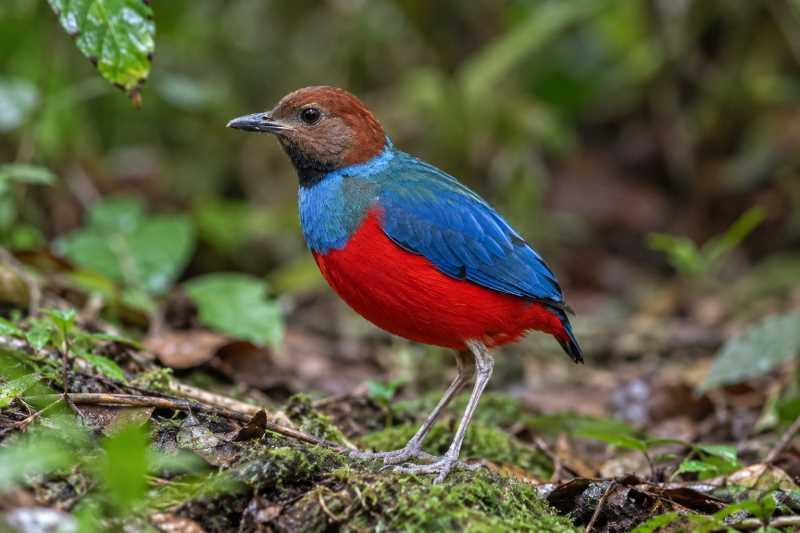
Pittas are among the most striking birds of Asian forests, but their bright plumage is often difficult to see because they spend much of their time in shadowy undergrowth. The Philippine Pitta is no exception. It usually moves quietly through leaf litter, pausing to listen before making short hops or bursts of movement. Its red belly, blue breast, dark throat and brown head can appear suddenly at close range, often after the bird has remained hidden for several minutes.
The species has a broad geographic range and is currently assessed as Least Concern on the IUCN Red List. Nevertheless, the population is considered to be decreasing, and continuing loss and degradation of forest remain important concerns. Current taxonomy is also worth noting. The former Red-bellied Pitta complex included numerous geographically distinct island forms, several of which are now treated as separate species. The present account follows the current Philippine Pitta concept used by BirdLife International and the 2025 IUCN assessment, while recognising that species limits and subspecies arrangements have changed over time. (doi.org)
Physical Description
The Philippine Pitta is a short-tailed, heavy-bodied passerine measuring approximately 16–18 centimetres in total length. Published weight estimates are in the region of 46–70 grams, although measurements vary among sources and geographic forms. Its body shape is typical of Erythropitta: a relatively large head, stout bill, broad rounded wings, short tail and strong legs suited to walking and hopping through leaf litter. (oiseaux.net)
Adult plumage is highly distinctive when seen well. The crown and nape are generally dark brown, sometimes appearing warmer or more reddish in certain island populations. The face is also brownish, with darker areas around the eye and sides of the head. The throat is black or very dark, creating a strong contrast with the blue breast and breast-sides. A small amount of pale or whitish colour may occur in the throat area, but the amount varies and is reduced compared with some related pittas.
The upperparts, rump and tail are rich cobalt, turquoise or blue-green, depending on light and the individual’s geographic form. The wings are darker and can look almost black in shade, while flashes of blue may become visible as the bird moves. The lower breast, belly and undertail region are bright scarlet to reddish-orange. This red underpart is the source of the older English name Red-bellied Pitta, which was historically applied to a much broader complex of related birds.
The bill is dark, moderately long and slightly downcurved. The eyes are dark, and the legs and feet are usually pinkish, greyish or flesh-coloured. The combination of blue breast, red belly, dark throat and brown head is more useful in the field than any single colour patch.
Reliable information on sexual dimorphism is limited. Males and females are generally considered similar in overall plumage, and sex is not normally determined confidently from field appearance alone. Small differences in size, colour intensity or pattern may occur, but these are not sufficiently consistent to serve as dependable field marks.
Young birds are duller than adults. Juveniles usually show less saturated blue and red, with browner upperparts and less sharply contrasting underparts. The throat and breast pattern can appear softer or less clearly defined. As the bird matures, the vivid blue and scarlet colours become more obvious, although plumage wear, light conditions and local variation can affect apparent colour.
Geographic variation is significant. The Philippine Pitta was once treated as part of a very widespread Red-bellied Pitta complex that extended through the Philippines, Indonesia, New Guinea and nearby regions. Genetic and morphological studies demonstrated deep differences among many island populations, leading to a series of taxonomic splits. The remaining Philippine Pitta populations are still variable, particularly in the extent and shade of blue, the strength of the red belly, crown colour and throat pattern. (pmc.ncbi.nlm.nih.gov)
Range and Habitat
The Philippine Pitta is primarily a Philippine species. Its range extends across much of the archipelago, including parts of Luzon, the Visayas, Mindanao and numerous smaller islands. It is also associated with Palawan and nearby islands, where the form traditionally called propinqua has been recognised. The current IUCN treatment includes Palawan and the Sulu Islands within the species account. It also includes the Talaud Islands and three islands of the Nanusa group in Indonesia, although the precise treatment of some island forms depends on the taxonomic authority consulted. (doi.org)
This is a resident species rather than a regular long-distance migrant. Its island distribution means that populations can be separated by substantial stretches of sea, and local forms may show marked plumage differences. The species is not endemic to the Philippines in the strictest current treatment because some Indonesian island populations are included, but the vast majority of its global range lies in the Philippines.
The Philippine Pitta occupies tropical forest and other habitats with dense ground cover. It is associated with primary and secondary forest, forest edge, shaded thickets, bamboo, scrub and regenerating woodland. The IUCN assessment lists forest, shrubland, inland wetlands and some artificial or terrestrial habitats among the environments used by the species. This broad habitat description should not be interpreted as evidence that all individuals can live in heavily modified landscapes. Pittas still require suitable cover, leaf litter and relatively undisturbed feeding areas, even when they occur close to gardens, plantations or urban green space. (doi.org)
The species has been recorded from sea level to approximately 1,400 metres in the current IUCN account. Older or broader treatments of the former species complex have cited higher elevations, but elevation records should be interpreted carefully because they may include populations that are now considered separate species. In the Philippines, it can occur in lowland forest, foothill woodland and suitable upland habitats, with local abundance depending on forest condition and the availability of moist ground cover.
Moist forest floors are particularly important. Areas beside small streams, shaded paths, ravines, forest margins and damp gullies may offer suitable feeding habitat because they retain leaf litter and support earthworms, insects and other invertebrates. The birds may also use secondary forest when dense undergrowth has developed, but open farmland, intensively managed plantations and areas with little ground cover are likely to be less suitable.
The species’ broad range gives it some resilience at the global level. At the same time, its island populations are exposed to local pressures, and forest clearance can remove habitat from individual islands or mountain blocks. Distribution maps may therefore give a misleading impression of uniform abundance. A species can be widespread nationally while remaining uncommon or highly localised at particular sites.
Where to See This Species
The Philippine Pitta is secretive, and a documented occurrence does not guarantee an easy sighting. Early morning visits, quiet observation along shaded trails and attention to sharp calls or movement in leaf litter are more productive than searching open areas. Local access rules, opening times and conservation restrictions should be checked before travelling.
La Mesa Eco Park, Quezon City, Metro Manila, Philippines
La Mesa Eco Park is a practical urban site with a documented Philippine Pitta record. A bird was recorded and filmed there at approximately 70 metres elevation, feeding and moving through vegetation. The park’s mixture of planted woodland, dense undergrowth, damp ground and remaining forest-like habitat helps explain why a normally secretive forest-floor bird can occur within the metropolitan area. (macaulaylibrary.org)
This is best treated as an opportunistic location rather than a guaranteed stake-out. Quiet visits during the cooler part of the morning are likely to be more rewarding, particularly along less disturbed, shaded paths. Avoid playback unless it is specifically permitted and used sparingly, as repeated disturbance can alter the behaviour of shy birds.
Nearby accommodation: Quezon City and the wider Metro Manila area provide hotels, guest houses, serviced apartments and other practical accommodation categories.
Irawan Eco Park, Puerto Princesa, Palawan, Philippines
Irawan Eco Park in Puerto Princesa has a documented Philippine Pitta record in the Macaulay Library. Its Palawan setting is especially relevant because Palawan and the Calamian region support a geographically distinctive form traditionally associated with Erythropitta erythrogaster propinqua. The site’s wooded habitat and conservation-oriented setting make it a more plausible place to search than open urban ground, although the species remains difficult to see. (search.macaulaylibrary.org)
Observers should concentrate on shaded forest edges, quiet trails and areas with a deep layer of leaf litter. Visiting with a local guide or experienced birdwatcher is advisable because access arrangements and the most productive trails may change. The bird may be detected first by a brief call or by a sudden flash of blue and red low in the vegetation.
Nearby accommodation: Puerto Princesa is the nearest practical accommodation base, with hotels, guest houses, ecolodges and other visitor accommodation.
Behaviour and Diet
The Philippine Pitta is mainly terrestrial. It spends much of its active time on the forest floor, moving through leaf litter with a characteristic sequence of short hops, pauses and quick changes of direction. It may stand motionless for several seconds before probing or flicking aside leaves. The short tail and rounded wings are well suited to this understorey lifestyle, while the strong legs allow it to move efficiently over uneven ground.
It is generally secretive and solitary or encountered singly. Pairs may be present during breeding, but this does not necessarily mean that two birds will remain in view together. Individuals often keep to dense cover and may disappear immediately after crossing a path. Their bright plumage is therefore easier to detect in brief glimpses than through prolonged open views.
The diet is dominated by small invertebrates gathered from the ground and leaf litter. Likely prey includes earthworms, insects, insect larvae, spiders and other small arthropods. The bird uses its stout bill to probe soil, move leaves and seize prey. Feeding activity may increase after rain, when the forest floor is damp and earthworms and other invertebrates become more accessible, although local weather and prey availability will affect behaviour.
Pittas are capable of short, powerful flights but are not long-distance aerial foragers. When alarmed, a Philippine Pitta may fly only a short distance into dense vegetation, land low and remain still. This behaviour often makes the bird seem to vanish. It may also walk or hop away rather than fly when cover is available.
The call is an important part of field detection. Like many pittas, it produces a clear, penetrating whistle or brief repeated phrase that can carry through dense forest. Calls may be given from near ground level or from a concealed perch. Local variation in vocalisations is possible, especially across widely separated islands, so recordings from one population should not automatically be assumed to represent every Philippine Pitta.
Breeding information for the species as currently defined is incomplete. Pittas typically form pairs during the breeding period and build domed or rounded nests from vegetation, often close to the ground or in low vegetation. However, nest placement, clutch size, incubation roles and the length of the breeding season are not equally well documented for all Philippine populations. Claims that the species breeds throughout the year should be treated as a general indication of flexible or prolonged breeding rather than a precise schedule applying to every island.
Identification Tips
Look for a small, stocky bird moving on the ground rather than in the canopy. The most useful combination of features is:
- A rich cobalt or turquoise-blue breast, rump and tail;
- A vivid red or scarlet belly and undertail area;
- A dark brown head and crown;
- A blackish throat;
- A short tail, rounded wings and stout bill;
- Sudden, low movement through leaf litter or dense undergrowth.
The bird can be surprisingly difficult to identify when it is partly hidden. In deep shade, the blue may look black and the red belly may be invisible. A fleeting view from behind may show only a blue rump and short tail. When the bird turns, the red belly and black throat usually provide the strongest confirmation.
The Philippine Pitta should not be confused with the Whiskered Pitta, Erythropitta kochi, which is also found in the Philippines. The Whiskered Pitta is associated particularly with Luzon and has a different facial and breast pattern, including more obvious pale or whitish whisker-like markings. Taxonomy within the Erythropitta group has changed repeatedly, so comparisons should be made using a current Philippine field guide and the correct island range.
The Hooded Pitta, Pitta sordida, can also occur in parts of the Philippines and may share forest-edge habitat. It is generally recognised by its green upperparts, black head, chestnut or reddish belly and more conspicuous white throat patch, rather than the Philippine Pitta’s blue breast and dark throat. The Azure-breasted Pitta, Pitta steerii, is another genuinely similar Philippine pitta, but it has a different combination of green upperparts, blue areas and belly pattern and is restricted to a different set of islands.
Because several pittas can occupy the same broad habitat, location is valuable. A blue-and-red pitta in Palawan should be compared with the local Philippine Pitta form and with any species known from that particular site. Photographs, sound recordings and precise locality information are especially useful where taxonomic identification is uncertain.
Conservation Status
The Philippine Pitta is currently listed as Least Concern on the IUCN Red List, following an assessment published in 2025. The assessment gives the species a decreasing population trend, but the available evidence does not indicate a decline rapid enough to meet the thresholds for a threatened category. The global population has not been quantified reliably, and the number of mature individuals is recorded as unknown. (doi.org)
The main conservation concern is habitat loss and degradation. Philippine forests continue to be affected by agricultural expansion, shifting cultivation, logging, mining, infrastructure development, plantation conversion and settlement growth. Even where some forest remains, fragmentation can reduce the quality of the ground layer, increase edge effects and isolate local populations. Fire, repeated clearing and removal of understorey vegetation may be particularly harmful to a bird that depends on shaded leaf litter for feeding.
The species’ broad distribution and ability to use some secondary habitats provide a degree of protection, but these characteristics should not be mistaken for immunity from decline. Small island populations may be vulnerable to local forest clearance, and the conservation status of the species as a whole can conceal serious losses in particular regions.
Important conservation measures include maintaining large blocks of lowland and foothill forest, protecting forest corridors, controlling illegal logging and mining, and improving management within national parks, natural parks and other protected areas. Ecological surveys are also valuable because many Philippine forest sites remain poorly sampled. Responsible birdwatching can contribute to awareness and local conservation economies, provided that observers avoid playback abuse, nest disturbance and the trapping or handling of wild birds.
Frequently Asked Questions
What is the scientific name of the Philippine Pitta?
The accepted scientific name is Erythropitta erythrogaster. It was originally described under the genus Pitta, and older literature may therefore use Pitta erythrogaster or the common name Red-bellied Pitta.
Is the Philippine Pitta endemic to the Philippines?
It is mainly a Philippine species, but the current IUCN treatment also includes populations from the Talaud and Nanusa island groups of Indonesia. For that reason, it is best described as predominantly Philippine rather than strictly endemic to the Philippines.
What does the Philippine Pitta eat?
It feeds mainly on small ground-dwelling invertebrates, including earthworms, insects, larvae and other arthropods. It searches through leaf litter and soft soil with its bill.
Where does the Philippine Pitta live?
It occurs in primary and secondary forest, shaded forest edge, thickets, bamboo and some regenerating woodland. It has been recorded from sea level to about 1,400 metres in the current IUCN assessment.
Is the Philippine Pitta difficult to see?
Yes. It is secretive, spends much of its time on the forest floor and often remains in dense cover. Birdwatchers usually have better chances by listening for its call and watching quiet, shaded trails with good leaf litter.
What is the conservation status of the Philippine Pitta?
The species is classified as Least Concern, but its population trend is decreasing. Forest loss, habitat fragmentation and degradation remain the principal conservation concerns.
References
- IUCN Red List of Threatened Species
- IOC World Bird List
- Macaulay Library, Cornell Lab of Ornithology
Related posts