Introduction
The Javan Banded Pitta, Hydrornis guajanus, is a brightly coloured, ground-dwelling bird of the family Pittidae. It is endemic to the Indonesian islands of Java and Bali, where it inhabits forest undergrowth and other densely vegetated habitats. Despite its vivid plumage, this pitta is notoriously difficult to see. It usually remains close to the forest floor, moves quietly through tangled vegetation and is more often detected by its call than by direct observation.
The species was formerly treated as part of a wider Banded Pitta complex that also included populations from Sumatra, the Malay Peninsula and Borneo. Morphological, vocal and morphometric differences support recognition of the Javan population as a separate species, alongside the Malayan Banded Pitta and Bornean Banded Pitta. The name Hydrornis guajanus is used by current major taxonomic authorities, although older field guides and records may list the bird as Pitta guajana. (researchgate.net)
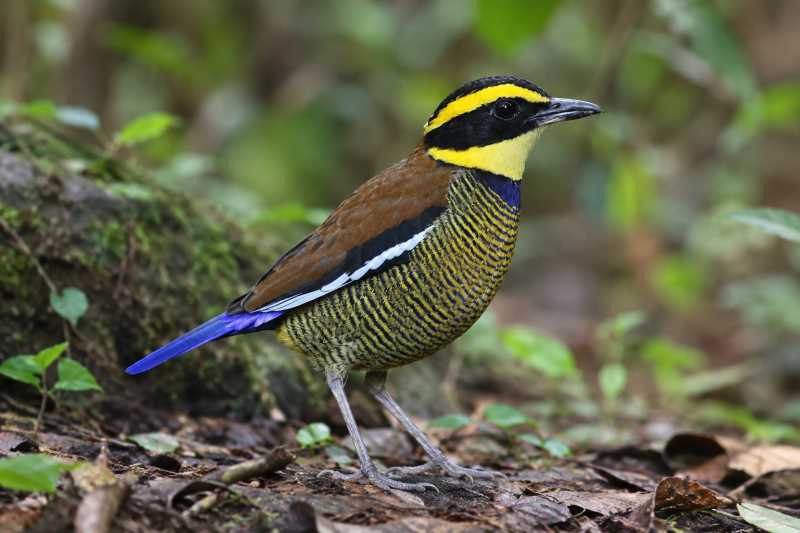
For birdwatchers, the Javan Banded Pitta is one of Java and Bali’s most sought-after forest birds. Its combination of a yellow eyebrow, blue rump and tail, chestnut upperparts and finely barred underparts makes an adult male distinctive when it finally steps into view. Finding one, however, generally requires patience, quiet observation and suitable intact or mature forest habitat.
Physical Description
The Javan Banded Pitta is a compact, powerful-looking pitta measuring approximately 20 to 23 centimetres in length. Available measurements indicate a relatively heavy bird for its size, with reported mass generally around 93 to 106 grams. These figures come from the larger-bodied Javan form and help distinguish it from some related Banded Pitta populations, although individual variation and measurement methods should be considered. (researchgate.net)
Adult males are strikingly patterned. The head is predominantly black, with a broad, bright yellow supercilium extending from the base of the bill towards the rear of the head. The upperparts are largely warm chestnut-brown. The wings are dark, with pale or white spots that can form a noticeable wingbar when the bird is seen in flight or while it is moving through vegetation.
The rump and tail are a rich deep blue. This blue is often the most conspicuous feature when a pitta darts across a path or disappears into a thicket. The chin and upper throat are pale, generally white, while the lower throat and breast become yellowish. A narrow dark blue band crosses the upper breast. Below this band, the yellow underparts are marked with dense blackish or dark blue barring. The combination of a yellow eyebrow, blue tail, narrow blue breast band and barred yellow underparts is highly characteristic.
The bill is dark and robust, suited to probing leaf litter and handling relatively large invertebrate prey. The legs are also dark. As in other pittas, the body is short and compact, the wings are rounded and relatively short, and the tail is brief compared with that of many forest passerines. These proportions reflect a bird adapted more for short flights and rapid movement through dense undergrowth than for sustained aerial travel.
Females are generally duller and less crisply contrasted than males. The blue breast band is narrower and the overall pattern is more subdued, although females still retain the species’ distinctive blue rump and tail, yellowish underparts and barred pattern. In the field, a female may appear browner and less immediately colourful, especially in shaded forest conditions.
Juveniles are substantially plainer. Young birds are mainly brown and may show a speckled or mottled appearance rather than the clean adult pattern. The yellow eyebrow is less developed, and the bill can show orange or pale areas at the base and tip. Juveniles retain enough of the blue wing or tail pattern to suggest their identity, but they should not be expected to resemble a richly coloured adult male.
There is some geographic variation within the former Banded Pitta complex, but the Javan and Balinese population is generally treated as a single species. Older literature may refer to forms such as affinis from western Java, while modern treatments do not consistently recognise these as separate subspecies. The safest approach is to use the current species name while acknowledging that historical specimens and records may appear under older combinations.
Range and Habitat
The Javan Banded Pitta is restricted to Java and Bali in Indonesia. This makes it an island endemic, rather than a continental or long-distance migrant. Its distribution is fragmented because much of the original lowland forest on both islands has been cleared, modified or converted to agriculture and settlements.
The species is associated mainly with primary forest and mature secondary forest, especially where the understorey is dense and the ground is covered by leaf litter, fallen branches and low vegetation. It may also occur in forest that has been selectively logged, in older plantations and in some forest-edge habitats, but its presence in modified landscapes appears to depend on the retention of dense cover and suitable foraging conditions.
The bird has been recorded from lowland and foothill forest as well as higher montane areas, with published accounts placing it at elevations of up to approximately 1,500 metres. Elevational use is likely to vary between Java and Bali, and local records do not mean that the species is evenly distributed throughout that entire range. In many locations, it is tied to particular patches of mature vegetation rather than simply to altitude.
On Java, suitable habitat remains in a network of national parks, forest reserves, mountain forests and other protected landscapes. Records come from both western and eastern parts of the island, including areas associated with Gunung Gede-Pangrango, Bromo Tengger Semeru and Meru Betiri. On Bali, the species is particularly associated with forest in and around Bali Barat National Park, although it can be difficult to locate even where it is known to occur.
The species is resident. There is no established evidence that it undertakes regular long-distance migration. Local movements may occur in response to food availability, breeding activity, rainfall or changes in vegetation, but these should not be confused with migration in the conventional sense.
The Javan Banded Pitta’s dependence on shaded ground cover is important when assessing habitat. A forest can retain a tall canopy yet become unsuitable if the understorey is cleared, the leaf litter is removed, paths are heavily disturbed or the ground is repeatedly exposed to people and livestock. Conversely, some lightly used plantations and older secondary forests may support the species if they preserve dense vegetation, moist soil and a relatively intact invertebrate community.
Where to See This Species
The Javan Banded Pitta is difficult to find anywhere, and a documented site should not be interpreted as a guaranteed location. Quiet early-morning visits, local birding knowledge and careful attention to calls are usually more valuable than simply walking through a large area of forest.
Bali Barat National Park, Bali, Indonesia
Bali Barat National Park is one of the most practical places to look for the species on Bali. The park protects a varied landscape that includes forest, woodland and dense understorey, and the Javan Banded Pitta is regularly mentioned in birding records and wildlife-viewing reports from the area. Local guides and birdwatchers sometimes use hides or quiet forest trails, but the bird remains secretive and sightings are never assured. (linnaeannewyork.org)
The best approach is to search shaded forest edges, trails with thick ground cover and quiet areas where the bird can forage without frequent disturbance. Listening for calls before moving closer is preferable to walking quickly through likely habitat.
Nearby accommodation: The gateway areas around Gilimanuk and Labuan Lalang offer practical options including hotels, guest houses, lodges and other visitor accommodation. Pemuteran is another recognised accommodation area for visitors exploring the western Bali region.
Gunung Gede-Pangrango National Park, West Java, Indonesia
Gunung Gede-Pangrango National Park contains extensive montane and lower-elevation forest and has a documented bird list that includes the Javan Banded Pitta. The species is most plausibly encountered in dense forest understorey rather than in open visitor areas. Trails around forested approaches and suitable lower or middle elevations may offer opportunities, although access, weather and local trail conditions can strongly affect the chances of detection. (avibase.bsc-eoc.org)
The park is also a major destination for birdwatchers seeking other Javan forest endemics. Because the pitta often stays below eye level and may cross a trail silently, slow progress and repeated listening stops are recommended.
Nearby accommodation: Cibodas and Cipanas are the most practical gateway settlements, with hotels, guest houses, villas and other visitor accommodation. Bogor can also serve as a larger urban base, although it is less convenient for early starts inside the park.
Meru Betiri National Park, East Java, Indonesia
The Javan Banded Pitta has been documented at Sukamade Resort within Meru Betiri National Park. A recent bird survey recorded the species in the resort area and associated forest habitats, confirming that this protected coastal and lowland forest landscape remains relevant for the species. (smujo.id)
Meru Betiri is more remote than Bali Barat or Gunung Gede-Pangrango. Visitors should expect forest tracks, limited infrastructure and the need to arrange transport and access locally. Dense forest, shaded trails and relatively quiet areas are the most appropriate places to search. The bird may be heard before it is seen, and patient scanning of the leaf litter and low vegetation is essential.
Nearby accommodation: Sukamade and Sarongan are the closest practical gateway areas, with basic guest houses, homestays, simple lodges and camping options. Jember is a larger regional base, but reaching the park generally requires additional overland travel.
Behaviour and Diet
The Javan Banded Pitta is primarily terrestrial. It spends much of its time on or close to the forest floor, where it moves by short hops and quick runs through leaf litter, low plants, fallen branches and shaded clearings. Its short rounded wings allow rapid escape flights, but the species generally prefers to remain concealed rather than fly in the open.
It is a shy and secretive bird. Individuals may freeze under cover, move behind vegetation or cross a trail so quickly that even an observer who hears the bird may fail to see it. When alarmed, it can disappear into dense foliage with remarkable speed. Its bright plumage is therefore not always an advantage to the observer, because the bird is usually visible only briefly and in broken light.
The species is often detected by voice. It may call from dense forest during the day, and observers sometimes hear repeated notes before locating a bird moving through the undergrowth. Calling activity can vary with weather, season, breeding condition and local disturbance. In some areas the bird may be easier to detect during quieter periods in the early morning, but there is no universal hour at which it can be expected to appear.
Javan Banded Pittas are usually encountered singly or in pairs. They are not flocking birds, although neighbouring individuals may call to one another. Outside the breeding period, males and females may sometimes be separated spatially, while pairs may use adjoining or overlapping areas. Detailed information on territory size and social organisation remains limited.
The diet consists mainly of ground-dwelling invertebrates. Recorded or reported prey include ants, termites, beetles, cockroaches, caterpillars, earthworms and land snails. Small fruits or berries may also be taken opportunistically. The bird searches by walking and hopping through leaf litter, turning or probing debris and inspecting the bases of plants and fallen wood.
A pitta’s strong bill and compact body are well suited to this foraging style. It may pause abruptly, tilt its head and then seize prey from the ground. Moist forest conditions are likely to be important because they support earthworms, snails and many insect groups, particularly after rain.
Breeding information for the species is less complete than for many better-studied Asian passerines. Reports from Java indicate breeding activity mainly during the first half of the year, with some records also suggesting additional seasonal activity. The nest has been described as a bulky, enclosed or roughly spherical structure made from leaves, grasses, twigs and other plant material, placed in low vegetation. Clutches are generally reported to contain about two to five eggs, commonly three or four, but available information should be treated as provisional because observations are limited.
Both parents are believed to contribute to the breeding effort, including nest attendance and care of young. The concealed nest and secretive behaviour probably reduce detection, but they also make the species vulnerable to disturbance when breeding habitat is heavily used or cleared.
Identification Tips
When identifying a possible Javan Banded Pitta, look for the following combination of features:
- A compact, short-tailed forest bird around 20 to 23 centimetres long.
- A black head with a broad, bright yellow eyebrow.
- Chestnut-brown upperparts.
- Dark wings with pale spots or a pale wingbar.
- A vivid deep blue rump and tail.
- Yellow underparts with dense dark barring.
- A narrow dark blue band across the upper breast.
- Strong, quick movements on the forest floor rather than prolonged flight.
The blue rump and tail are particularly useful when the bird is seen from behind or as it crosses a trail. The yellow eyebrow is usually more obvious on adult males, while females appear duller and may show a less prominent breast band.
The Javan Banded Pitta should not be confused with the related Malayan Banded Pitta, Hydrornis irena, or Bornean Banded Pitta, Hydrornis schwaneri, unless an observer is working with historical records or travelling elsewhere in the Sunda region. The Malayan form is associated with the Malay Peninsula and Sumatra, while the Bornean form occurs on Borneo. Their ranges do not normally overlap with the Javan species in the wild.
Among the former Banded Pitta complex, the Javan bird is distinguished by its strong yellow eyebrow, yellow and dark barring across the underparts and relatively narrow blue breast band. Related forms tend to differ in the colour and extent of the breast and belly patterning. Geographic range should always be considered alongside plumage, especially when identifying older photographs or museum specimens labelled under the former broad species concept.
Juveniles require additional care. A young Javan Banded Pitta may be mostly brown and mottled, with a less conspicuous eyebrow and partly orange bill. The blue tail and wing markings may still provide clues, but a plain brown pitta in Java or Bali should not be dismissed solely because it lacks adult colouration.
Conservation Status
The Javan Banded Pitta is currently assessed as Least Concern on the IUCN Red List. This category indicates that the species does not currently meet the global thresholds for a threatened category, but it does not mean that populations are secure everywhere or that local declines are unimportant. The species has a restricted island range, depends on forest habitat and is exposed to pressures that affect many Javan and Balinese birds. (cites.org)
The principal long-term concern is habitat loss and degradation. Conversion of forest to agriculture, plantations, settlements and infrastructure reduces the amount of suitable habitat and fragments remaining populations. Logging, understorey clearance and repeated disturbance can also make apparently forested sites less suitable, particularly where ground cover and leaf litter are removed.
The cage-bird trade is an additional concern. Javan Banded Pittas have been documented in Indonesian bird markets, and TRAFFIC has identified the species as one of the pittas encountered in trade on Java. Its attractive plumage, distinctive appearance and rarity in captivity can create demand even though it is a secretive forest bird. (traffic.org)
The species is listed in CITES Appendix II, which means that international trade is regulated rather than completely prohibited. Effective conservation therefore depends on accurate identification, enforcement of wildlife-trade laws, protection of remaining forest and careful monitoring of populations. The species’ presence in national parks and other protected areas provides an important foundation, but protected status alone cannot prevent illegal capture or habitat degradation.
A reliable global population estimate is not included here because no sufficiently robust, current figure could be verified. Local abundance can vary greatly between forest blocks, and the bird’s secretive behaviour makes standard population assessment difficult. Continued surveys, especially in protected forests and areas affected by trade or land-use change, are important for determining whether current Least Concern status remains appropriate over the long term.
Frequently Asked Questions
Where is the Javan Banded Pitta found?
The species is found only on the Indonesian islands of Java and Bali. It occurs mainly in primary and mature secondary forest with dense undergrowth, although it can sometimes persist in older modified forest and suitable plantations.
Is the Javan Banded Pitta a migrant?
No. It is regarded as a resident island species rather than a regular long-distance migrant. Local movements may occur, but there is no established evidence of seasonal migration between Java, Bali and other islands.
What does the Javan Banded Pitta eat?
It feeds mainly on invertebrates found on or near the forest floor, including ants, termites, beetles, caterpillars, earthworms and land snails. Small fruits or berries may also be taken occasionally.
How can the Javan Banded Pitta be identified?
Adults are recognised by their black head, broad yellow eyebrow, chestnut back, blue rump and tail, yellow barred underparts and narrow dark blue breast band. Females are duller, while juveniles are mostly brown and mottled.
Where is the best place to see a Javan Banded Pitta?
Documented wildlife-viewing locations include Bali Barat National Park in Bali, Gunung Gede-Pangrango National Park in West Java and Meru Betiri National Park in East Java. It is difficult to see at all of these sites, so local guides, quiet trails and patient listening greatly improve the chances.
Is the Javan Banded Pitta endangered?
It is currently assessed as Least Concern, not globally threatened. Nevertheless, habitat loss, forest degradation and capture for the cage-bird trade remain important conservation concerns, especially because the species has a restricted range on Java and Bali.
References
- BirdLife International
- IUCN Red List of Threatened Species
- Rheindt and Eaton, Biological Species Limits in the Banded Pitta, Forktail 26, 2010
Related posts