Introduction
The Malayan Banded Pitta, Hydrornis irena, is a brightly coloured forest-floor bird of the Thai-Malay Peninsula and Sumatra. It belongs to the pitta family, Pittidae, a group of compact passerines known for strong legs, short tails and often vivid plumage. Despite its striking appearance, it is usually difficult to observe because it moves quietly through dense undergrowth and leaf litter, where it searches for invertebrate prey.
The species was formerly treated as part of a wider Banded Pitta complex. Morphological, vocal and ecological differences between the birds of the Thai-Malay Peninsula and Sumatra, Borneo, and Java and Bali have led modern taxonomies to recognise the Malayan, Bornean and Javan forms as separate species. The accepted scientific name is Hydrornis irena (Temminck, 1836), although older literature may use Pitta irena or include the species within Pitta guajana. (static1.squarespace.com)
The Malayan Banded Pitta is principally associated with humid evergreen forest, especially habitats with a shaded floor, deep leaf litter and a well-developed understorey. It is generally regarded as resident rather than a long-distance migrant, although local movements may occur and birds in Singapore are treated as winter visitors or passage migrants under the local population account. (nparks.gov.sg)
Physical Description
The Malayan Banded Pitta is a stocky, medium-sized pitta with a short tail, powerful legs and a stout bill suited to probing soil and leaf litter. Published field accounts commonly place pittas of this group at roughly 16 to 19 centimetres in length, although reliable standard measurements for H. irena are not consistently available across reference works. Because of this variation in reported measurements, overall shape and plumage are more useful than a precise length when identifying the species in the field.
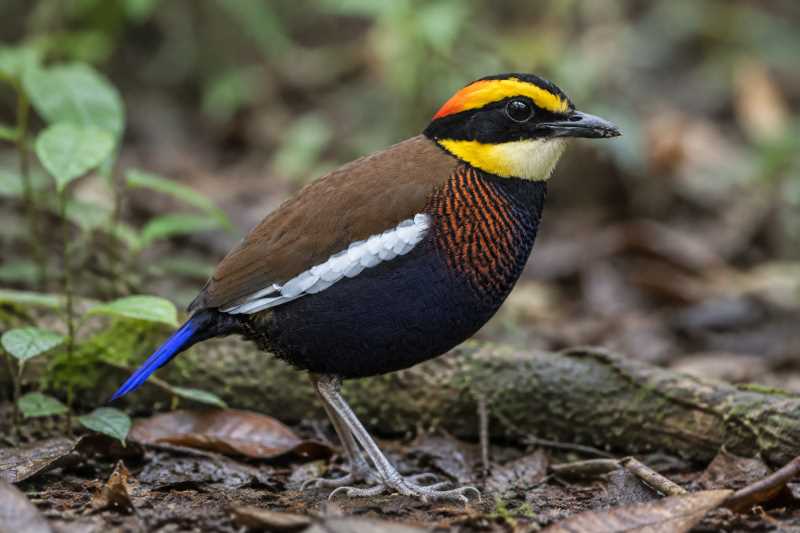
The adult male is exceptionally colourful. The head is predominantly black, with a conspicuous warm orange or reddish-orange supercilium extending above the eye. The nape and rear neck are orange-red to chestnut. The throat is yellow, and the breast is strongly barred or patterned with contrasting orange, chestnut and dark bluish tones. The central belly is blue, while the back and mantle are mainly brown. The rump and tail show blue tones, which are particularly noticeable when the bird hops through an opening or makes a short flight. The wings are dark, with pale spotting or barring visible when they are spread.
The combination of a dark head, orange eyebrow, yellow throat, patterned breast and blue belly is the most useful overall plumage character. The species is not simply a blue-and-orange bird, however. The breast pattern can appear variable with light, posture and wear, and a bird partly hidden in vegetation may show only the blue belly or the orange supercilium.
Females are noticeably duller than males. They retain the general structure of the male’s pattern but usually have less saturated colours, reduced contrast and a less vivid blue on the belly. Their upperparts are more subdued brown, and the orange, yellow and blue areas may be washed with buff or brown. This sexual dimorphism is important because a dull, low-contrast bird seen briefly on the forest floor may be a female rather than a different species.
Juveniles and recently fledged birds are less well documented than adults and are generally more subdued. Young birds are expected to show reduced saturation and less sharply defined barring, with brownish upperparts and less developed blue and orange tones. Field observers should be cautious when identifying an immature pitta from a short view, particularly if the head pattern or belly colour is not clearly visible.
Geographic variation occurs within the species’ range. Birds from southern Thailand and the northern Malay Peninsula have historically been associated with the form ripleyi, but this name has often been treated as a synonym of irena. The distinction is not consistently maintained in modern taxonomies. The most useful broad pattern is that birds assigned to H. irena share the orange-toned eyebrow, blue belly and orange-and-dark breast pattern that distinguish them from the Bornean and Javan Banded Pittas. (static1.squarespace.com)
Range and Habitat
The Malayan Banded Pitta occurs in southern Thailand, Peninsular Malaysia and Sumatra. Its distribution is centred on the Thai-Malay Peninsula and extends southwards through the Malay Peninsula to the Sumatran side of the Sunda region. It is not a Borneo species. Borneo supports the closely related Bornean Banded Pitta, Hydrornis schwaneri, while Java and Bali support the Javan Banded Pitta, Hydrornis guajanus.
The species is most strongly associated with primary lowland evergreen rainforest, including humid forest with dense undergrowth and substantial leaf litter. It may also occur in swamp forest, hill forest and some older secondary woodland. The available accounts indicate that it can occur from low elevations to approximately 1,500 metres, although it is most often sought in lowland and foothill forest. Elevational limits may vary between regions, and the species should not be assumed to be equally common throughout its potential altitudinal range.
Important habitat features include a shaded forest floor, damp soil, fallen leaves, decaying wood and low vegetation that provides cover. These conditions support the earthworms, snails, insects and other invertebrates on which the pitta feeds. Dense ground cover also allows the bird to move without crossing large exposed areas.
The species can be recorded in secondary forest, but it appears less tolerant of habitat alteration than some other pittas. Forest that has lost its understorey, been heavily logged, fragmented by roads or converted to plantations is less likely to support persistent populations. This does not mean that every record outside primary forest is exceptional, but it does suggest that habitat quality is important when interpreting local abundance.
The Malayan Banded Pitta is generally considered sedentary or resident across most of its range. It does not undertake a regular continental migration. Local movements may occur in response to breeding, rainfall, food availability or changes in forest conditions. In Singapore, however, the National Parks Board describes the pitta as a winter visitor and passage migrant, with records from wooded parks, large gardens and nature reserves during the cooler months. This may reflect regional movements of birds from the northern part of the range rather than a contradiction of the species’ broader tendency to remain within suitable habitat year-round. (nparks.gov.sg)
Where to See This Species
The Malayan Banded Pitta is elusive even where it is locally regular. Quiet early mornings, recent calls and patient observation along shaded trails are usually more productive than walking quickly through open forest. Playback should be used sparingly and only in accordance with local regulations and ethical birding guidance.
Taman Negara, Pahang, Malaysia
Taman Negara is one of the most credible places to look for the species in Peninsular Malaysia. The park contains extensive lowland rainforest and is a documented locality for Hydrornis irena, including records from trails and forest around the Kuala Tahan area. A published taxonomic study used a territorial recording of the Malayan Banded Pitta from Taman Negara, and independent birding records have reported the species along forest trails. The combination of intact habitat, established access and regular birding activity makes the park a realistic venue, although sightings are far from guaranteed. (static1.squarespace.com)
Look for dense, shaded undergrowth and leaf-littered trails rather than exposed clearings. The bird may call from cover before appearing briefly on the ground, and some observers hear several individuals without obtaining a view.
Nearby accommodation: Kuala Tahan is the principal gateway settlement, with a range of lodges, guest houses, small hotels, camps and riverside accommodation serving visitors to the national park.
Khao Phra-Bang Khram Wildlife Sanctuary, Krabi Province, Thailand
The Khao Phra-Bang Khram area, also known as Khao Nor Chuchi, is a recognised birdwatching locality in southern Thailand and is documented for the Malayan Banded Pitta. Bird checklists for the site include the species, while published field recordings from Khao Nor Chuchi have also been used in work on Banded Pitta vocal differences. The sanctuary’s humid evergreen forest and forest-floor habitat are suitable for the species, but access can be challenging and conditions may be wet or uneven. (static1.squarespace.com)
This is a site where careful listening is particularly useful. The species may remain hidden in thick vegetation, and observers should allow time to stand quietly near suitable forest-floor habitat rather than relying only on active searching.
Nearby accommodation: Khlong Thom and the wider Krabi area provide the most practical bases, with guest houses, hotels and small resorts available outside the sanctuary.
Sungei Buloh Wetland Reserve, Singapore
Sungei Buloh Wetland Reserve is a publicly accessible and officially documented location for the Malayan Banded Pitta. Singapore’s National Parks Board reports the species from the reserve, particularly around the freshwater pond area and visitor-centre surroundings, where it may forage among leaf litter and undergrowth. The local account describes it as a winter visitor and passage migrant, so the cooler months are the most appropriate period in which to look. (nparks.gov.sg)
Although much of Sungei Buloh is associated with mangroves and shorebirds, the pitta uses wooded edges, freshwater habitats and quiet terrestrial cover. Visitors should follow all reserve rules and avoid entering restricted areas or approaching a bird too closely.
Nearby accommodation: Northern Singapore, including the Woodlands and Kranji areas, offers the most practical base, with hotels, guest houses and other urban accommodation connected to the reserve by local transport.
Behaviour and Diet
The Malayan Banded Pitta is primarily terrestrial. It spends much of its active time walking, hopping and pausing on the forest floor, often beneath shrubs, palms, rattan, saplings and low branches. Its short tail and strong legs reflect this ground-oriented lifestyle. It can fly strongly when disturbed, but flights are usually short and directed towards nearby cover.
The species is generally solitary or found in pairs. Pairs may hold territories in suitable forest, particularly during the breeding season. Its rich plumage can create the impression of a conspicuous bird, but its behaviour is usually the opposite. It often freezes beneath vegetation, moves quietly through leaf litter and gives observers only brief views of the head, tail or underparts.
The diet is dominated by invertebrates. Likely prey includes insects and their larvae, earthworms, snails, spiders and other small forest-floor animals. Fruit and berries may also be taken, particularly when available, but the species is best regarded as an invertivore rather than a fruit specialist. The bird searches by walking slowly and probing among leaves, soil, twigs and rotting wood. It may turn or flick aside small pieces of debris with its bill before seizing prey.
Foraging behaviour makes the species sensitive to changes in the forest floor. Removal of leaf litter, repeated clearing of undergrowth, soil compaction and the drying of formerly humid habitat can reduce the availability of prey even when a forest canopy remains.
The species’ vocal behaviour is important for detection and taxonomy. Males produce territorial calls, and alarm or contact calls may be given when a bird is disturbed. Studies of the wider Banded Pitta complex found differences in call timing and frequency between the Malayan, Bornean and Javan forms, supporting their treatment as separate species. The calls can carry through dense forest, but they may be difficult to localise because of echoes and the bird’s concealed position. (static1.squarespace.com)
Breeding information is less complete than for many more conspicuous Asian birds. Available descriptions of the former Banded Pitta complex indicate that the nest is a bulky, roughly domed structure made from leaves, fine stems and other plant material. It may be placed low in vegetation, such as a shrub, sapling or rattan palm, rather than directly on the open ground. Clutch sizes reported for the group are commonly two to five eggs, although regional data for H. irena are limited and should not be treated as a definitive species-wide average.
Breeding timing varies geographically and is likely influenced by rainfall and the seasonal availability of invertebrate prey. Both members of a pair are believed to participate in territory defence and parental care, but detailed observations of incubation, nestling development and fledgling survival remain limited. This lack of information is one reason that cautious wording is preferable when describing the species’ breeding biology.
Identification Tips
When searching suitable forest, listen first and scan the ground second. The Malayan Banded Pitta often reveals itself through a short, repeated call before it appears. Stand quietly beside a leaf-littered trail, stream margin or shaded patch of undergrowth and watch for a compact bird moving in short hops.
Key identification features include:
- A stocky, short-tailed shape with strong legs and a stout bill.
- A black head with a warm orange or reddish-orange eyebrow.
- An orange-red or chestnut nape.
- A yellow throat.
- Orange and dark bluish barring across the breast.
- A blue central belly and blue tones in the rump or tail.
- Brown upperparts contrasting with the brighter underparts.
- A preference for walking or hopping on the forest floor rather than remaining in the canopy.
The most important comparison is with the other members of the former Banded Pitta complex. The Bornean Banded Pitta, Hydrornis schwaneri, occurs on Borneo and generally shows a different balance of yellow, blue and dark barring on the underparts. The Javan Banded Pitta, Hydrornis guajanus, occurs on Java and Bali and typically differs in the colour and arrangement of the eyebrow, breast and belly pattern. Range is therefore a major part of identification. A bird in Peninsular Malaysia, southern Thailand or Sumatra is far more likely to be the Malayan Banded Pitta than either of those species.
The Blue-winged Pitta can occur in some of the same broad regions, but it is a different-looking bird. It usually has a more obvious blue wing and crown, a reddish-brown head and buff or orange underparts rather than the Malayan Banded Pitta’s strongly patterned blue belly and barred breast. It is also more likely to be encountered in open woodland edges, plantations, gardens or secondary habitats, although habitat overlap can occur.
Do not rely on the name “banded” alone. Several pittas have barred or patterned underparts, and a partial view through vegetation can be misleading. A combination of location, call, head pattern, throat colour, belly colour and body shape is more reliable than one plumage mark.
Conservation Status
The Malayan Banded Pitta is currently assessed as Near Threatened on the IUCN Red List. The assessment reflects concern about the loss and degradation of suitable forest across parts of its range, rather than evidence that the species is uniformly rare everywhere. It remains locally regular in some protected forests but is scarce or declining in areas where intact lowland forest has been heavily altered. (thainationalparks.com)
The principal threat is habitat loss. Logging, agricultural expansion, plantation development, road construction and fragmentation reduce the extent and quality of humid forest. Conversion of lowland forest is especially significant because much of the species’ preferred habitat occurs at elevations where land-use pressure is high. Degraded forest may retain some canopy cover while losing the dense understorey and damp leaf litter required for foraging.
Illegal trapping for the cage-bird trade has also been identified as a threat. Pittas are attractive, vocal and highly valued by some bird keepers, which can increase pressure on local populations. Trapping is likely to be most damaging where it is combined with forest fragmentation and low natural population density.
Conservation measures should focus on retaining large blocks of evergreen and swamp forest, maintaining links between fragmented reserves, protecting forest-floor structure and enforcing laws against capture and trade. Monitoring is also important because the species’ secretive habits make population changes difficult to detect through casual observation. Protected areas such as Taman Negara, southern Thai wildlife sanctuaries and Singapore’s nature reserves provide important opportunities for habitat protection, research and public education.
The conservation status should not be interpreted as a precise measure of local abundance. A species can be fairly common in one protected forest and absent from a nearby site where habitat has been cleared or heavily degraded. More field research on population density, breeding success, dispersal and trapping pressure would improve assessment of its long-term trend.
Frequently Asked Questions
What is the scientific name of the Malayan Banded Pitta?
The accepted scientific name is Hydrornis irena (Temminck, 1836). Older sources may refer to it as Pitta irena or include it within the broader Banded Pitta treatment, Pitta guajana.
Where does the Malayan Banded Pitta live?
It occurs in southern Thailand, Peninsular Malaysia and Sumatra. It mainly inhabits humid evergreen forest, including lowland rainforest, swamp forest and some hill forest with dense undergrowth and leaf litter.
Is the Malayan Banded Pitta migratory?
It is generally regarded as resident or largely sedentary across its main range. Some local movements occur, and Singapore records describe the species as a winter visitor and passage migrant.
What does the Malayan Banded Pitta eat?
Its diet consists mainly of forest-floor invertebrates, including insects, earthworms, snails and other small prey. It may also take berries or other small fruits when available.
How can the Malayan Banded Pitta be identified?
Look for a stocky, short-tailed bird with a black head, orange eyebrow, yellow throat, orange-and-dark breast pattern and blue belly. It usually walks or hops through shaded leaf litter and dense undergrowth.
Is the Malayan Banded Pitta threatened?
Yes. It is currently listed as Near Threatened. Habitat loss, forest degradation, fragmentation and illegal capture for the cage-bird trade are the principal documented concerns.
References
- IUCN Red List of Threatened Species
- IOC World Bird List
- National Parks Board, Singapore
Related posts