The Blue-headed Bee-eater (Merops muelleri): A Jewel of the African Canopy
The Blue-headed Bee-eater (Merops muelleri) is a striking avian species that captures the eye with its vibrant plumage and captivates ornithologists with its intriguing behaviors. Found primarily in the dense lowland rainforests of Central and West Africa, this bird is a testament to the rich biodiversity of the region and plays a pivotal role in its ecological tapestry. In this article, we delve into the fascinating world of the Blue-headed Bee-eater, exploring its habitat, behavior, and conservation status.
Habitat and Distribution
The Blue-headed Bee-eater is predominantly found in the lowland rainforests stretching from Guinea in West Africa to Uganda and northwestern Tanzania in East Africa. These birds favor the upper canopy of these forests, where they thrive in the humid, tropical climate. Unlike many of its relatives that prefer more open habitats, the Blue-headed Bee-eater has adapted to life among the dense foliage, where it finds both shelter and sustenance.
This species is particularly associated with primary rainforests, although it can occasionally be spotted in secondary forests and forest edges. The preference for pristine habitats underscores the importance of forest conservation efforts, as habitat degradation poses a significant threat to their populations.
Physical Characteristics
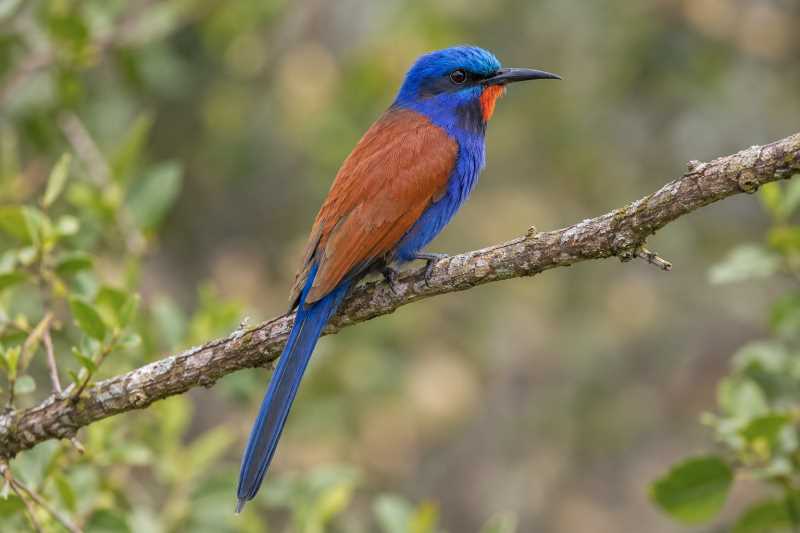
The Blue-headed Bee-eater is a medium-sized bird, measuring approximately 28 centimeters in length, including its elongated tail feathers. As its name suggests, one of the most distinctive features of this bird is its vivid blue head, which provides a striking contrast to its predominantly green body. The wings and back are a rich, iridescent green, while the throat and underparts are a lighter green. The bird’s eyes are a deep red, adding to its striking appearance.
Both males and females display similar plumage, although males are generally slightly larger. The long, pointed bill, typical of bee-eaters, is perfectly adapted for catching their prey mid-flight.
Diet and Feeding Behavior
True to their name, bee-eaters primarily feed on bees and other flying insects. The Blue-headed Bee-eater employs a highly specialized hunting technique: it perches quietly on a tree branch, surveying the area for potential prey. Once a target is spotted, the bird swiftly launches into the air, capturing the insect with precision.
Before consuming bees, the Blue-headed Bee-eater performs a fascinating behavior known as ‘bee-bashing.’ It repeatedly hits the insect against a hard surface to remove the stinger and any venom sacs, ensuring the prey is safe to eat. This meticulous preparation highlights the bird’s remarkable adaptation to its niche diet.
Breeding and Nesting
The breeding season of the Blue-headed Bee-eater typically coincides with the onset of the rainy season, which varies depending on its geographical location. During this time, pairs engage in elaborate courtship displays that include aerial acrobatics and the offering of food by the male to the female.
These bee-eaters are cavity nesters and prefer to excavate nesting holes in sandy banks or riverbanks, where the soil is soft enough to burrow. The female lays a clutch of 2-4 eggs, which both parents incubate. After hatching, both parents are involved in feeding and caring for the chicks until they fledge.
Conservation Status and Threats
Currently, the Blue-headed Bee-eater is classified as Least Concern by the International Union for Conservation of Nature (IUCN). However, this status does not imply that the species is free from threats. Deforestation and habitat fragmentation are significant concerns, as they lead to the loss of suitable nesting and feeding sites.
Moreover, forest fires and agricultural expansion further exacerbate habitat degradation. While the bird is not presently endangered, continued environmental pressures could pose a risk to its populations in the future. Conservation efforts focusing on preserving the integrity of tropical rainforests are crucial to ensuring the long-term survival of this species.
Ecological Significance
The Blue-headed Bee-eater plays a vital role in its ecosystem as both a predator and a prey species. By controlling insect populations, it helps maintain a balance within its habitat. Additionally, as a prey item for larger birds of prey, it is an integral part of the food web.
Furthermore, bee-eaters are considered indicators of environmental health. Their presence in an area often signifies a robust, biodiverse ecosystem, making them valuable for ecological studies and conservation planning.
Conclusion
The Blue-headed Bee-eater is more than just a visual marvel of the African rainforests. It is a species that embodies the complexity and beauty of its environment. Protecting this bird and its habitat is essential not only for its survival but for the continued resilience and diversity of the ecosystems it inhabits.
Conservationists, ornithologists, and bird enthusiasts alike must continue to monitor and advocate for the preservation of these vital habitats, ensuring that the Blue-headed Bee-eater remains a vibrant part of Africa’s natural heritage for generations to come.
Related posts