Introduction
The Green-tailed Trainbearer (Lesbia nuna) is a small Andean hummingbird named for the male’s exceptionally long, green-banded tail. It belongs to the hummingbird family Trochilidae and is generally a resident of montane shrubland, forest edges, Polylepis woodland, gardens and other open highland habitats.
Physical Description
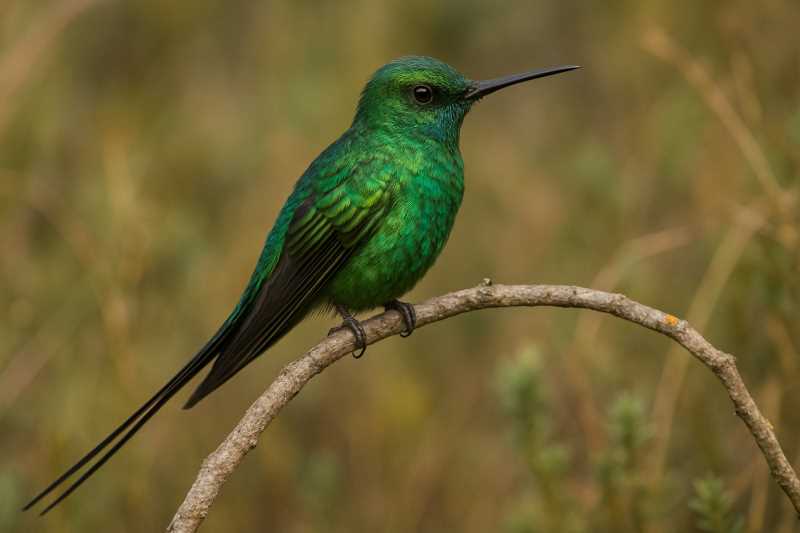
The Green-tailed Trainbearer has a compact body, a short, straight bill and a remarkably elongated tail. Adult males measure about 16 to 16.5 centimetres in total length, while females are considerably shorter at approximately 11 to 11.5 centimetres. Much of the difference is caused by the male’s greatly extended tail feathers.
Males are predominantly green, with a bright iridescent emerald throat and breast. The long tail is green overall, with darker markings towards the tips of the longest feathers. Females are less strongly coloured, with a greener back and paler, whitish underparts marked with green spotting. Their tails are noticeably shorter than those of males.
The species can vary in colour and size across its wide Andean range. Individual age differences are not well documented in general field references, so young birds are best identified using structure, tail length, habitat and the overall green plumage rather than relying on a single feature.
Range and Habitat
The Green-tailed Trainbearer occurs discontinuously along the Andes from Colombia through Ecuador and Peru to Bolivia. Historical or uncertain records have also been associated with Venezuela, but the core, consistently recognised range is Andean.
It is usually found between about 1,600 and 3,800 metres above sea level, with many records coming from elevations around 2,200 to 3,300 metres. It occupies open or semi-open montane environments, including shrubland, forest margins, secondary vegetation, highland gardens, cultivated areas and Polylepis woodland. The species may also occur near towns where flowering plants provide suitable feeding opportunities.
The Green-tailed Trainbearer is considered a resident species rather than a long-distance migrant. Its distribution is geographically varied, and several regional forms or subspecies have been recognised by different taxonomic authorities.
Where to See This Species
Yanacocha Biological Reserve, Pichincha, Ecuador
Yanacocha Biological Reserve has Green-tailed Trainbearer on its bird checklist, where it is recorded as a resident species. The reserve’s high-elevation Andean forest, shrubland and flowering vegetation provide suitable habitat for this hummingbird. Look along forest edges and flowering plants on authorised trails.
Nearby accommodation: Quito is the main practical base, with hotels, guest houses and other accommodation available in the city. Local lodges and birding accommodation are also available in the wider north-western Quito and Mindo region.
Chingaza National Natural Park, Cundinamarca and Meta, Colombia
The official Chingaza bird guide includes Green-tailed Trainbearer among the park’s recorded species, with records from approximately 2,200 to 2,800 metres. The species may be encountered in montane shrubland, woodland edges and open highland vegetation along authorised birdwatching and hiking routes. Chingaza is open to visitors, but entry requires advance arrangements and an authorised guide.
Nearby accommodation: La Calera, Guasca and Fómeque are practical gateway settlements, offering hotels, guest houses, rural lodges and self-catering accommodation.
Jardín Botánico de Quito, Pichincha, Ecuador
The public botanical garden in Quito is listed in recognised birding records for Green-tailed Trainbearer. Its planted areas, flowering shrubs and open urban habitat make it a realistic place to look for the species, particularly where native or highland flowering plants are established.
Nearby accommodation: Quito provides a wide range of hotels, guest houses, hostels and serviced apartments, with the city centre and La Carolina area being convenient bases.
Behaviour and Diet
Green-tailed Trainbearers are active hummingbirds that usually forage alone. They hover while taking nectar from flowers and may also perch conspicuously on exposed twigs or other vantage points. Their rapid wingbeats allow them to remain stationary in front of flowers and manoeuvre quickly through dense vegetation.
Their diet consists mainly of nectar from flowering plants. They also take small insects and spiders, which provide additional protein and may be especially important when feeding young. By moving between flowers, the species contributes to pollination in highland habitats, although the exact importance of this role varies according to local plant communities.
The species’ breeding behaviour is not as well documented as that of some more intensively studied hummingbirds. As in other hummingbirds, the female is expected to undertake nest building and most direct care of the young, while males generally invest more in territorial or courtship behaviour. Detailed information on nesting dates and nest sites varies between regions.
Identification Tips
- Look for a small, green hummingbird with a very long, narrow tail, especially in adult males.
- The male’s emerald throat and elongated green tail are the most distinctive field marks.
- Females have shorter tails and paler, spotted underparts, but still show the characteristic green back and trainbearer shape.
- The bill is relatively short and straight compared with several other Andean hummingbirds.
- The Black-tailed Trainbearer (Lesbia victoriae) is the most important comparison. It generally has a darker tail and can appear duller green overall, while the Green-tailed Trainbearer shows more obvious green in the tail.
- Identification is safest when tail colour, tail length, bill shape, plumage and location are considered together, as lighting can alter the apparent colour of iridescent feathers.
Conservation Status
The Green-tailed Trainbearer is classified as Least Concern on the IUCN Red List. A precise global population estimate is not available, and the population trend is not established with confidence.
The species uses some modified habitats, including gardens and secondary vegetation, which may reduce its dependence on intact forest. Nevertheless, the conversion and degradation of montane shrubland, forest edges and high-elevation woodland remain potential local threats. Urban expansion, agricultural intensification and the loss of native flowering plants may reduce habitat quality in some parts of its range.
Protection of Andean forests, Polylepis woodland, shrubland and flowering corridors, together with responsible land management in highland settlements, can help maintain suitable habitat. Further monitoring would improve understanding of regional abundance, population trends and the effects of habitat change.
Frequently Asked Questions
Where can the Green-tailed Trainbearer be found?
It occurs in the Andes of Colombia, Ecuador, Peru and Bolivia. Records are concentrated in montane areas, generally from about 1,600 to 3,800 metres above sea level.
What does the Green-tailed Trainbearer look like?
It is a small green hummingbird with a short, straight bill and a very long tail. Adult males have a bright emerald throat and a much longer tail than females.
What does the Green-tailed Trainbearer eat?
It mainly feeds on nectar from flowers. It also takes small insects and spiders for additional protein.
Is the Green-tailed Trainbearer migratory?
It is generally regarded as a resident species. Local movements may occur in response to flowering conditions, altitude and habitat availability, but it is not known as a long-distance migrant.
How can it be distinguished from the Black-tailed Trainbearer?
The Green-tailed Trainbearer usually shows greener tail feathers, while the Black-tailed Trainbearer has a darker tail. Bill shape, overall plumage and geographic location should also be considered because the two species can occur in similar Andean habitats.
Is the Green-tailed Trainbearer threatened?
It is currently classified as Least Concern. Local habitat loss and degradation may affect populations, but there is no reliable evidence supporting a global threatened category at present.
References
- BirdLife International
- IUCN Red List of Threatened Species
- Parques Nacionales Naturales de Colombia
Related posts