The Enigmatic Purple-bearded Bee-eater: A Jewel of the Avian World
The Purple-bearded Bee-eater (Meropogon forsteni) is a mesmerizing bird species that captivates both ornithologists and bird enthusiasts alike. Known for its striking plumage and fascinating behavior, this avian wonder is native to the lush forests of Sulawesi, Indonesia. As a member of the Meropogon genus, the Purple-bearded Bee-eater is the only species within its genus, making it a unique subject of study and admiration.
Taxonomy and Classification
Belonging to the family Meropidae, the Purple-bearded Bee-eater shares its lineage with other bee-eaters, a group renowned for their vibrant colors and aerial agility. First described by the Dutch zoologist Coenraad Jacob Temminck in 1824, the species was named in honor of Eltio Alegondas Forsten, a Dutch naturalist and explorer who contributed significantly to the understanding of Indonesian fauna.
Physical Characteristics
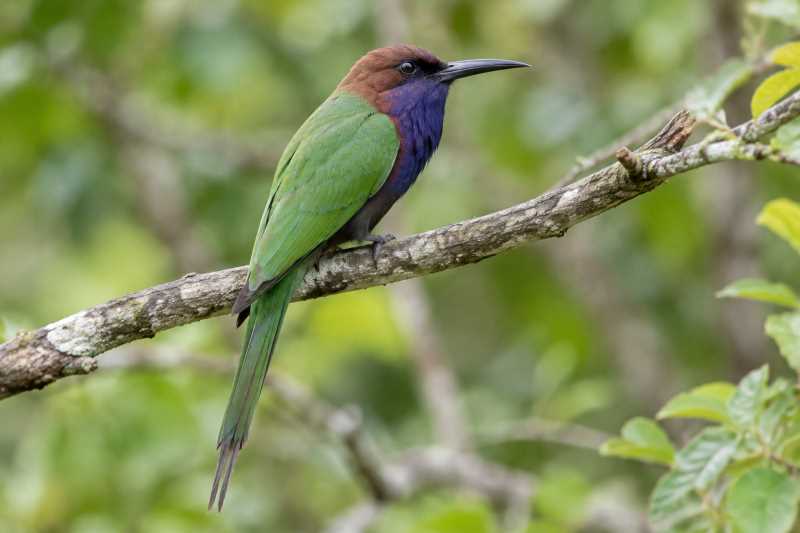
The most striking feature of the Purple-bearded Bee-eater is undeniably its vivid plumage. The bird boasts a predominantly green body with a rich purple hue adorning its throat and chin, forming the "beard" that gives the species its name. This purple region is set off by a contrasting blue crown and a subtle lavender wash over its breast. The bird’s long, slightly curved bill is perfectly adapted to its insectivorous diet, allowing it to snatch flying insects with precision.
Measuring approximately 25 to 28 centimeters in length, the Purple-bearded Bee-eater is a medium-sized bird within its family. Its wings are streamlined, facilitating agile flight as it pursues prey mid-air. Another notable feature is its elongated central tail feathers, which add to its graceful appearance during flight.
Habitat and Distribution
The natural habitat of the Purple-bearded Bee-eater is the tropical and subtropical moist lowland forests of Sulawesi. This island, part of the Indonesian archipelago, offers a rich biodiversity that supports an array of endemic species. The bee-eater thrives in the dense, humid canopy, where it can easily find its primary food source: bees and other flying insects.
The species is generally found at elevations ranging from sea level to about 1,500 meters, although it tends to prefer the lower altitudes where insect activity is more abundant. Despite its limited range, the Purple-bearded Bee-eater’s adaptability to different types of forest environments, including secondary growth and forest edges, helps sustain its population.
Behavior and Diet
As its name suggests, the Purple-bearded Bee-eater primarily feeds on bees. However, its diet is not restricted to just one type of insect. It consumes a variety of flying insects, including wasps, dragonflies, and butterflies. The bird employs a hunting technique known as "hawking," where it perches patiently before launching into the air to catch its prey.
The bee-eater’s social behavior is another point of interest. While it can often be seen alone or in pairs, it sometimes forms small flocks, especially during migration. These flocks exhibit a remarkable degree of coordination and communication, which can be observed during their communal hunting sessions.
Breeding and Nesting
Breeding for the Purple-bearded Bee-eater typically occurs during the dry season when food is plentiful. The species is known for its unique nesting habits, which involve burrowing tunnels into sandy banks or soil mounds. These tunnels can extend up to a meter in length and serve as a protective environment for the eggs and chicks.
A typical clutch consists of 3 to 5 eggs, which are incubated by both parents. The cooperative nature of the breeding pair extends to the rearing of the young, with both mother and father sharing the responsibility of feeding and protecting the chicks until they fledge.
Conservation Status
The International Union for Conservation of Nature (IUCN) currently lists the Purple-bearded Bee-eater as a species of "Least Concern." While its population is stable, the bird faces potential threats from habitat loss due to deforestation and land conversion for agriculture. Conservation efforts are crucial to ensure that this vibrant species continues to thrive in its natural habitat.
Conclusion
The Purple-bearded Bee-eater is a testament to the rich biodiversity found in Indonesia’s Sulawesi island. Its striking appearance, coupled with its intriguing behavior, makes it a subject of fascination for bird watchers and researchers. As with many of the world’s avian species, continued conservation efforts are essential to preserve the delicate balance of ecosystems that support such unique wildlife.
By understanding and appreciating the ecological role and the beauty of the Purple-bearded Bee-eater, we can better advocate for measures that protect its habitat and ensure the survival of this remarkable bird for generations to come.
Related posts