Introduction
The Ornate Pitta, Pitta concinna, is a colourful, ground-dwelling bird endemic to Indonesia’s Lesser Sunda Islands. It belongs to the pitta family, Pittidae, a group known for compact bodies, strong legs, short tails and brilliant plumage. The species was formerly treated as part of the broader Elegant Pitta complex, but taxonomic work using plumage, measurements and vocal characteristics supports recognition of the Ornate Pitta as a distinct species. The split is now reflected in major contemporary bird taxonomies. (science.ebird.org)
Sometimes called Wallace’s Elegant Pitta, the species occupies a chain of islands extending from Lombok eastwards through Sumbawa and Flores to Adonara, Lembata and Alor. It is usually encountered in dense undergrowth, forest margins and other habitats with substantial leaf litter, where its striking colours are surprisingly difficult to see. Most records involve a bird heard calling or glimpsed briefly as it runs, hops through vegetation or makes a low, rapid flight.
Although the Ornate Pitta is not currently considered globally threatened, its distribution is naturally fragmented because it is confined to islands. Continued loss and degradation of lowland and foothill forest remain conservation concerns, particularly where small forest patches are isolated by agriculture, roads, settlement and repeated burning. BirdLife International maintains a species factsheet for Pitta concinna within its Red List data system. (datazone.birdlife.org)
Physical Description
The Ornate Pitta is a compact, broad-bodied passerine measuring approximately 19 cm in length. Like other pittas, it has a relatively large head, stout bill, strong legs, short tail and rounded wings. Its body proportions are adapted to movement through dense ground vegetation rather than prolonged flight in open country.
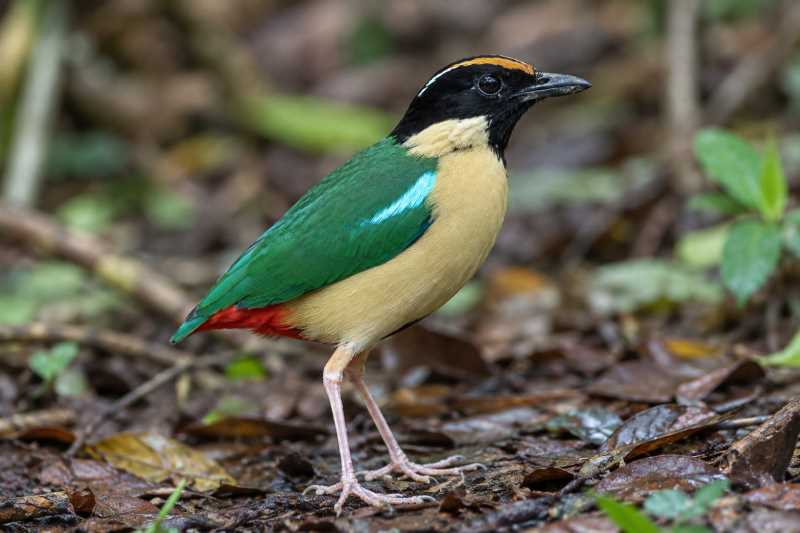
Adults are richly coloured. The head and hindneck are predominantly black, contrasting with a pale eyebrow or supercilium that becomes whitish or bluish towards the rear of the eye. A warm reddish-buff or cinnamon crown stripe may be visible along the side of the crown. The upperparts are dark green, with a conspicuous turquoise-blue rump and vivid blue markings on the wing coverts. The flight feathers are largely black, while pale or white areas near the bases of the primaries can be visible when the bird opens its wings or flies.
The underparts are warm cinnamon-buff to golden-buff. A black area extends from the chin and upper throat down across the central breast and belly, producing one of the species’ most useful field characters. Below this dark central patch, the lower belly and vent are red or rich crimson. The tail is short and dark, with greenish tones towards the tips.
The bill is dark, and the legs are usually pinkish, reddish or flesh-coloured, although lighting and viewing conditions can make the legs appear darker. The colour pattern is especially vivid in good light, but a bird in shadow can look predominantly black, green and brown until it moves or turns.
Available descriptions indicate little obvious sexual dimorphism. Males and females are generally similar in size and plumage, so sexing an individual in the field is normally impractical. Reliable sex-specific measurements are not widely available in accessible literature, and apparent differences in brightness may reflect age, wear, moult, lighting or individual variation rather than sex.
Juveniles are duller than adults. Young birds show less intense blue in the wings and may have a more subdued brownish or pinkish lower belly. The bill can show a paler or orange-red tip in immature birds. As the plumage develops, the blue wing markings, black breast pattern and red lower belly become more clearly defined. These age-related differences should be treated as general field tendencies rather than rigid criteria, because detailed information on the species’ moult and immature plumage remains limited.
The Ornate Pitta’s short tail and strong legs are important structural clues. When seen from behind or in poor light, it may appear almost tailless compared with a robin, thrush or flycatcher. Its habit of keeping low, combined with a tendency to pause motionless beneath leaves, makes the bird easy to overlook even where it is present.
Range and Habitat
The Ornate Pitta is endemic to Indonesia. Its recognised range includes Nusa Penida, Lombok, Sumbawa, Flores, Adonara, Lembata, also known as Lomblen, and Alor. Some distribution summaries differ slightly in how they treat island records, especially around the boundaries of the former Elegant Pitta complex, so individual observations should be checked against the taxonomy in use. The current split-based treatment places the Lombok-to-Alor population under Pitta concinna. (avibase.bsc-eoc.org)
The species occurs across the Lesser Sunda Islands, a region characterised by strong rainfall gradients. Western islands such as Lombok can support wetter forest in mountainous areas, while many eastern islands have more seasonal climates, dry forest, scrub and open woodland. This helps explain why the Ornate Pitta has been recorded in a wider range of habitats than the phrase “tropical forest bird” might suggest.
It is associated with lowland and foothill forest, but records also come from hill forest, forest edge, selectively logged woodland, dense secondary growth and small wooded patches near human settlements. On Flores, birding records and tour reports have documented the species in forest mosaics, roadside woodland and lowland or lower-elevation sites around Kisol, Labuan Bajo and the Ruteng region. (birdquest-tours.com)
The bird’s most important habitat features appear to be dense ground cover, leaf litter, shade and enough undisturbed vegetation for foraging. It may tolerate some habitat modification, but tolerance of secondary vegetation should not be interpreted as independence from natural forest. Small forest remnants can support individual birds while still suffering from isolation, reduced food availability, invasive plants, fire and gradual structural degradation.
Published summaries describe the species from near sea level to montane elevations, although it is most often sought in lowland, foothill and lower montane habitats rather than exposed high-altitude areas. Exact elevation limits are not well documented across the entire range. Local abundance is likely to vary substantially with rainfall, vegetation density, disturbance and the availability of suitable leaf-litter habitat.
The Ornate Pitta is generally regarded as resident rather than a long-distance migrant. This is an important distinction from some populations formerly included within Elegant Pitta, especially birds associated with Timor that undertake seasonal movements towards Sulawesi and the Moluccas. Current taxonomic treatments separate those migratory populations from Pitta concinna. (science.ebird.org)
Geographic variation is part of the species’ taxonomic history. Before the recent split, birds from several island groups were grouped under Elegant Pitta. Bioacoustic and morphological comparisons found differences in plumage, measurements and vocalisations among the island populations, supporting recognition of the Ornate Pitta, Elegant Pitta and Banda Sea Pitta as separate species. The Ornate Pitta is generally treated as monotypic under the current species concept, although taxonomic practice can change as additional recordings and genetic data become available. (d-nb.info)
Where to See This Species
The Ornate Pitta is difficult to locate reliably, and a confirmed occurrence at a site does not guarantee an observation. The following venues and wildlife-viewing areas have current or recent documentation of the species and offer practical access to suitable habitat.
Golo Lusang and Ruteng Nature Reserve, East Nusa Tenggara, Indonesia
Golo Lusang is a recognised birding area in the Ruteng highlands of Flores, with roads and forest edges passing through protected or semi-protected montane and hill forest. Local birding itineraries list the Ornate Pitta among the target species, and recent regional records have reported the bird around the Ruteng and Golo Lusang area. Look along shaded roadsides, dense undergrowth and forest margins, especially during quiet morning walks. (floreskomodobirdwatching.com)
The higher forest here also supports a range of Flores endemics and restricted-range birds. Because the Ornate Pitta often stays close to the ground, patient listening is more productive than scanning the canopy. A local bird guide can help interpret the species’ two-part call and identify accessible stretches of habitat.
Nearby accommodation: Ruteng is the practical gateway, with guest houses, small hotels, homestays and locally operated lodges available in and around town.
Kisol Forest and surrounding woodland, East Nusa Tenggara, Indonesia
Kisol, in southern Flores, has become a reliable stop on specialist birding routes because of its mixture of dry forest, woodland, scrub and forest-edge habitat. The Ornate Pitta has been seen well in the Kisol area on multiple recent birding expeditions, making it one of the strongest documented sites for visitors specifically seeking this species. (birdquest-tours.com)
The landscape is not necessarily a conventional national park with formal visitor infrastructure. It is better understood as a locally guided wildlife-viewing area comprising forest remnants, tracks and surrounding habitat. Visits should therefore be arranged responsibly with local knowledge, and observers should avoid playback overuse, entering private land without permission or disturbing ground vegetation.
Nearby accommodation: Ruteng is the principal accommodation base for organised birding visits, while simple guest houses and locally arranged stays may be available closer to Kisol.
Mbeliling Forest Landscape, West Flores, East Nusa Tenggara, Indonesia
The Mbeliling landscape near Labuan Bajo contains humid forest, hill woodland and secondary forest patches that support a diverse Flores bird community. The Ornate Pitta is listed among the birds recorded or sought in the wider Labuan Bajo rainforest and Mbeliling area, and recent wildlife-viewing accounts have documented sightings in the landscape. (wherenobodygoes.com)
Habitat around forest roads, shaded trails, small clearings and lodge surroundings can be productive, especially after rain when invertebrate prey is active. As with other sites, the species is much easier to hear than to see. Early starts, slow walking and careful attention to movement in leaf litter are more useful than covering ground quickly.
Nearby accommodation: Labuan Bajo is the main gateway, offering hotels, guest houses, homestays, ecolodges and other accommodation, with some forest-based lodges in the wider Mbeliling area.
Behaviour and Diet
The Ornate Pitta is primarily terrestrial and usually forages alone. It moves through leaf litter by hopping, walking and making short runs, often pausing beneath shrubs, vines, fallen branches or dense ground cover. When alarmed, it may disappear into vegetation without flying. If it does take flight, the movement is commonly low and direct, followed by another attempt to hide.
The species is secretive even where it is locally regular. A bird may remain silent for long periods, then give a short call from dense vegetation. It is most often detected by sound, a brief flash of blue or a sudden movement across a path. Dawn and the first few hours of daylight are generally the best times to search, although activity may increase after rain when the forest floor becomes damp and prey is more available.
Published field summaries describe the call as a distinctive two-part whistle, with the second element faster and higher-pitched. The alarm note is described as a short, nasal single note. Vocal variation within the Elegant Pitta complex was one of the features that helped support the modern species split, so careful recording of calls can be valuable for distributional and taxonomic work. (birdforum.net)
The diet is poorly documented specifically for the Ornate Pitta, but available accounts indicate that it is chiefly insectivorous or, more broadly, an invertebrate feeder. Likely prey includes beetles, ants, termites, caterpillars, other insects, earthworms and small molluscs. Pittas commonly probe or turn leaf litter and may seize prey from the ground surface or from shallow soil. Small vertebrates could be taken opportunistically, but there is not enough species-specific evidence to describe them as a regular part of the diet.
The bird’s strong bill and legs are suited to ground foraging. Its bright plumage does not mean it spends much time in exposed positions. The green back blends with shaded vegetation, while the blue wing patch and red lower belly are often visible only during a quick turn, wing movement or short flight.
Detailed breeding information for the Ornate Pitta is scarce. It is reasonable to expect a territorial pair-bonded system similar to that of other pittas, but species-specific observations should not be replaced by assumptions based on better-studied relatives. Pittas generally build domed nests with side entrances, often in concealed positions among roots, banks, fallen vegetation or low dense growth. However, published information on the Ornate Pitta’s nest placement, clutch size, incubation period and fledging success remains limited.
The timing of breeding may be linked to local rainfall and the seasonal increase in invertebrate prey. Because the species occupies islands with different climates, breeding periods may vary between Lombok, Sumbawa, Flores and the eastern islands. More fieldwork is needed to establish whether breeding is concentrated in a particular season or occurs over a broad portion of the year.
Identification Tips
Look for a compact, short-tailed bird moving on or very close to the ground in shaded forest, dense scrub or leaf litter. The most useful combination of features is:
- Black head and upper throat.
- Pale eyebrow, often becoming whiter or bluish behind the eye.
- Dark green back.
- Bright turquoise-blue rump and blue wing-coverts.
- Cinnamon-buff underparts.
- Black central breast and belly patch.
- Red lower belly or vent.
- Short dark tail and stout bill.
The bird’s behaviour is as informative as its colour. It usually hops or runs through cover rather than perching conspicuously. A low, rapid flight across a track, followed by silence in dense vegetation, is typical of a pitta and should prompt a careful search of the ground rather than the canopy.
The main identification problem within its range is the Elegant Pitta, Pitta elegans, because the two were formerly treated as members of the same complex. Where their ranges approach or overlap in historical records, the Ornate Pitta can be separated by its stronger black breast and belly pattern, more contrasting head pattern and characteristic two-part call. Elegant Pitta generally shows less extensive black on the breast and a more uniformly pale supercilium, although field conditions, sex, age and individual variation can complicate the comparison. (birdforum.net)
The Banda Sea Pitta, Pitta vigorsii, is another former member of the complex, but it is associated with islands farther east and is not normally the principal confusion species in the Ornate Pitta’s core range. Identification should be based on locality as well as plumage and voice.
Do not rely on a single blue patch or on the presence of a red belly alone. Several pittas share blue, green, black and red plumage. A confirmed identification should combine the complete pattern, body shape, behaviour, call and geographic context. Photographs, sound recordings and notes on habitat can be particularly useful when a view is brief.
Conservation Status
The Ornate Pitta is currently assessed as Least Concern on the IUCN Red List framework used by BirdLife International. This category means that the species does not currently meet the thresholds for a threatened category at global level. It does not mean that every island population is secure or that local declines are unimportant. (inaturalist.org)
A reliable global population estimate should not be given without a current assessment. The species is distributed across several islands, but its habitat is naturally fragmented and the quality of remaining forest varies considerably. Island birds can be vulnerable to rapid local changes because populations may be separated by unsuitable habitat and have limited opportunities for recolonisation.
The principal conservation concern is likely to be loss and degradation of forest and dense woodland. Relevant pressures include agricultural expansion, fuelwood collection, road construction, settlement growth, repeated fires, grazing and the gradual conversion of forest edge to open land. Selective logging may leave enough trees for some forest birds while still reducing the dense, shaded understorey and leaf-litter conditions required by a ground-foraging pitta.
The species’ apparent use of secondary forest and forest-edge habitat offers some resilience, but this should not be interpreted as proof that severe habitat degradation has little effect. Small patches may support birds temporarily while lacking sufficient area for stable breeding populations. Conservation measures should therefore include protection of remaining natural forest, maintenance of habitat corridors, prevention of uncontrolled burning and careful management of frequently visited birding sites.
More information is needed on population trends, breeding success, island-by-island distribution, elevation limits and responses to different forms of disturbance. Standardised surveys using both visual observations and call recordings would help clarify whether the Ornate Pitta is stable across its range or declining in particular regions.
Responsible birdwatching can support conservation when it benefits local guides and communities, but observers should avoid excessive playback, approaching nests, trampling leaf litter, entering restricted areas and publicising sensitive locations without local guidance.
Frequently Asked Questions
Where does the Ornate Pitta live?
The Ornate Pitta lives in Indonesia’s Lesser Sunda Islands. Its recognised range includes Lombok, Sumbawa, Flores, Adonara, Lembata and Alor, with some distribution summaries also listing Nusa Penida. It uses forest, woodland, forest edge and dense secondary vegetation.
Is the Ornate Pitta migratory?
The Ornate Pitta is generally regarded as resident. It is separated taxonomically from migratory populations of the former Elegant Pitta complex, particularly birds associated with Timor that move seasonally towards Sulawesi and the Moluccas.
What does the Ornate Pitta eat?
Its diet is thought to consist mainly of invertebrates found on or near the forest floor, including insects and other small prey. Species-specific feeding studies are limited, so the exact proportions of different prey types are not well established.
How can the Ornate Pitta be identified?
Look for a short-tailed ground bird with a black head and throat, pale eyebrow, green back, turquoise-blue rump and wing markings, cinnamon-buff underparts, a black central breast patch and a red lower belly. Its two-part whistle and secretive ground-foraging behaviour are also useful clues.
Is the Ornate Pitta endangered?
The species is currently assessed as Least Concern, not globally threatened. Nevertheless, habitat loss, forest degradation and the fragmentation of island populations remain conservation concerns, and local populations may face greater risks than the global category suggests.
Where is the best place to see an Ornate Pitta?
Documented wildlife-viewing areas include Golo Lusang and Ruteng Nature Reserve, Kisol and the Mbeliling forest landscape on Flores. Sightings are never guaranteed because the species is secretive. Early morning visits with an experienced local bird guide provide the best chance.
References
- BirdLife International
- IUCN Red List of Threatened Species
- IOC World Bird List
Related posts