Introduction
The Feather-tailed Possum, scientifically known as Distoechurus pennatus, is a unique and fascinating member of the marsupial family. This small, nocturnal creature is renowned for its distinctive adaptations and plays a crucial role in the ecosystems it inhabits. Despite its name, the Feather-tailed Possum is not related to the true possums of Australia but belongs to a different group of marsupials found in New Guinea. This article delves into the various aspects of the Feather-tailed Possum, from its physical traits and habitat to its behavior, dietary habits, and conservation status.
Physical Description
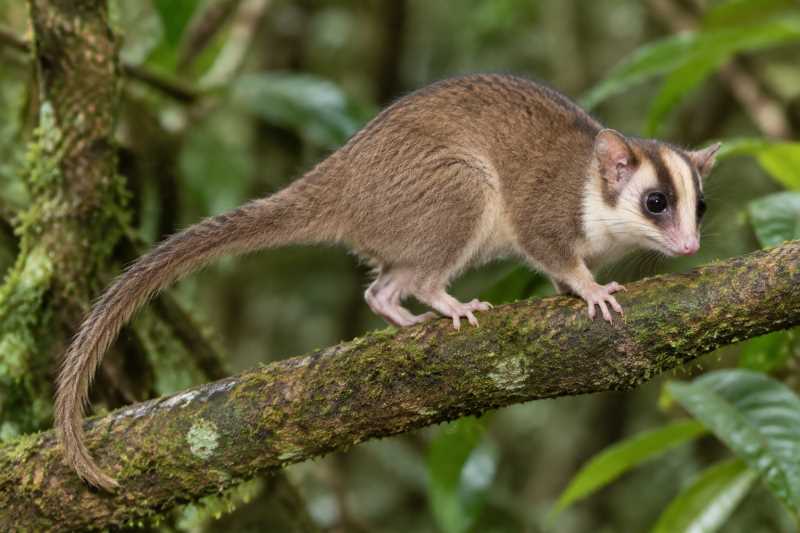
The Feather-tailed Possum is a small marsupial, characterized by its distinct and remarkable tail, which resembles a feather. This tail is not only unique in appearance but also serves important functional roles in the possum’s life. Measuring approximately 10 to 14 centimeters in body length, the Feather-tailed Possum is petite, with a tail almost equal in length to its body.
The possum’s fur is soft and dense, providing insulation in its often cool, mountainous habitat. Its coloration ranges from a grayish-brown to a more reddish hue, which helps it blend into the forest environment. The undersides are typically lighter, ranging from off-white to pale gray. Notably, the Feather-tailed Possum has large, forward-facing eyes, an adaptation for its nocturnal lifestyle, allowing it to see efficiently in low-light conditions. Its ears are also proportionally large, aiding in acute hearing to detect predators and prey.
Range and Habitat
Feather-tailed Possums are primarily found in the rainforests of New Guinea and some nearby islands. They inhabit montane and lowland forests, preferring areas with dense canopy cover that provides ample foliage for climbing and foraging. These possums are arboreal, spending most of their lives in trees, where their prehensile tails assist in navigating the forest canopy.
The regions they occupy are characterized by high biodiversity and rich ecosystems, which support their dietary and shelter needs. However, their reliance on forested areas makes them vulnerable to habitat loss, a significant threat in many parts of their range due to logging and agricultural expansion.
Behavior and Diet
Feather-tailed Possums are predominantly nocturnal, becoming active at dusk and spending the night foraging for food. Their diet primarily consists of nectar, pollen, fruits, and small insects, making them important pollinators in their ecosystem. The possum’s long, brush-tipped tongue is specially adapted to extract nectar from flowers, facilitating the pollination process as they move from plant to plant.
These possums are solitary creatures, with individuals maintaining distinct territories. They communicate through vocalizations and scent markings to establish and defend their territories. During the day, they rest in nests made from leaves and twigs, usually located in tree hollows or dense foliage, providing protection from predators and the elements.
Identification Tips
Identifying a Feather-tailed Possum in the wild can be challenging due to their nocturnal habits and arboreal lifestyle. However, certain characteristics can aid in recognition:
- Tail: Look for the unique feather-like tail, which is bushy and flat with a fringe of long hairs along its edges.
- Size and Shape: Note their small size and compact body shape, which helps them maneuver through the forest.
- Facial Features: Their large eyes and ears are indicative of their night-active behaviors.
- Behavior: Observe their movement patterns; they are agile climbers and often found in treetops.
Conservation Status
Currently, the Feather-tailed Possum is listed as Least Concern by the International Union for Conservation of Nature (IUCN). However, this status does not mean they are free from threats. The primary concerns for this species are habitat destruction due to deforestation for agriculture and logging. Climate change also poses a potential threat by altering their montane forest habitats.
Conservation efforts focus on habitat protection and sustainable land-use practices to ensure the preservation of the lush forests these possums depend on. Protected areas and reserves play a crucial role in maintaining viable populations and safeguarding their natural habitat from further degradation.
Frequently Asked Questions
What is the primary diet of the Feather-tailed Possum?
The Feather-tailed Possum primarily feeds on nectar, pollen, fruits, and insects. Its diet makes it an important pollinator in its ecosystem.
How does the Feather-tailed Possum use its tail?
The possum’s feather-like tail aids in balance and maneuverability in the trees, and is also used for communication and signaling to other possums.
Where can Feather-tailed Possums be found?
These possums are native to the rainforests of New Guinea and nearby islands, inhabiting both montane and lowland forests.
Are Feather-tailed Possums endangered?
Currently, Feather-tailed Possums are not considered endangered, but they face threats from habitat destruction and climate change.
What adaptations help the Feather-tailed Possum survive?
Adaptations such as a prehensile tail, nocturnal vision, and a diet that includes nectar and insects help the Feather-tailed Possum thrive in its arboreal environment.
Related posts